
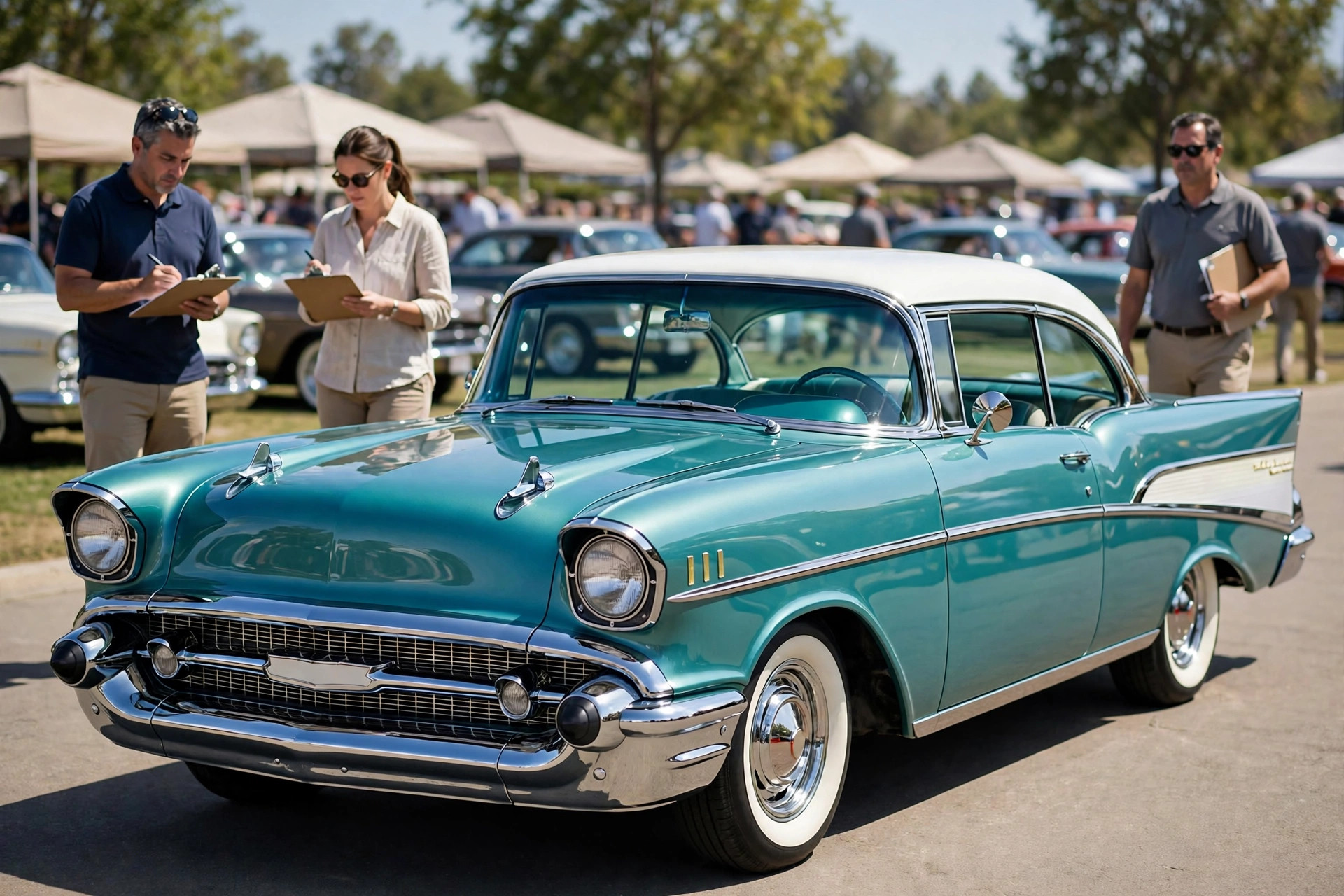
How are car shows judged, who decides the winners, and why does the most expensive car on the field so often go home empty-handed? Most first-time exhibitors treat judging like a mystery ritual: judges walk around with clipboards, cars get looked at for a few minutes, and somehow trophies get handed out. Once you understand how the points systems actually work, the whole process stops being mysterious and starts looking like what it really is — a checklist with math.
Almost every organized show scores cars against a written standard, and the winner is usually the car with the fewest deductions, not the most expensive car on the field. Understanding the judging format before you arrive changes how you prepare. A car entered in a points-judged concours class needs obsessive originality, while a people’s choice show rewards curb appeal and a good story.
Competitors who study classic car restoration guide methods learn this quickly, because restoration-grade work is graded against factory-correct standards that casual shows never bother to check. Knowing which game you are playing lets you spend your preparation hours where they actually score. That applies whether the field is full of classics or newer metal presented like the cars in this look at 2026 Hyundai Crossover Exterior: Design Trends & Features and this rundown of 2026 Subaru Suv Specs.
How Car Show Judging Actually Works
At a judged show, cars are divided into classes and evaluated by a team of judges, usually two or three per team. Each team walks the cars in their assigned classes with a standardized score sheet, spending anywhere from five to fifteen minutes per car depending on the prestige of the event. They look at the exterior, interior, engine bay, and often the undercarriage and trunk, comparing what they see against the standard for that class.
Scores are tallied, and the highest-scoring cars in each class take first, second, and third. The judges are almost always experienced enthusiasts, restorers, or marque-club members, and at serious shows they are trained on the rulebook for that event. They are not picking the car they personally like best — they are measuring each car against a written standard and recording deductions for everything that falls short. This is the same philosophy that governs a formal Concours d’Elegance, scaled up or down to fit the event.
That distinction matters because it means
That distinction matters because it means you can prepare directly against the standard. If the score sheet gives ten points to paint condition and five to engine cleanliness, you know exactly where your effort pays off. Some shows publish their judging standards and score sheets in advance, and smart competitors read them like a study guide.
When the standard is published, preparation becomes a project plan: every category has a weight, and you allocate your time and budget to match. Even when the sheet is not published, most shows use one of the familiar formats described below. You can prepare against the generic version and adjust on arrival.
The Most Common Points Systems
The most widespread format is the 100-point deduction system. Every car starts with a perfect score and loses points for each flaw the judges find: a rock chip costs a point, a dirty door jamb costs half a point, a non-original hose costs two. This is the system used by major concours events and most serious marque-club shows, and it rewards correctness above all else.
A flawless, stock, older car will routinely beat a flashier modified car under this system, because modifications themselves count as deductions in classes where originality is the standard. A second common format is the additive system, where cars earn points for merit: quality of paint, quality of interior, quality of presentation, and so on. Judges add points in each category up to a maximum, and the highest total wins.
Additive systems tend to reward effort and modification more generously, which is why they are popular at custom and tuner shows. Under additive scoring, a well-executed custom build can beat a perfect stocker because the creativity and workmanship categories only exist to be filled. A third approach is the rank system, where each judge simply ranks the cars in a class from best to worst, and the totals decide the order.
Rank systems are fast and need no score sheets, which makes them common at small local shows and cruise nights. They are also the most subjective, because there is no written standard forcing consistency. If you are entering a rank-judged show, presentation and overall impression matter more than granular correctness, because the judge is scoring the whole car in one gut response. The three systems, side by side:
- 100-point deduction: every car starts perfect and loses points per flaw — a rock chip costs a point, a dirty door jamb costs half a point, a non-original hose costs two.
- Additive: judges add points for merit in categories such as paint, interior, and presentation, up to a maximum in each.
- Rank: each judge simply ranks the cars in the class from best to worst, with no score sheet at all.
The Categories on a Typical Score Sheet
Exterior condition is almost always the heaviest-weighted category. Judges look at paint quality, panel fit and gaps, chrome or trim condition, glass clarity, and wheel and tire condition. They run their eyes along body lines for ripples, check reflections in the paint for orange peel or sanding marks, and look for overspray, mismatched panels, and rust.
Because this category carries the most points, it is also where the most deductions accumulate on daily-driven show cars. It is the first place serious competitors spend their budget. No other single area decides more trophies.
Interior condition covers seats, carpet, headliner, dashboard, door panels, and gauges. Judges check for wear, fading, cracks, incorrect materials, and cleanliness. This is a category where engine bay detailing for show cars principles apply indirectly: the same obsessive cleanliness that wins points under the hood wins points inside the cabin, because judges read dirt as neglect everywhere they find it.
Trunks are often scored as part of the interior category. A bare, stained trunk can quietly cost points that owners never expect to lose. It pays to treat the trunk with the same care as the cabin.
Engine bay and undercarriage are the
Engine bay and undercarriage are the categories that separate contenders from participants. Many owners detail the exterior and interior and then pop the hood on an engine bay full of dust, corroded fasteners, and leaking fluids. Judges notice immediately, because the engine bay is where mechanical honesty lives.
Undercarriage judging varies by event; at concours levels, cars are examined on lifts or over mirrors, and frame, suspension, and exhaust cleanliness all count. At casual shows the undercarriage may not be judged at all. That is worth confirming before you spend a weekend detailing parts nobody will see.
Judged Shows vs People's Choice
People’s choice shows replace the judging team with a ballot box. Every attendee, or every registered exhibitor, votes for their favorite cars, and the most votes win. There is no score sheet, no standard, and no deductions.
Preparation for a people’s choice show is about curb appeal: bold paint, a great stance, interesting modifications, and a display that makes people stop. Originality barely matters. A wildly modified car that would bleed points at a concours can sweep a people’s choice field.
The trade-off is predictability
The trade-off is predictability. Judged shows reward preparation against a known standard, so a careful owner can reliably place. People’s choice shows reward crowd taste, which shifts with trends and can be influenced by turnout, car clubs that vote as a bloc, and even weather.
Experienced competitors treat the two formats as different sports with different training plans, and they choose their events based on what kind of car they own and what kind of preparation they enjoy doing. Some shows run both formats at once, with judged class trophies plus separate people’s choice awards. These dual-format events are ideal for beginners, because you can enter the judged classes to learn where your car stands against the standard, and still have a shot at a people’s choice trophy based on pure appeal.
Ask the organizers which awards are judged and which are voted before you register. The answer shapes your entire preparation strategy. It is a five-minute question that can save a month of misdirected work.
What Happens During the Judging Walk
The judging walk usually happens in a scheduled window, often mid-morning, and most shows require the hood and trunk to be open during judging. Judges work in teams to keep things consistent: one reads the standard while the others inspect, or they each score independently and average the results. They will open doors, look under the car, check the trunk, and sometimes ask the owner questions about modifications or history.
You are usually expected to stand nearby but not hover, because hovering reads as pressure. Questions from judges are almost always neutral fact-finding, not accusations. They may ask whether a component is original, when a repaint was done, or what a particular modification is.
Answer honestly and briefly, because judges can spot a bluff and the score sheet does not award points for stories. If something on your car is non-original, saying so plainly is better than being caught, since honesty costs nothing and dishonesty can cost credibility across the whole sheet. After the walk, scores are tallied away from the field, and protests or questions usually have a formal process.
Most shows allow owners to review their score sheets after awards are announced, and this is the single most valuable document a competitor can take home. A completed score sheet tells you exactly where points were lost. That means your preparation for the next show can target the specific categories that cost you the trophy.
How to Use a Score Sheet to Get Better
Treat every score sheet as a diagnostic report. If you lost six points in the engine bay and two everywhere else, your next month of work has an obvious priority. Competitors who improve fastest are the ones who photograph their score sheets, keep them in a folder, and track deductions show to show.
Patterns emerge quickly: the same half-point deductions for dirty door jambs and dusty wheels repeat until the owner builds a pre-judging routine that eliminates them permanently. Compare your sheet against the winner’s approach, not just the winner’s car. Winners at points-judged shows tend to share habits: they arrive early, they do a final wipe-down after the drive in, they open everything before the judges arrive, and they carry a touch-up kit.
None of these habits cost money, and all of them show up in the scores. The concours d'elegance events guides to major concours events describe this culture of preparation in detail, and the lessons scale down to local shows without losing their value. Finally, judge for a show yourself if you get the chance — nothing teaches you what judges see like standing on the other side of the clipboard, noticing the dust you never saw on your own car and the fingerprints on other people’s glass.
Related posts:


This is one stop in the Car Reviews & Features garage. Plenty more models, guides and stories are parked in the same category.
Found this useful? Pass it on to a friend who would appreciate it too.

