

Every drift begins with initiation: the deliberate act of breaking rear traction to start the slide. If you are learning how to drift, where you practice matters less at first than how you start each slide, because how you initiate determines the angle, speed, and stability of everything that follows. That is why initiation technique is one of the most important skills a beginner can develop. The three fundamental methods are the handbrake turn, the clutch kick, and the power over, each with distinct advantages, drawbacks, and ideal situations.
Understanding all three techniques, and knowing when to use each, separates drivers who can slide a single corner from drivers who can link an entire course. This guide breaks down each method step by step, explains the physics behind it, and helps you decide where to start your own practice.
Key Takeaways
- What Initiation Means in Drifting — Initiation is the transition from grip driving to drift driving.
- The Three Core Initiation Techniques — Handbrake Initiation The handbrake initiation is the most intuitive technique for beginners.
- Weight Transfer, Shift Lock, and Which Technique to Learn First — Beyond the big three, two related techniques deserve mention.
- Linking Techniques Into Full Runs — Real drifting is not about single corners; it is about linking them.
What Initiation Means in Drifting
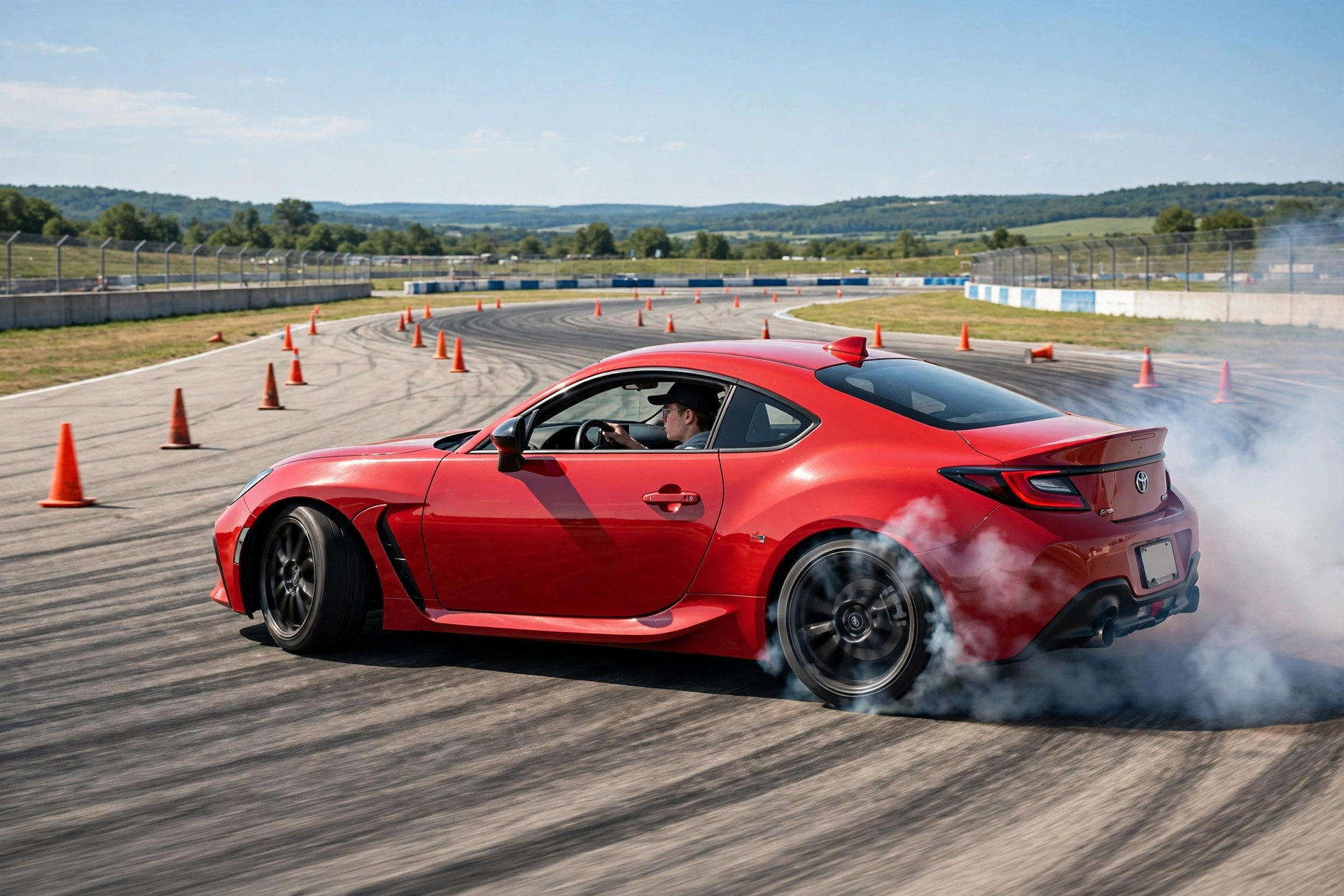
Initiation is the transition from grip driving to drift driving. Before initiation, the car is following its tires’ grip; after initiation, the rear tires are sliding and the driver is managing that slide with steering and throttle. The moment of initiation sets the initial yaw angle, and everything the driver does afterward is about maintaining and shaping that angle through the corner.
Good initiation is early, decisive, and smooth. Early initiation gives the driver time to settle the car before the corner’s critical phase. Decisive initiation commits fully rather than hesitating halfway, which is the most common beginner error. Smooth initiation avoids upsetting the chassis so violently that the slide becomes unrecoverable, and these three qualities matter regardless of which technique you use.
Different corners demand different initiations. A slow hairpin might call for a handbrake pull, while a fast sweeper rewards a clutch kick or power over. Professional drivers switch techniques corner by corner, sometimes mid-run, choosing whatever the corner geometry and their car’s characteristics demand. Learning all three methods gives you this adaptability, which is why beginners should eventually practice each one.
The Three Core Initiation Techniques
Handbrake Initiation
The handbrake initiation is the most intuitive technique for beginners. As you approach the corner, you turn the steering wheel toward the corner, pull the handbrake sharply to lock the rear wheels, and the rear of the car swings outward. Once the car reaches the desired angle, you release the handbrake, apply throttle, and counter-steer to hold the slide. It is simple, repeatable, and works at almost any speed.
In practice, the sequence looks like this:
- Approach the corner and turn the steering wheel toward it
- Pull the handbrake sharply to lock the rear wheels so the rear of the car swings outward
- Release the handbrake once the car reaches the desired angle
- Apply throttle and counter-steer to hold the slide
The handbrake’s biggest advantage is reliability. It does not depend on engine power or clutch condition, so it works in low-powered cars and in situations where other techniques would fail. It is also the easiest technique to modulate: pull harder for more rotation, release earlier for less. For tight corners and low-speed practice areas, it is often the only practical option, much like the classic handbrake turn it is named after.
The drawbacks are real, though. Handbrake initiations scrub speed, which hurts on fast corners where momentum matters. Repeated use overheats rear brakes and wears components quickly. Many beginners also develop a dependency on the handbrake, using it as a crutch instead of learning throttle-based techniques.
Think of the handbrake as training wheels: essential at first, but something to outgrow as your skills develop. Upgrading to a hydraulic handbrake later gives more precise control for advanced driving, but the stock cable handbrake is perfectly adequate for learning.
Clutch Kick Initiation
The clutch kick is the workhorse technique of drifting. Approaching the corner under power, the driver turns in, then rapidly presses and releases the clutch. This momentarily disconnects and reconnects the engine, sending a shock of torque to the rear wheels that breaks them loose. Done correctly, it produces a fast, aggressive initiation that carries speed through the corner.
Clutch kicking works best in cars with enough power to break traction on demand, typically 200 horsepower and up, though skilled drivers can clutch kick lower-powered cars with the right setup. The technique demands coordination: clutch in, revs rise, clutch out sharply while turning. The timing of the release relative to steering input determines how much angle you get. Too early and the car barely rotates; too late and it snaps violently.
The cost of clutch kicking is component wear. The shock loading punishes the clutch, transmission, differential, and axles, which is why drift cars consume drivetrain parts. Beginners should practice with moderate aggression rather than violent kicks; smooth, well-timed kicks break traction just as effectively as brutal ones while being far kinder to the car. As your timing improves, you will find yourself kicking less and less hard for the same result, which is a sign of genuine progress.
Power Over Initiation
Power over is the simplest technique conceptually: use the throttle to overwhelm rear grip. Entering a corner, the driver turns in and applies aggressive throttle, and the engine’s torque breaks the rear tires loose. There is no clutch work and no handbrake pull, just the elegant violence of horsepower defeating traction. It is the technique that looks most natural and feels most satisfying when it works.
The catch is that power over requires power. In a 150-horsepower car on grippy tires, mashing the throttle mid-corner will just produce understeer and embarrassment. Power over shines in torquey cars, on slippery surfaces, or with hard, worn rear tires that break loose easily. This is why experienced drifters often run cheap, hard-compound tires on the rear: they make power-over initiations accessible even in moderately powered cars.
Power over initiations tend to produce smooth, flowing drifts because the rear wheels are already spinning when the slide begins. There is no sudden shock like a clutch kick, just a progressive transition into oversteer. The skill lies in throttle modulation afterward: too much throttle and the car spins, too little and the slide dies. Learning to balance the throttle at the edge of grip is the essence of drifting, and power over teaches it directly.
Weight Transfer, Shift Lock, and Which Technique to Learn First
Beyond the big three, two related techniques deserve mention. Weight transfer initiation, sometimes called the feint or Scandinavian flick, uses a sharp steering input away from the corner followed by a hard turn into it. This rocks the car’s weight from side to side, unloading the rear tires at the critical moment so they break loose. It requires no handbrake and no clutch abuse, just precise steering timing, and it is devastatingly effective on fast, flowing corners.
Shift lock is the aggressive cousin of the bunch: the driver downshifts aggressively without rev matching, letting engine braking lock the rear wheels momentarily. It produces a violent, instant initiation that looks spectacular but punishes the drivetrain severely. Most beginners should avoid shift lock until their car control is solid, as the suddenness of the initiation leaves little margin for correction.
Understanding weight transfer conceptually improves all your initiations. Every technique ultimately works by managing the load on the rear tires: reduce their grip suddenly while the car is turning, and the rear steps out. Once you feel this principle in your hands and seat, you will start inventing your own combinations, blending a small feint with a gentle clutch kick or a touch of handbrake exactly as the corner demands.
For most beginners, the handbrake is the right starting point. It is forgiving, easy to understand, and lets you experience the feeling of a slide without demanding precise coordination. Spend your first practice sessions getting comfortable with handbrake initiations in a safe, open area. Learn what angle feels like, how counter-steering catches the slide, and how throttle sustains it.
Once handbrake initiations feel natural, add the clutch kick. It is the technique you will use most in real drifting, and learning it early builds the coordination that everything else depends on. Practice in a straight line first: drive at moderate speed, press and release the clutch sharply, and feel the car squirm. Then try it turning into a wide, open corner with plenty of runoff room.
Power over comes last, not because it is hardest, but because it demands the throttle control that only experience develops. Attempting power-over initiations before you can modulate the throttle reliably leads to spins and frustration. When you can hold a slide initiated by handbrake or clutch kick with smooth throttle inputs, you are ready to explore power over. Be patient: rushing the progression is the most common reason beginners plateau.
Linking Techniques Into Full Runs
Real drifting is not about single corners; it is about linking them. Transitions between corners require you to end one slide and initiate the next in the opposite direction, often in a fraction of a second. This is where technique blending becomes essential: you might clutch kick into the first corner, use a weight transfer to flick the car the other way, and power over through the exit.
Practice linking on a simple figure-eight course. The symmetry forces you to initiate in both directions and teaches the rhythm of transitions. Start slowly, focusing on smooth weight shifts rather than big angle. As your confidence grows, increase speed and angle gradually, because the figure-eight is the single most valuable drill in drifting, and drivers at every level return to it.
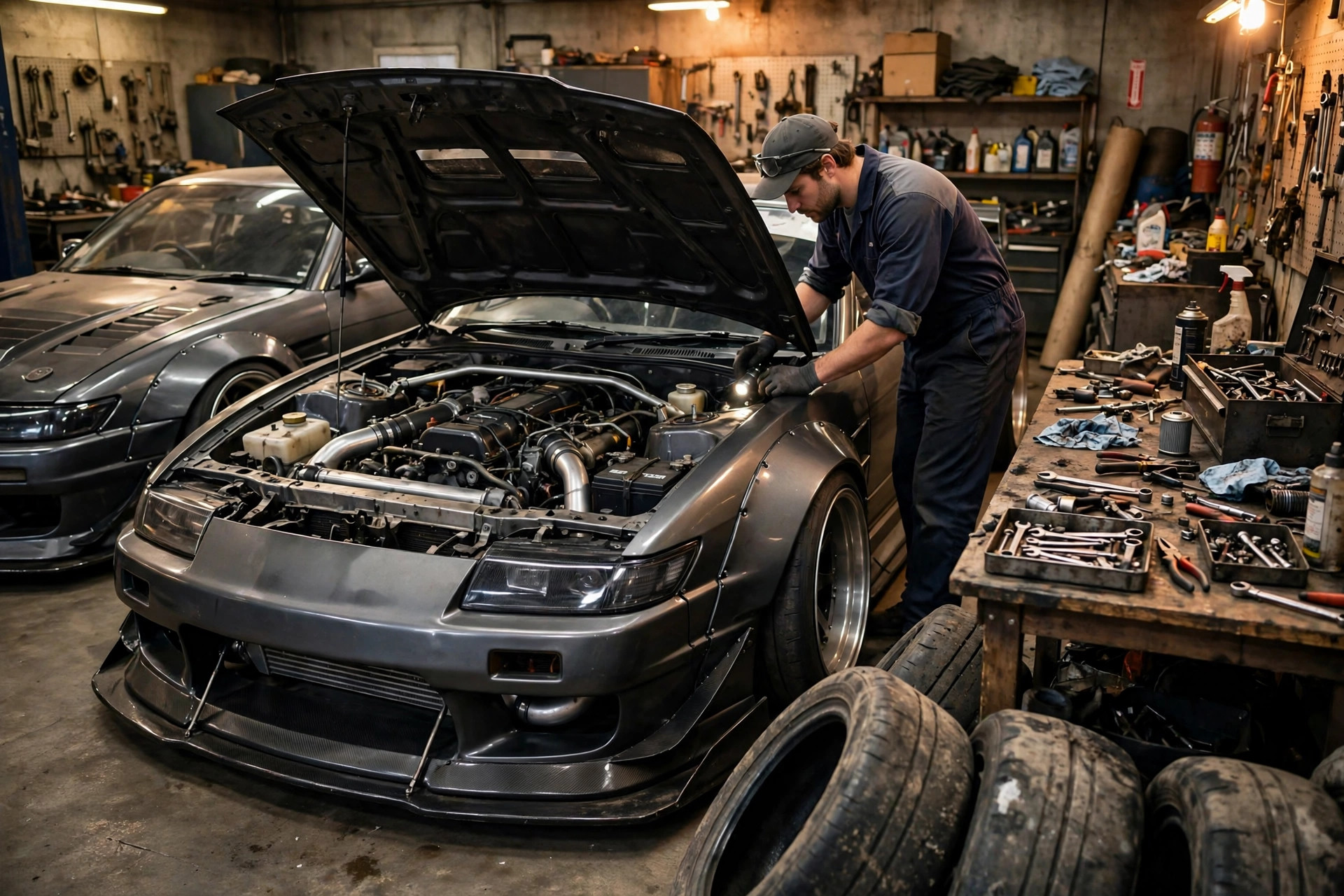
Practice days also run more smoothly when your gear is sorted before you arrive. Sensible tool storage for car owners keeps sockets and spares where you can find them quickly between runs. If you end up loading or unloading in dim paddock light, trunk lighting upgrades make that job noticeably easier.
Record your sessions and study them like the guides to mastering the art of sliding suggest: watch your initiations frame by frame and compare them to professional runs. Notice how the pros initiate early and how little steering correction they need afterward. Your goal is not to copy their style but to understand their efficiency.
Every unnecessary input is a sign of a technique that needs refinement, and the path from beginner to competent drifter is paved with thousands of small corrections. Take inspiration from the underground scenes captured in Tokyo street drifting culture and the purpose-built machines in drift missile builds, but remember that every expert was once a beginner practicing initiations in an empty lot.
Related posts:
Every Maintenance & Repair article adds another tool to the shed. The related reads below are worth a spin.
Bookmark this guide — it will come in handy in the garage.

