
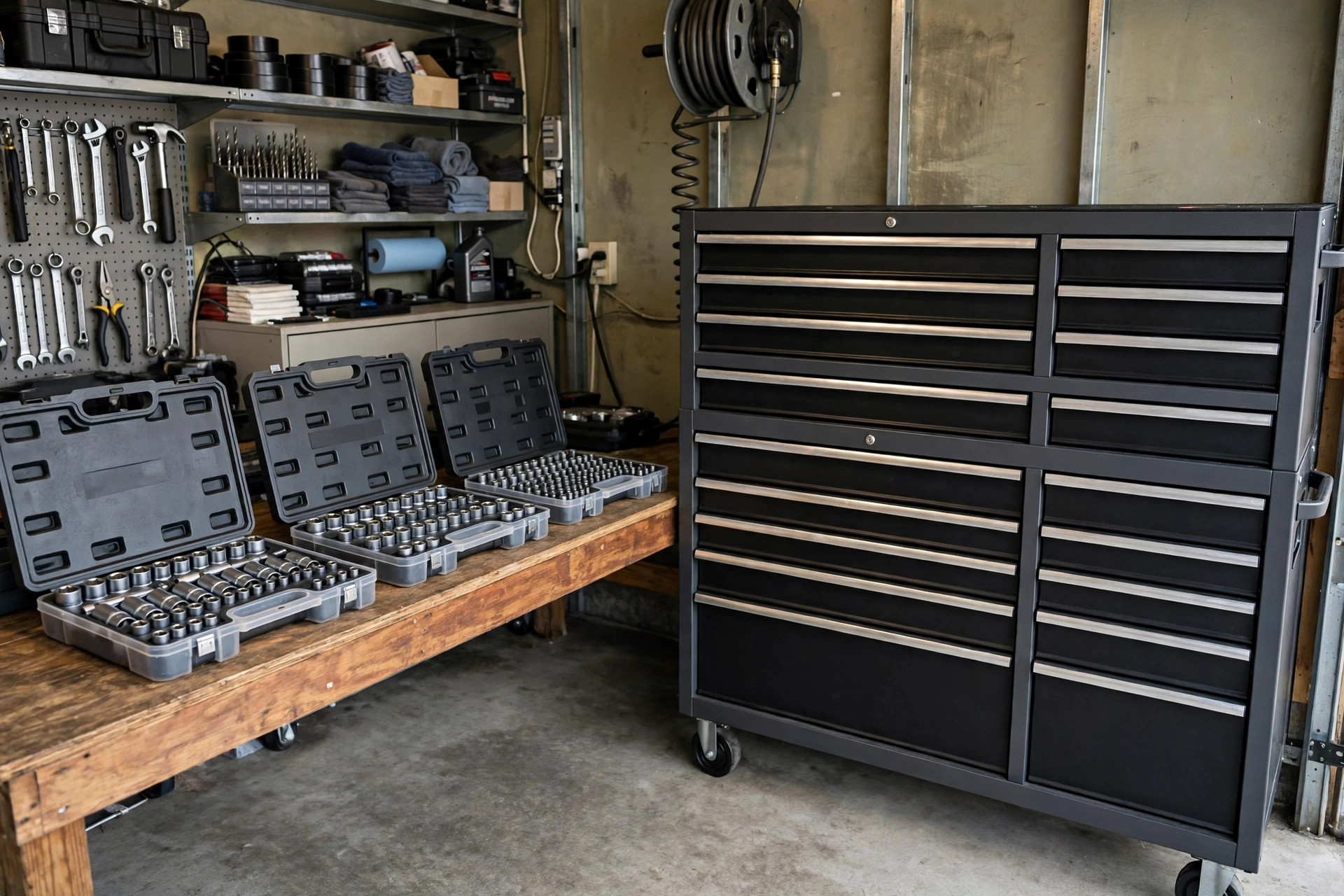
- Why Tool Organization Is a Performance Issue
- Blow-Mold Cases: The Set’s First Home
- Socket Rails, Clips, and Keeping Sizes Findable
- Rolling Chests and Cabinets: The Garage Standard
- Rolling Carts: The Mobile Workstation
- Pegboard and Wall Storage: Vertical Real Estate
- Small Parts: Bins, Organizers, and Fastener Discipline
- Storing Tools in the Vehicle
- The Verdict: A Place for Everything
Why Tool Organization Is a Performance Issue
Every mechanic knows the feeling: mid-job, hands greasy, car half apart, and the 14mm deep socket has vanished. The next ten minutes are spent hunting through piles instead of turning bolts, the job’s momentum dies, and mistakes creep in during the reassembly scramble. Tool organization is not about aesthetics or showing off a tidy garage. It is about working faster, making fewer errors, and knowing instantly what you own.
The economics are straightforward. A socket set with labeled slots tells you at a glance which sizes are in use, which are missing, and which one you need next. A jumbled toolbox tells you nothing, and every hunt costs time and focus. For car owners, who often work in stolen weekend hours, that wasted time is the most expensive thing in the garage.
Organization also protects your investment. Sockets rattling loose in a drawer chip their finishes and wear their markings; ratchets bouncing around damage their mechanisms; precision tools like torque wrenches suffer from impacts they were never designed to take. A proper home for each tool extends its life measurably. This guide covers the storage options that work for car owners, from the case your set came in to the rolling chest that anchors a serious garage.
Blow-Mold Cases: The Set’s First Home
Most socket sets arrive in a blow-molded plastic case with a labeled slot for every piece. These cases are the most underappreciated organization tool in the garage: each socket has a marked home, missing pieces are obvious at a glance, and the whole set transports as a unit. For the car owner with one or two sets, the original cases, kept intact and closed, are genuinely sufficient storage.
The key discipline is putting every piece back in its slot after use. It sounds trivial and it is the habit most people abandon first. The payoff comes during the next job, when the complete set is instantly verifiable, and during the rare moment you need to lend or transport the set. A complete cased set is also how you discover losses early, when the empty slot stares at you, rather than mid-job months later.
Cases do have limits. The latches wear, the hinges crack, and large cases become unwieldy as sets grow. When a case starts shedding pieces or refusing to stay closed, replace it or graduate the set to a better system rather than letting the tools go feral. A broken case is worse than no case, because it promises organization it no longer delivers.
Socket Rails, Clips, and Keeping Sizes Findable
Once sockets outgrow their original cases, socket rails are the standard upgrade. A socket rail is a metal bar with spring clips that hold sockets in size order; the clips grip the socket’s drive square and release with a firm pull. Rails mount in drawers, on pegboard, or stand alone, and they keep dozens of sockets organized in a fraction of the space cases require.
The discipline that makes rails work is size order, always. Sockets on a rail should run smallest to largest without gaps or swaps, so your hand learns where each size lives. Many mechanics use separate rails for shallow and deep, for 6-point and 12-point, and for each drive size, with the rails labeled. It sounds fussy; in practice, it means grabbing the right socket without looking.
Alternative holders include twist-lock socket organizers, which use a rotating mechanism to lock sockets in place, and magnetic strips for frequently used sizes. Whatever system you choose, the test is the same: can you find the 14mm deep 6-point in the dark, with greasy hands, without hunting? If yes, the system works.
Rolling Chests and Cabinets: The Garage Standard
The rolling tool chest, the big box with drawers on casters, is the aspirational centerpiece of the home garage, and for good reason. A quality chest puts every tool within arm’s reach, protects tools from dust and damage, locks for security, and rolls to wherever the work is. The drawer layout, shallow top drawers for sockets and wrenches, deeper lower drawers for power tools and bulky items, matches how mechanics actually work.
Buying a chest is a long-term decision, so buy for the garage you will have in five years, not the one you have today. A chest that is full on day one is too small. Look for ball-bearing drawer slides rated for the weight you will load, a tubular or reinforced frame that does not flex, casters that roll smoothly under load and lock securely, and a finish that resists the chemicals of garage life.
The top chest, the smaller box that sits on the rolling cabinet, is where daily drivers live: the sockets, ratchets, and wrenches you reach for constantly. Keeping the top chest organized is the highest-leverage organization habit, because those are the tools whose hunt costs the most time. For a deeper dive into chest selection and garage organization systems, see our tool storage chests, cabinets, and organization guide.
Rolling Carts: The Mobile Workstation
The rolling cart is the chest’s nimble sibling: a smaller, open-topped cart with a few shelves or drawers that parks next to the car and holds exactly what the current job needs. Load it with the sockets, wrenches, and parts for today’s brake job, roll it to the wheel, and everything is at hand without a single trip back to the chest.
Carts shine in small garages where the chest lives against the wall and the car fills the middle. They also serve as project staging: keep the parts, fasteners, and tools for an ongoing job on the cart, and the project stays contained even if the garage must be cleared for daily parking. A cart with a locking top tray doubles as a secure spot for small parts during multi-day jobs.
You do not need an expensive cart. The loads are light, the distances are short, and even a basic cart transforms workflow. What matters is the habit: load the cart at the start of the job from a plan, not by wandering back and forth. The cart rewards preparation and punishes improvisation, which makes it a quiet teacher of good work habits.
Pegboard and Wall Storage: Vertical Real Estate
Garage floor space is precious; wall space is free. Pegboard, the perforated hardboard panel with hook accessories, turns walls into tool storage for wrenches, pliers, hammers, and frequently used hand tools. Outlining each tool’s position with a marker creates a shadow board where missing tools announce themselves as empty silhouettes.
Pegboard works best for tools with a hanging profile: wrenches, pliers, screwdrivers, and the like. It is less ideal for sockets, which are better on rails in drawers, and for heavy items that stress the hooks. Mount the pegboard on furring strips so the hooks have clearance behind the panel, use metal hooks rather than plastic for anything with weight, and keep the most-used tools at comfortable reaching height.
Alternatives include slatwall panels, which use stronger locking accessories, and simple French cleat systems for custom holders. Whatever the system, the principle is the same: vertical storage for visible, grab-and-go tools, drawer storage for precision and small items. The combination covers everything.
Small Parts: Bins, Organizers, and Fastener Discipline
Fasteners are the dark matter of car work: invisible until missing, catastrophic when lost. Every job produces a small collection of bolts, clips, and screws that must return to exactly the right holes, and small-parts organization is what makes that possible. The minimum viable system is a set of labeled magnetic trays: one per job stage, with fasteners grouped by where they came from.
For the longer term, compartment organizers with adjustable dividers store the consumable fasteners every car owner accumulates: spare lug nuts, trim clips, hose clamps, fuses, and bulbs. Label every compartment; unlabelled organizers become mystery boxes within months. For bulk hardware, stackable parts bins with label holders scale from a handful to hundreds of compartments.
The advanced habit is the fastener map: as you disassemble, place fasteners on a labeled diagram or in sequentially numbered bags. It feels slow during disassembly and saves hours during reassembly, especially on jobs with multiple similar-but-different bolts. Our small parts organization and fastener bins guide goes deep on systems that scale from weekend jobs to full restorations.
Storing Tools in the Vehicle
Tools that live in the car need different storage thinking than garage tools. Vibration, temperature swings, and limited space punish bulky cases and reward compact, secure kits. A dedicated trunk tool bag or small case, packed with the roadside essentials and secured so it does not become a projectile, is the right approach.
For truck owners, the options expand dramatically. Crossover toolboxes, side-mount boxes, and under-seat storage turn a pickup into a mobile workshop, with weather-sealed compartments for tools that must survive the elements. Our truck toolboxes complete guide covers the types, mounting, and security considerations for truck-based tool storage.
Whatever the vehicle, the discipline is the same as the garage: every tool has a home, and it returns there after use. A trunk kit that migrates piece by piece into the garage is a trunk kit that will be incomplete when the roadside emergency arrives. Check the vehicle kit seasonally, alongside the spare tire pressure and the emergency supplies.
The Verdict: A Place for Everything
Tool storage is a system, not a purchase. The original cases keep sets complete, socket rails keep sizes findable, the rolling chest anchors the garage, the cart serves the active job, the walls hold the daily tools, and the bins tame the fasteners. No single product does all of this; the system emerges from combining the right pieces and, above all, from the habit of returning every tool to its home.
Start where you are: keep the cases intact, add rails when sets outgrow them, buy the chest when the collection justifies it. And if you are setting up the workspace around your newly organized tools, our garage workbenches build-or-buy guide covers the surface everything else sits on. Organization is the cheapest performance upgrade in the garage, and its dividends compound with every job.
Related posts:



Finished here? Brushed vs Brushless Car Vacuum Motors: Lifespan, Noise, and Real Power is the most natural next drive from this page.
Share this with a fellow driver or enthusiast who needs to see it.

