
- What a Vacuum Motor Actually Does All Day
- Brushed Motors: Cheap, Proven, and Wearing Out
- Brushless Motors: Efficient, Quiet, and Pricier
- Real Power Comparison: Does Brushless Clean Better
- Lifespan and Noise: The Two Differences You Will Feel
- Buying Advice: When the Motor Type Should Decide
What a Vacuum Motor Actually Does All Day
Every vacuum specification sheet throws around air watts, kilopascals, and amps, but the component that decides whether those numbers survive contact with reality is the motor. It is the hardest-working part in the machine: spinning at tens of thousands of revolutions per minute, pulling dusty air across its own windings, and doing it in a plastic housing that traps heat. In car vacuums, which live in hot trunks and get used in short violent bursts, motor design matters more than the headline suction number.
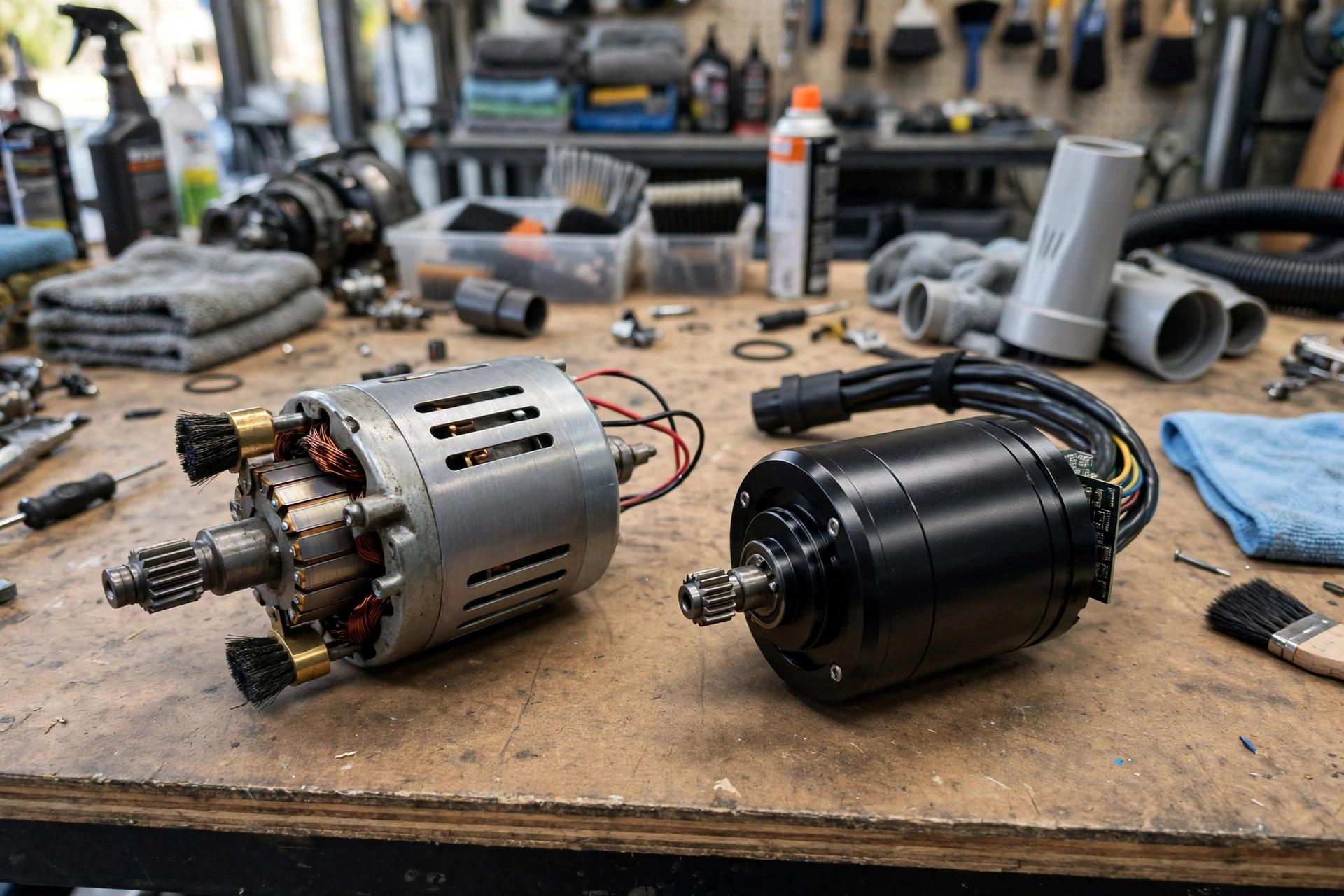
There are exactly two motor types in consumer car vacuums. Brushed motors use physical carbon brushes that rub against a spinning commutator to switch current direction; they are a nineteenth-century design still manufactured by the billions because they are cheap and simple. Brushless motors replace the brushes with electronics: a controller senses rotor position and switches current through the windings with solid-state precision, no rubbing parts at all. That one difference, friction versus electronics, cascades into lifespan, noise, efficiency, and price.
Manufacturers love to advertise brushless as premium, and sometimes charge a premium that the cleaning results do not justify. This guide strips the marketing away. You will learn how each motor works, where the real-world differences show up in car cleaning, and when the motor type should genuinely swing your purchase decision versus when it is just a badge on the box.
Brushed Motors: Cheap, Proven, and Wearing Out
A brushed motor is beautifully simple: a spinning armature, a stationary field, and two carbon brushes pressed against the commutator like little brake pads. Every rotation, the brushes hand current to a new winding. That contact is the motor’s genius and its doom. It works without any electronics, which is why brushed motors survive in the cheapest corded handhelds and 12V car vacuums, but the brushes wear down with use, just slowly, like pencil lead on rough paper.
In practice, a brushed car vacuum motor lasts somewhere between a few hundred and a couple thousand hours of runtime. That sounds like plenty until you realize car vacuums run hot and dusty: ten minutes of vacuuming sand from floormats is harder on brushes than an hour of household use. Symptoms of worn brushes creep in as gradual suction loss, intermittent cutouts, and a smell like hot electronics. Eventually the motor stutters and dies, and in a forty-dollar vacuum nobody repairs it.
Brushed motors are also inherently inefficient at the margins. Some energy becomes friction heat at the brush contact, and the mechanical switching cannot optimize timing the way electronics can. That is why cheap brushed 12V vacuums often sound furious but clean modestly: a lot of battery or alternator energy becomes noise and heat instead of airflow. For occasional use, none of this matters. For a weekly detailing habit, it adds up.
Brushless Motors: Efficient, Quiet, and Pricier
A brushless motor has no rubbing contact at all. A microcontroller watches the rotor spin and fires the windings in perfect sequence, thousands of times per second. Because timing is computed rather than mechanical, the controller can run the motor at its most efficient point across the speed range, and it can ramp speed smoothly instead of slamming on at full power. The result is more airflow per watt, less heat, and dramatically longer life.
The lifespan difference is the headline: brushless motors routinely outlast the product around them, often rated for ten thousand hours or more. In a car vacuum, that effectively means the motor will never be the part that dies. Batteries, filters, and plastic latches will give up first. For anyone who cleans cars often, or runs a small detailing side business from a garage, brushless is not a luxury; it is the difference between replacing a tool every two years and every six.
There are tradeoffs. Brushless motors need control electronics, which adds cost and a small failure surface of its own, and budget brushless implementations can have annoying electronic whines at certain speeds. The controller also means the motor is harder to service; when a brushless vacuum dies it is usually a board or battery issue, and repair is rarely economical. But for most buyers, the efficiency and silence gains outweigh a controller that will probably outlive the housing.
Real Power Comparison: Does Brushless Clean Better
Here is the uncomfortable truth: a well-designed brushed vacuum can out-clean a poorly designed brushless one. Airflow depends on the whole system, fan geometry, housing seals, filter restriction, nozzle design, and only partly on the motor. A brushless motor in a leaky housing with a clogged filter still cleans badly. When shoppers compare two vacuums, the motor type is less predictive than sealed suction, tested on carpet with real debris, and that is rarely printed on the box.
Where brushless genuinely cleans better is at the margins that matter in cars: sustained suction under load. Brushed motors lose speed as brushes heat and resistance rises, so a long session cleaning sandy carpets gets progressively weaker. Brushless controllers hold rotor speed steady, compensating as load changes, which keeps pickup consistent from the first floormat to the last. If you have ever noticed a cheap vacuum fading halfway through the job, you have felt brushed-motor sag.
Brushless also enables smarter power modes. Because speed is electronically controlled, many brushless handhelds offer eco and boost modes that actually work, stretching battery on light dust and unleashing full airflow for embedded pet hair. Brushed vacuums typically have one speed: loud. For car use, where a session mixes delicate headliner dusting and brutal carpet extraction, that flexibility is a real cleaning advantage, not just a spec-sheet bullet.
Lifespan and Noise: The Two Differences You Will Feel
Lifespan is the difference you feel in your wallet. A brushed handheld used weekly for car detailing might last two to four years before the motor fades; a brushless equivalent often lasts until you are bored of it. For a casual owner who vacuums monthly, either lasts effectively forever, so the premium buys little. For parents of crumb-generating toddlers or dog owners doing weekly fur extraction, brushless pays for itself by not dying.
Noise is the difference you feel in your ears, and it matters more than people expect in cars. Brushed motors produce a harsh, buzzy scream with strong high-frequency content from brush arcing, the classic cheap-vacuum whine that makes neighbors glance over. Brushless motors produce a smoother, lower-pitched tone that is easier on ears and less likely to terrify pets or wake a sleeping baby in the back seat. Measured decibels may differ by only a few points, but the character of the sound changes completely.
Heat is the quiet third difference. Brushed motors run hotter, and in a car vacuum that heat bakes onto the filter and the plastic around it, slowly degrading both. Ever noticed a vacuum that smells hot after five minutes? That is brushed inefficiency you can smell. Brushless runs cooler, which is kinder to filters, batteries, and the plastic housing, and it means the vacuum can be run longer without a cool-down break during a full interior detail.
Buying Advice: When the Motor Type Should Decide
Pay the brushless premium when you vacuum often, need quiet operation, or run a detailing habit where the tool earns its keep. In cordless handhelds, brushless plus a good battery is the combination that actually delivers the advertised runtime and suction; a brushed motor in a cordless body is often the reason cheap models disappoint. If the price gap is small, under twenty dollars or so, brushless is an easy yes.
Save your money when the vacuum is an occasional-use backup, a glovebox emergency tool, or a 12V unit that plugs into the car for rare spill duty. A brushed motor is perfectly fine for ten minutes a month, and the money is better spent on attachments, a better crevice tool, or a second battery. Do not buy brushless as a magic cleaning upgrade for a machine with a leaky housing; fix the system, not the motor.
One final tip: motor type is sometimes hidden in the fine print. Listings that trumpet digital motor or brushless usually have it; listings that say nothing are almost certainly brushed. When in doubt, check the runtime and noise claims against the price, a suspiciously cheap vacuum claiming huge suction is telling you something about its motor. To decode those suction claims properly, read car vacuum suction power explained, and for battery realities see the cordless car vacuum battery guide. Our roundup of the best handheld car vacuums notes which picks are brushless, and noise-sensitive buyers should read the quiet car vacuum guide first.
Related posts:



Cars like these are part of a bigger Maintenance & Repair story — DIY Tool Storage in the Trunk: Keeping Hand Tools Rattle-Free and Safe tells the next chapter.
Share this with a fellow driver or enthusiast who needs to see it.

