
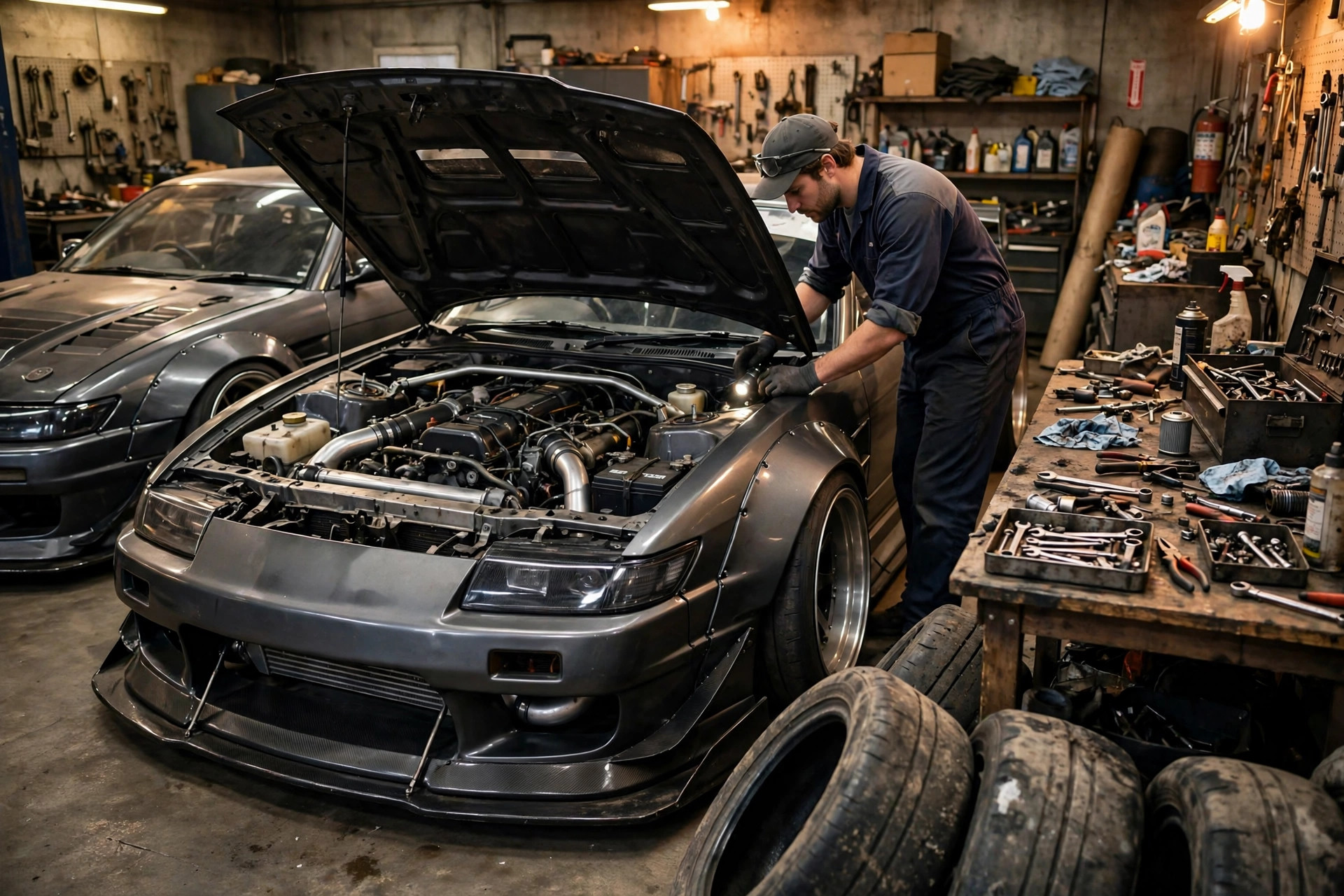
Drifting is uniquely hard on cars, so a driver who wants to keep a car alive season after season needs to know what breaks, why it breaks, and how to prevent it with routine checks before and after every event. Sustained high RPM, shock-loaded drivetrains, extreme heat, and occasional contact with barriers or other cars all take their toll. Understanding what breaks, why it breaks, and how to prevent it is the difference between a car that survives seasons of abuse and one that dies at its third event.
This guide is a maintenance roadmap for drift cars. It covers the wear items to budget for, the failure points to monitor, and the checklists that keep you driving instead of wrenching.
The Abuse Drifting Inflicts on Cars and the Consumables to Budget For
To maintain a drift car intelligently, you must understand what drifting does to it. Clutch kicks send shock waves through the transmission, differential, and axles, fatiguing metal with every hit. Sustained slides keep the engine at high RPM for minutes at a time, generating heat that street driving never produces.
The steering system works at full lock repeatedly, stressing pumps, racks, and tie rods. Tires are the obvious consumable, but they are far from the only one. This abuse is not a reason to avoid drifting; it is the price of admission, and it is manageable.
Production cars are engineered with safety margins, and most drift wear is predictable and preventable with maintenance, as general guidance on car maintenance also emphasises. The drivers whose cars last are not lucky; they are diligent. Think of maintenance as part of driving, not separate from it.
Every hour of track time earns an hour of inspection and upkeep. This ratio sounds burdensome until you compare it to the alternative: a blown engine or a failed tech inspection that ends your season. Diligence is cheap; neglect is expensive.
Certain parts are consumables in drifting, full stop. Tires lead the list; budget for multiple sets per season and source them cheaply as discussed in tire guides. Brake pads are next: drifting uses the handbrake and foot brake aggressively, and stock pads fade and crumble.
Upgrade to track-capable pads and carry spares. Engine oil takes a beating from sustained high RPM and heat. Change it frequently, every two to three events for a hard-driven car, and use quality synthetic oil in the correct viscosity.
Oil is cheap; engines are not. The same logic applies to transmission and differential fluid: change them on a schedule, not when they fail, because by the time they fail, the damage is done. Clutches are consumables in drift cars, especially while you are learning.
Beginners learning clutch kicks can destroy a clutch in a single season. Budget for replacement, learn to do the job yourself, and consider it tuition. As your technique smooths out, clutch life improves dramatically, which is another reason smooth driving saves money.
Knowing which tools the frequent jobs require helps as well, from the items in Specialty Sockets Every Car Owner Should Know: Axle Nuts, Oil Filters, and O2 Sensors to a tidy setup inspired by DIY Tool Storage in the Trunk: Keeping Hand Tools Rattle-Free and Safe.
Drivetrain: Clutches, Diffs, and Axles
The drivetrain absorbs the worst abuse in drifting. Clutch kicks shock-load everything from the flywheel to the axles, and components fail in a predictable order: clutch first, then axles and CV joints, then differentials, then transmissions. Knowing this hierarchy helps you prioritize upgrades and carry the right spares.
Axles and CV joints deserve special attention. The combination of steering lock and power that defines drifting stresses CV joints enormously, and clicking or vibrating axles are telling you they are about to fail. Carry spare axles to events; they are relatively cheap and can be swapped in the paddock.
Upgraded axles are a worthwhile investment once you are breaking stock ones regularly. Differentials, especially welded ones, stress the surrounding components. Inspect differential mounts and bushings regularly, as the constant shock loading cracks mounts and tears bushings.
A clunking rear end is not character; it is a warning. The legendary durability of platforms like the Toyota Chaser comes partly from overbuilt drivetrains, but even legends need inspection.
Cooling System: Your Engine’s Lifeline, and Brakes
Overheating is the number one mechanical day-ender in grassroots drifting. Sustained high-RPM running with limited airflow generates heat that overwhelms marginal cooling systems. The stock radiator that handles street driving fine will creep toward the red zone after a few hard runs, and once an engine overheats seriously, head gaskets and worse follow.
Upgrade the radiator to a quality aluminum unit with increased capacity, and consider an oil cooler as mandatory rather than optional. Engine oil both lubricates and cools; when oil overheats, it thins and stops protecting bearings. A dedicated oil cooler with a thermostat keeps temperatures in the safe zone during long sessions.
Maintain the entire cooling system proactively. Replace aging water pumps, thermostats, and hoses before they fail, not after. Bleed the system properly to eliminate air pockets, and use quality coolant at the correct concentration.
Between runs, let the car idle with the heater on full blast to shed heat; it is uncomfortable, but it works. Watch the temperature gauge like a hawk, because by the time the warning light comes on, damage may already be done.
Beginners underestimate brakes because drifting seems like a throttle sport, but brakes are critical safety equipment. You need reliable stopping power for the moments when drifts go wrong, for the drive home, and for the handbrake initiations that start your slides. Faded, worn brakes turn every mistake into a potential crash.
Upgrade brake fluid to a high-temperature DOT 4 fluid and bleed it regularly; boiling fluid causes the terrifying experience of a brake pedal going to the floor. Use track-oriented pads that resist fade, and inspect rotors for cracking. The handbrake needs attention too: adjust the cables or hydraulic system so it locks the rears reliably, because a weak handbrake makes initiations inconsistent.
Develop a brake inspection habit. Check pad thickness, fluid level, and line condition before every event. Feel for pulsation or fade during the first session and address it immediately rather than hoping it improves.
Brakes are the system you need most when everything else goes wrong; maintain them like your safety depends on it, because it does.
Suspension and Steering Wear
Suspension components wear faster in drift cars due to the constant lateral loading and impacts. Ball joints, tie rod ends, and control arm bushings all have finite lives that drifting shortens. Inspect them regularly for play; a clunk over bumps or vague steering feel means something is worn.
Catastrophic suspension failure at speed is among the scariest mechanical failures, so do not defer these inspections. Power steering systems work hard in drifting, with the pump running at high RPM while the rack sees full lock repeatedly. Check fluid level and condition, listen for pump whine, and inspect hoses for leaks.
Some drivers add power steering coolers, which is cheap insurance for a system that is easy to overlook until it fails mid-drift. Wheel bearings take abuse from the combination of lateral loads and heat. A humming or grinding noise that changes with speed indicates a failing bearing; replace it promptly, because a seized bearing can lock a wheel.
Keep a maintenance log of when components were replaced so you can predict service intervals rather than reacting to failures. The suspension fundamentals covers what quality components look like, and quality components last longer under abuse. A regular inspection should cover at least the following:
- Ball joints, tie rod ends, and control arm bushings checked for play, with any clunk or vague steering feel investigated.
- Power steering fluid level and condition checked, with the pump listened to for whine and hoses inspected for leaks.
- Wheel bearings listened to for humming or grinding that changes with speed, and replaced promptly if a bearing is failing.
- Differential mounts and bushings inspected regularly for cracks and tearing from constant shock loading.
Pre-Event and Post-Event Checklists
Before every event, run through a systematic check. Fluids: engine oil, coolant, brake fluid, power steering fluid, transmission and differential oil all at correct levels. Hardware: lug nuts torqued, battery tied down, no loose items in the car.
Rubber: tire condition and pressures set, brake pads adequate, belts and hoses intact. Leaks: none, anywhere. Throttle: returns freely.
This fifteen-minute ritual prevents the majority of event-day failures. After every event, inspect for new damage. Check for fluid leaks that developed during the day, inspect tires for cord showing or damage, look under the car for bent or broken components, and listen for new noises on the drive home.
Address anything you find before the next event; small problems become big ones when ignored. Keep records. A simple notebook or spreadsheet tracking maintenance dates, parts replaced, and issues noticed builds a history that reveals patterns.
You will learn your car’s specific appetites: which axle fails first, how many events a clutch lasts, when the brake pads need changing. This data transforms maintenance from guesswork into science. Combined with knowledge of tire wear patterns and honest assessment of incidents like roadside tire failures you will develop the mechanical sympathy that keeps drift cars alive for seasons of hard use.
In the end, keeping a drift car alive is about small, timely checks, honest records, and parts replaced before they fail. Do that work consistently, and the car will repay you with season after season of hard, reliable use.
Related posts:
Every Maintenance & Repair article adds another tool to the shed. The related reads below are worth a spin.
Share this with a fellow driver or enthusiast who needs to see it.

