
- The Philosophy: Buy for Jobs, Not for Dreams
- The Core: Sockets and Ratchets First
- Wrenches: The Other Half of Fastener Work
- Screwdrivers, Pliers, and the Gripping Tools
- Lifting Safely: Jacks, Stands, and Chocks
- The Torque Wrench: Precision You Cannot Guess
- What to Skip: The Beginner Traps
- Buying Tiers: Good, Better, and When Premium Pays
- The Verdict: A Kit That Grows With You
The Philosophy: Buy for Jobs, Not for Dreams
Every home mechanic faces the same temptation: the giant tool set with the impressive piece count, promising a fully equipped garage in a single purchase. And every experienced mechanic gives the same advice: buy tools for the jobs you actually do, in the order you need them, in quality that matches how hard you will use them. The difference between these approaches is thousands of dollars and a garage full of either useful tools or expensive clutter.
The philosophy that works is job-based buying. Your first oil change needs a socket set, a drain pan, and a filter wrench, not a 230-piece set. Your first brake job adds a breaker bar and a caliper tool. Your first suspension job adds the 1/2-inch drive gear. Each job funds the next tool purchase, each tool earns its place through use, and the kit that results is perfectly matched to your actual work.
This guide builds the essential car mechanic tool set from first principles: the core tools every car owner needs, the order to buy them, what to skip, and how to think about quality tiers. Whether you are equipping your first garage or rationalizing an inherited pile of tools, this is the framework that keeps spending smart and the toolbox useful.
The Core: Sockets and Ratchets First
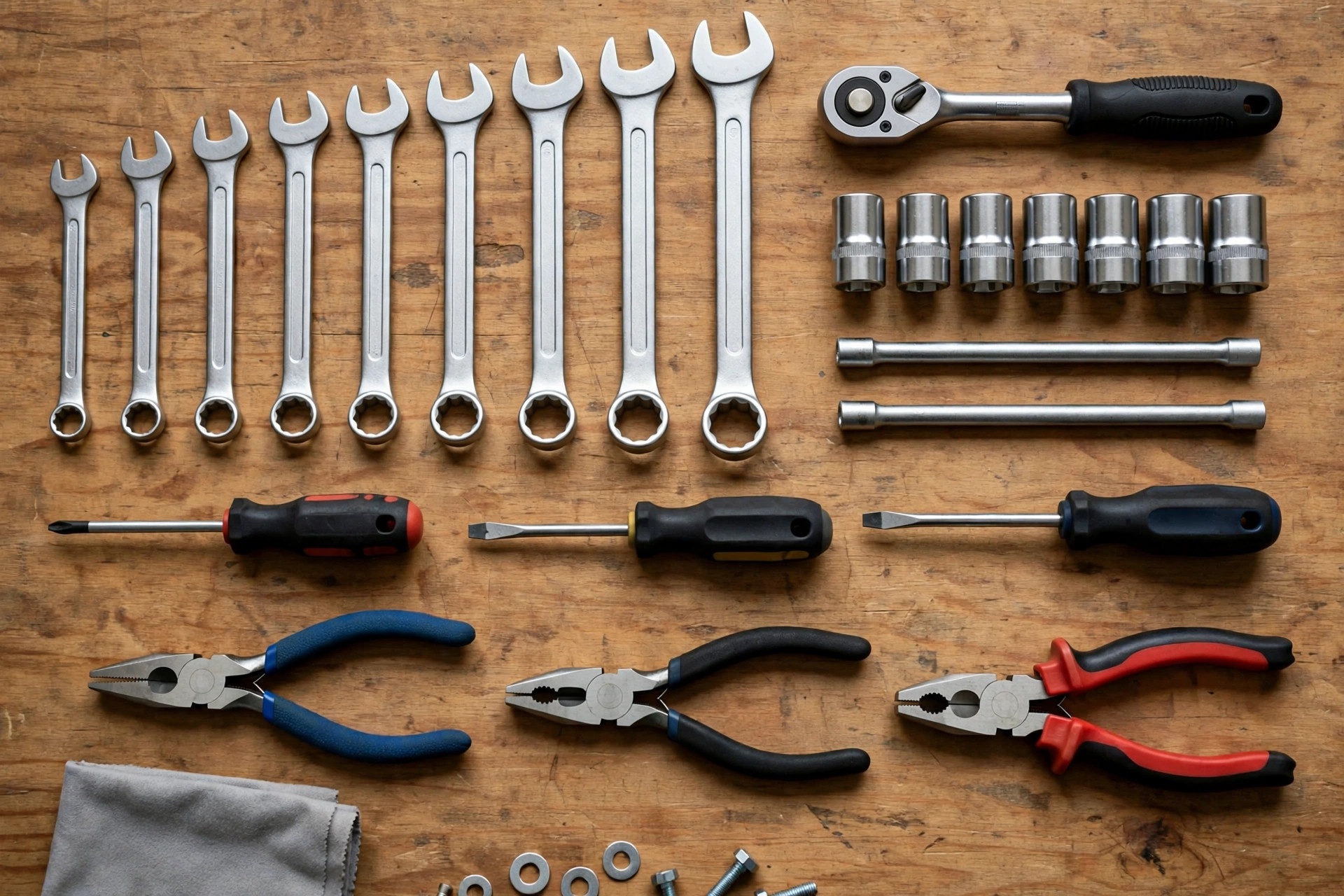
The socket set is the foundation everything else builds on. Start with a quality 3/8-inch drive metric set, 6-point, covering 8 through 19mm in shallow and deep, with 3 and 6-inch extensions. This single purchase handles the majority of fasteners on a modern car and is the highest-leverage tool buy a car owner can make. Add a 1/4-inch drive set for small fasteners and tight spaces as the second purchase.
The third socket purchase is the 1/2-inch drive set for wheels and suspension: a breaker bar, a 1/2-inch ratchet, and impact or heavy-duty sockets in 17, 19, 21, and 22mm, plus the larger sizes your specific vehicles need. This is the kit that makes tire rotations, brake jobs, and suspension work possible and safe. Do not attempt those jobs on 3/8-inch drive; the tool breakage risk is real.
Around the sockets, add the drive accessories that make them usable: wobble extensions, a universal joint, drive adapters, and a spark plug socket in your car’s size. These small additions multiply the capability of the sockets you already own. For the full context of building a working garage around these core tools, our essential tools for home car restoration guide ranks every category by priority and explains what comes after the basics.
Wrenches: The Other Half of Fastener Work
Sockets cannot reach everything, which is where combination wrenches earn their place. A combination wrench has an open end on one side and a box end on the other, and the box end grips like a socket while the open end slips onto fasteners from the side where a socket cannot go. Brake line fittings, oxygen sensors in tight spots, and fasteners where a ratchet head will not fit all call for wrenches.
Buy combination wrenches in metric, 8 through 19mm, in the same quality tier as your sockets. The box end should be 12-point for versatility or 6-point for maximum grip; most mechanics prefer 12-point box ends for the indexing convenience on light fasteners and rely on sockets for the heavy work. Ratcheting wrenches, which add a ratcheting box end, are a genuine productivity upgrade for engine-bay work and worth the premium once the basics are covered.
Flare nut wrenches, also called line wrenches, deserve a special mention. Brake and fuel line fittings use soft flare nuts that an open-end wrench will round in a heartbeat; the flare nut wrench wraps almost fully around the fitting like a box end with a slot for the line. If you ever touch brake lines, own the flare nut sizes your car uses. It is a small purchase that prevents a very bad day.
Screwdrivers, Pliers, and the Gripping Tools
Screwdrivers remain essential despite the socket’s dominance: interior trim, hose clamps, electrical connectors, and countless small jobs need them. Buy a quality set with Phillips #1 and #2, flatheads in small, medium, and large, and a set of Torx drivers, since Torx fasteners are everywhere on modern cars. The difference between a good screwdriver and a cheap one is the tip: precise, hardened tips grip screws instead of camming out and chewing them up.
Pliers are the gripping, bending, and holding tools. The essential trio is combination pliers for general gripping, needle-nose pliers for reaching into tight spots and handling clips, and locking pliers for holding things that need to stay put. Add a set of snap-ring pliers, internal and external, when you start doing bearing and transmission work, and hose clamp pliers when cooling system service begins.
Do not overlook the humble pick set. O-rings, seals, cotter pins, and electrical connectors all surrender more easily to a pick than to a screwdriver, and a four-piece pick set costs almost nothing. It is one of those tools that, once owned, gets used weekly.
Lifting Safely: Jacks, Stands, and Chocks
No tool category matters more for safety than lifting equipment. A hydraulic floor jack lifts the car; jack stands hold it while you work underneath; wheel chocks keep it from rolling. The rule is absolute and non-negotiable: never, ever work under a car supported only by a jack. Jacks fail, seals leak, and the result of trusting a jack with your life is exactly as bad as it sounds.
Buy a floor jack rated well above your vehicle’s weight, with a low profile if your car sits low and a long reach if you need to get to central jacking points. Buy jack stands in pairs, rated equally, with a positive locking mechanism you can verify by feel. Chocks are cheap insurance that every lift should include. This is the one category where buying the cheapest option is genuinely dangerous; lifting equipment is where quality is a safety issue, not a luxury.
Learn your car’s jacking points from the owner’s manual before you lift anything. Unibody cars have reinforced pinch welds and subframe points; lifting from the wrong spot damages the car or, worse, creates an unstable lift. A few minutes with the manual prevents both.
The Torque Wrench: Precision You Cannot Guess
The torque wrench is the tool that separates careful mechanics from hopeful ones. Wheels, suspension components, engine fasteners, and spark plugs all have specified torque values, and guessing those values by feel is how wheels come loose, threads strip, and gaskets fail. A torque wrench is not a luxury for professionals; it is a safety tool for everyone.
The click-type torque wrench in 3/8-inch drive, covering roughly 10 to 100 foot-pounds, is the right first torque wrench for a car owner. It handles lug nuts, spark plugs, and most engine and suspension fasteners. Add a 1/2-inch drive model covering higher ranges when you do axle nuts and large suspension work. Store it properly, unwound to its lowest setting, calibrated periodically, and never use it as a breaker bar.
Learning to use a torque wrench correctly takes minutes and pays off forever: set the value, tighten smoothly until the click, stop. No extra ugga-dugga after the click. For choosing between the types, our comparison of click versus beam versus digital torque wrenches breaks down the options, and when fasteners refuse to move at all, our breaker bar guide for stubborn bolts covers the other end of the force spectrum.
What to Skip: The Beginner Traps
Knowing what not to buy is as valuable as knowing what to buy. Skip the giant all-in-one set until you know you need it; the job-based approach builds a better kit for less money. Skip ultra-cheap tools in categories where failure is dangerous or expensive: lifting equipment, torque wrenches, and anything that touches high-torque fasteners. A broken cheap socket is an annoyance; a failed cheap jack stand is a tragedy.
Skip duplicate coverage early on. You do not need SAE sockets until you have an SAE job, you do not need a full Torx set until Torx fasteners block you, and you do not need specialty pullers until a bearing or hub demands one. Each of these is a fine purchase when the job arrives; each is clutter before it does.
Skip the tool truck payment plan as a beginner. Premium tools are wonderful, and professional mechanics buy them for good reasons, but financing a box full of premium tools before you know which ones you will actually use is how beginners end up with debt and a drawer of pristine, untouched wrenches. Buy mid-range, use hard, upgrade the pieces you wear out. The tools you replace through wear are the ones that deserved premium all along.
Buying Tiers: Good, Better, and When Premium Pays
Tool quality exists on a spectrum, and the smart money matches the tier to the use. The good tier, reputable mid-range brands, is where most home mechanics should live: precise enough for real work, durable enough for weekend use, priced sanely. This tier handles sockets, wrenches, screwdrivers, and pliers excellently.
The better tier, upper mid-range and entry professional, pays off in tools you use constantly or where precision matters most: your primary 3/8-inch ratchet, your torque wrench, your floor jack. These are the tools where feel, accuracy, and longevity justify the premium, because you will touch them on every job for a decade.
The premium tier, tool-truck brands, makes sense for professionals who use tools eight hours a day and for the specific home tools you have already worn out once. If you have replaced the same mid-range tool twice, the premium version is cheaper in the long run. Until then, it is a luxury. Spend the difference on the jack stands, the torque wrench calibration, and the next job’s parts.
The Verdict: A Kit That Grows With You
The essential car mechanic tool set is not a product you buy; it is a collection you grow. Start with the 3/8-inch socket core, add wrenches and drivers, invest in safe lifting equipment, buy the torque wrench before you need it, and let each job fund the next addition. Skip the traps, match quality to use, and store everything so you can find it.
A kit built this way has a wonderful property: every tool in it has a story, a job that demanded it and a repair it completed. That is not sentimentality; it is the sign of money well spent. For help turning a growing tool collection into a working space, our home garage setup guide covers layout, lighting, and the infrastructure that makes tools useful.
Related posts:



If this read fired you up, Tool Storage for Car Owners: Cases, Chests, and Keeping Your Sockets Organized keeps the Maintenance & Repair momentum rolling.
Share this with a fellow driver or enthusiast who needs to see it.

