
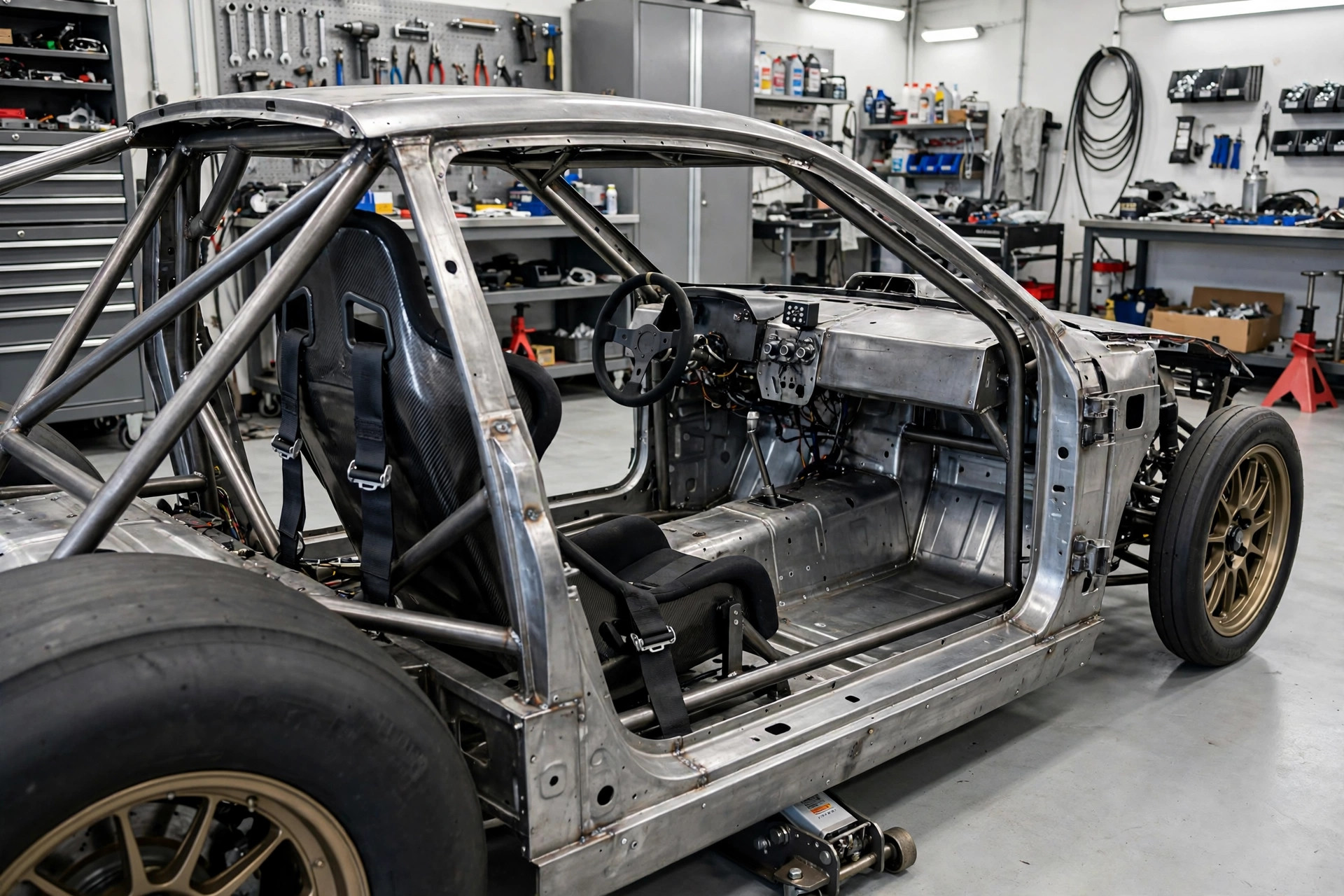
For any drag racer asking how to go quicker without spending on engine parts, weight reduction is where the free speed lives, and this guide explains what to remove, where it matters most, when to stop, why the physics works, and how to track the gain. Weight reduction is the most underappreciated performance modification in drag racing. It costs little or nothing, it improves every aspect of acceleration, and unlike engine modifications, it never hurts reliability. The old racer’s rule of thumb says every 100 pounds removed is worth roughly a tenth of a second in the quarter mile, a relationship rooted in the car’s power-to-weight ratio.
Beginners routinely spend thousands on engine parts to gain fifty horsepower while ignoring hundreds of pounds of easily removable weight sitting in their car. This guide covers the physics that makes weight reduction so effective, the free removals every racer should do, the cheap modifications worth buying, and the critical judgment calls about what must stay. Free speed is real, and it is sitting in your trunk right now.
The Physics: Why Weight Matters So Much
Newton’s second law, force equals mass times acceleration, is the entire argument. Your engine produces a fixed force at the tires, and acceleration is that force divided by the car’s mass. Reduce the mass and acceleration rises proportionally, everywhere, at every speed, with no trade-offs in drivability. A ten percent weight reduction is roughly equivalent to an eleven percent power increase in terms of acceleration, except the weight reduction also improves braking, handling, tire wear, and fuel economy.
The rule of thumb, 100 pounds equals a tenth in the quarter mile, holds reasonably well for typical street cars in the 12 to 15-second range. Do the economics: removing 200 pounds of interior, spare tire, and clutter costs nothing and gains two tenths, while buying two tenths through engine modifications might cost two thousand dollars or more. This is why experienced racers strip weight before they buy power, and why the fastest budget bracket cars are often the lightest rather than the most powerful. Power-to-weight ratio is the true currency of acceleration, and weight is the cheaper side of the fraction to improve.
Free Removals and Cheap, Reversible Mods
Free Weight Removal: The Obvious First Step
Start with what costs nothing. The spare tire, jack, and trunk clutter typically total 40 to 60 pounds. Rear seats in many cars weigh another 40 to 60 pounds and unbolt in minutes.
The first round of free removals usually includes:
- The spare tire, jack, and trunk clutter, typically 40 to 60 pounds in total.
- Rear seats, another 40 to 60 pounds in many cars, unbolted in minutes.
- Floor mats, the cargo cover, owner’s manual bulk, and accumulated junk throughout the car.
- The passenger seat on race days, sound deadening material under the carpet in dedicated cars, the rear wiper assembly, and plastic engine covers that serve no structural purpose.
Floor mats, the cargo cover, owner’s manual bulk, and accumulated junk add up faster than you think; a thorough cleanout of a daily-driven car routinely finds 100 pounds or more. None of this affects the car’s function as a race car, and all of it is reversible in an afternoon if you need the car for family duty. Each deeper item seems trivial alone, but weight reduction is an accumulation game, and twenty five-pound items equal one significant gain.
Weigh everything you remove on a bathroom scale and log it, because the psychological effect of watching the total climb keeps the project going. Free weight is the highest-return modification in the sport, and most racers leave half of it on the table.
Cheap and Reversible Weight Mods
Beyond free removals, the best value in weight reduction is a lightweight battery, which saves 25 to 35 pounds for around a hundred dollars and installs in minutes. Lightweight wheels are the next big win, often saving 5 to 8 pounds per corner while also reducing rotating mass, which matters disproportionately as the next section explains. A smaller, lighter exhaust system or the removal of resonators and heavy mufflers on a race car saves meaningful weight at the rear of the car.
Manual window and lock conversions are a deeper step for dedicated cars, as are fiberglass or carbon-fiber body panels, though those escalate in cost quickly. The guiding principle is dollars per pound: a lightweight battery at three dollars per pound is an obvious buy, while a carbon hood at fifty dollars per pound needs justification against other modifications. For budget-focused racers, the sweet spot is the combination of free removals plus a lightweight battery and wheels, which together can drop 150 to 200 pounds for a few hundred dollars. That is genuine, measurable ET improvement, and it pairs well with choosing an affordable platform in the first place, like the sensible options on a budget-friendly car list, where less starting weight means less work.
Weight Placement, Balance, and Rotating Weight
Weight Placement and Balance
Where weight sits matters nearly as much as how much there is, especially at the launch. In a RWD drag car, weight over the rear axle aids traction, which is why battery relocations to the trunk are a classic drag racing move: the battery’s 30 to 40 pounds moves from the front to exactly where the drive tires need load. Conversely, weight ahead of the front axle or high in the car hurts twice, adding mass without aiding traction and raising the center of gravity.
Think in terms of the car’s weight distribution relative to its drivetrain. FWD cars want weight over the front axle and as little as possible at the rear, which is why FWD racers strip the trunk aggressively. RWD cars want a rearward bias within reason, and ballast, actual added weight, is sometimes placed over the rear axle in classes with minimum weight rules, because controlled weight in the right place beats uncontrolled weight in the wrong place. When removing weight, prefer the front of a RWD car and the rear of a FWD car, and keep a rough log of distribution changes so the car’s balance evolves intentionally rather than accidentally.
Unsprung and Rotating Weight: The Multiplier Effect
Not all pounds are equal. Unsprung weight, everything not supported by the suspension, including wheels, tires, and brakes, affects how well the tires follow the track surface, and reducing it improves traction as well as acceleration. Rotating weight, everything that spins, including wheels, tires, brake rotors, driveshaft, and flywheel, is worse still, because the engine must spend energy spinning it up in addition to moving the car forward. A pound removed from a wheel is worth significantly more than a pound removed from the trunk.
This is why lightweight wheels are such a celebrated modification and why racers obsess over brake rotor weight, driveshaft material, and flywheel mass. An aluminum driveshaft, lightweight brake rotors, and forged wheels attack rotating mass directly, and the gains show up disproportionately in the 60-foot time, where acceleration rates are highest. When budgeting, prioritize rotating and unsprung weight over static weight: the dollars-per-effective-pound math favors wheels, rotors, and driveline components over interior trim. Understanding this hierarchy separates effective weight programs from random stripping.
What Not to Remove and Tracking Your Gains
What Not to Remove
Discipline matters as much as enthusiasm. Never remove structural components, crash bracing, or anything the rulebook requires; a lighter car that fails tech or folds in an incident is not a race car, it is a mistake. Keep the factory seatbelts or proper harnesses, keep the battery secured no matter how light it is, and never compromise the braking system to save weight, since the shutdown area at the far end demands full stopping power every pass. Components like performance brake calipers exist precisely because stopping matters as much as going.
Be cautious with removals that affect cooling, lubrication, or electrical reliability: the weight saved is never worth a DNF. Air conditioning removal is common and usually safe on dedicated cars but miserable on street-driven ones, so weigh comfort against the gain honestly. And check class rules before removing anything visible, since some street classes require full interiors or working accessories. The art of weight reduction is knowing what the car does not need, and the science is verifying each removal against safety, rules, and reliability before the weight comes off.
Tracking Your Gains
Measure everything, because weight reduction without measurement is just tidying. Weigh the car on a proper scale before you start, ideally with corner weights so you know the distribution, and re-weigh after each phase of removals. Log every removed item with its weight, and correlate the totals with timeslip data: you should see the ET respond as the weight drops, and the relationship validates the rule of thumb for your specific car. A dyno run before and after is unnecessary for weight work, since the engine is unchanged, but power-to-weight calculations from your scale numbers tell the real story.
Set targets in pounds rather than in parts: decide the car will lose 150 pounds this season, and let the target drive the decisions. Revisit the log when progress stalls, because the easy removals go first and the later ones require creativity. And remember that weight reduction compounds with every other modification: lighter cars need less tire, less brake, and less power to achieve the same ET, which means the weight you remove today makes every future dollar more effective. There is no modification with a better return on investment, and the scale does not lie.
Related posts:



Cars like these are part of a bigger Driving & Road Trips story — How Much Does It Cost to Start Drag Racing? Real Budgets Breakdown tells the next chapter.
Save this page and send it to your car group — good tips travel.

