

If you want to understand what drifting is and how it is judged in competition, start here: drifting is the art of sliding a car sideways through corners while keeping it under control, and judges score how you slide, not how fast you finish. Unlike most motorsports where the stopwatch decides the winner, drifting is a judged sport where drivers earn points for how they slide. The rear tires lose grip on purpose, and the car travels at an angle to its direction of motion. The driver balances throttle, steering, and weight transfer to hold that slide from corner entry to corner exit.
When it looks effortless, it is because the driver has practiced hundreds of hours to make chaos look choreographed. The sport grew out of Japanese mountain roads in the 1980s and 1990s, where drivers learned to slide through tight hairpins for fun rather than lap times. Organized competitions like D1 Grand Prix and Formula Drift turned that street culture into a stadium sport with standardized judging criteria. Today, understanding how drifting is judged helps you appreciate what separates a champion from a spinout artist, and it gives beginners a clear target for their practice sessions.
What Drifting Actually Is
At its core, drifting is controlled oversteer. Oversteer means the rear of the car rotates more than the front, so the car points somewhere other than where it is traveling. Every driver experiences accidental oversteer on a wet road, but a drifter creates it deliberately and sustains it through an entire corner or a linked series of corners. The technique requires a rear-wheel-drive car in most cases, because breaking rear traction while driving the rear wheels is the most natural way to start and maintain a slide.
What makes drifting a motorsport rather than a stunt is the demand for precision. A good drift is not just sideways; it follows a specific racing line, holds a dramatic angle, and flows smoothly from one corner into the next. Judges watch for the driver who commits early, stays close to the clipping points marked on the track, and makes the whole run look aggressive yet controlled. The difference between drifting and simply sliding around is intention: every input the driver makes is aimed at shaping the slide, not just surviving it.
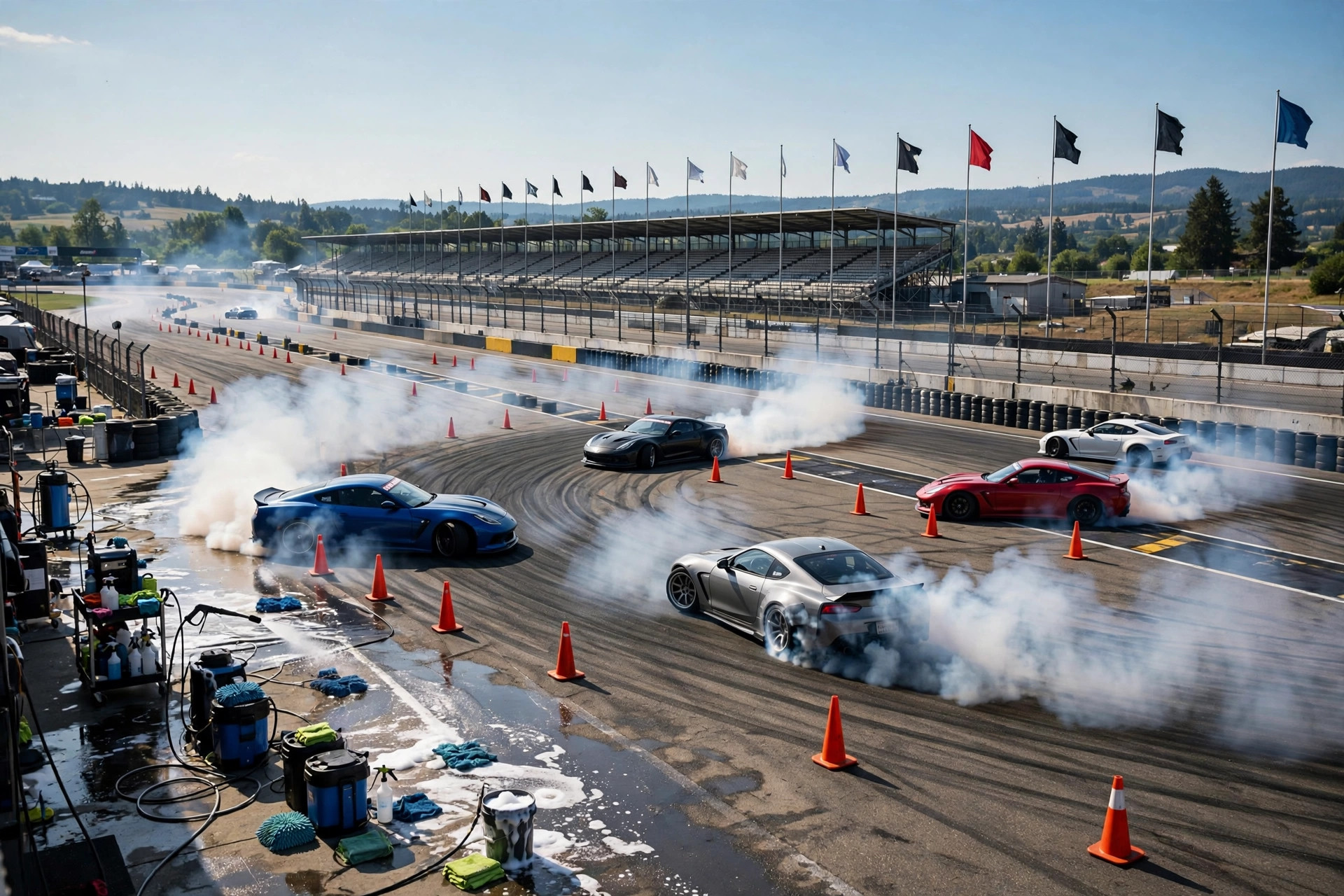
Modern drift competitions take place on purpose-built courses or closed circuits with marked clipping zones. A clipping point might be a cone, a painted zone on the asphalt, or a wall the driver is expected to run close to while sideways. Hitting these points at full angle is the fundamental skill the whole sport revolves around. Spectators love the smoke and noise, but the judges are watching something much more specific, and that precision is what makes drifting a legitimate competitive discipline.
How Drift Competitions Are Judged
Drift competitions use a panel of judges, usually three, who score each run based on a published set of criteria. There is no lap timer involved. Instead, each judge watches the run and awards points for line, angle, and style, with small deductions for mistakes. The exact weighting varies between series, but the philosophy is consistent everywhere from grassroots events to the top professional drifting series: reward the driver who is most committed, most accurate, and most entertaining.
Judging happens in two phases at most events. First comes qualifying, where each driver runs the course alone and receives a score out of 100. The highest qualifiers advance to the tandem bracket, where drivers compete head-to-head in pairs. Tandem judging is comparative rather than numerical: the judges decide which driver performed better across two runs, one leading and one chasing, and the winner moves on.
This dual structure tests both raw solo skill and the ability to handle pressure with another car inches from your door. Because judging is subjective, consistency between judges matters enormously. Series publish detailed rulebooks and hold judges’ meetings before events so everyone scores the same behaviors the same way. Drivers can request explanations after their runs, and at the professional level, instant replay helps judges review close calls.
The system is not perfect, but it has proven remarkably robust over two decades of professional competition. For a formal overview of the discipline itself, see Drifting (motorsport). The three pillars judges return to in every phase are:
- Line — the path the car takes through the course, measured against inside and outside clipping points
- Angle — how sideways the car gets, and whether that angle is initiated early, held consistently, and adjusted fluidly
- Style — speed, fluidity, commitment, and showmanship through entries, transitions, and aggressive moves
Line is the path the car takes through the course. Judges define an ideal line using clipping points, and the driver who stays closest to that line scores highest. There are usually inside clips, where the front of the car should nearly touch a marker, and outside clips, where the rear of the car should swing wide. Running the correct line while sideways is the hardest part of drifting, because the car is traveling at an angle and the driver must predict where the rear will go while looking ahead through the windshield.
Angle is how sideways the car gets. More angle generally scores better, but only if the driver maintains it smoothly and stays on line. A car that snaps to huge angle and then straightens halfway through the corner loses points, while a car that holds a moderate angle cleanly from start to finish scores well. Judges look for angle that is initiated early, held consistently, and adjusted fluidly as the course demands.
Maximum angle with minimum correction is the ideal. Style covers everything else: speed, fluidity, commitment, and showmanship. Judges reward drivers who enter corners fast, transition between slides without hesitation, and make aggressive moves like running inches from a wall. Smoke, noise, and crowd reaction are byproducts of style, not scored directly, but a run that looks spectacular usually reflects the commitment judges want to reward.
The great drivers make every run look like an attack, never a cautious cruise. In qualifying, each driver typically gets two solo runs, and the better score counts. Judges score out of 100 points, often split into sections for different parts of the course. A driver might earn up to 30 points for the first section, 30 for the second, and 40 for the final section, for example.
This sectional scoring means a mistake in one corner does not automatically ruin the whole run, though a spin or straightening almost always does. Solo qualifying rewards consistency and risk management. Smart drivers run their first pass at about 90 percent to bank a solid score, then attack the second run for a higher number. Going all-out on the first run and spinning leaves you with nothing, while a conservative banker run guarantees a place in the bracket.
This strategic layer is part of what makes professional drifting interesting to follow. At grassroots events, qualifying works the same way but with simpler scoring. Many local competitions use a single 100-point scale or even a simple rank-order system. The principles do not change: hit your clips, hold your angle, and look committed.
Beginners should treat every practice run like a qualifying run, scoring themselves mentally on line and angle, because that self-judgment accelerates learning dramatically. Tandem battles are where drifting becomes a true duel. Two drivers run the course together: one leads, one chases, then they swap roles. The lead driver is judged on running the qualifying line as if alone, while the chase driver is judged on proximity, mimicking the lead car’s line and angle while staying as close as possible without contact.
Tandem Battles: Chase and Lead
Judges then declare a winner, or call for a rerun with another “one more time” if the battle is too close to call. Chasing is widely considered the harder job. The chase driver must react to everything the lead car does, including mistakes, while maintaining their own slide. A great chase run looks like a shadow glued to the lead car through every transition.
Lead drivers, meanwhile, try to run a line that is fast and clean but hard to follow, sometimes pulling away on straights or taking unexpected lines to shake the chaser. This cat-and-mouse dynamic is the most exciting part of the sport for spectators. Contact between cars is discouraged but not always penalized, depending on fault. If the chase driver bumps the lead car because the lead car slowed unexpectedly, judges may forgive it.
Deliberate contact or contact caused by a sloppy chase run usually loses the battle. At the highest level, drivers have an unwritten code of respect: close is good, crashing is not, and the show matters as much as the result.
Common Deductions and Zero Scores
Not all mistakes are equal in the judges’ eyes. Minor errors like missing a clipping point by a small margin or a brief wobble in angle cost a few points. Major errors like straightening the car mid-corner, dropping two wheels off the course, or spinning earn large deductions or an automatic zero for the run. Understanding this hierarchy helps drivers decide when to save a run and when to abandon it.
Straightening, where the driver briefly points the car straight to regain control, is the most common deduction in amateur competition. It usually happens when the driver enters too fast or misjudges grip, and the car refuses to rotate. Judges see it as a failure of commitment or car control, and it breaks the flow that style points reward. Spinning is worse: once the car rotates past 90 degrees, the run is effectively over, and most rulebooks assign a zero.
Off-course excursions, where the car leaves the defined track surface, also draw heavy penalties. Grass, gravel, and walls are not part of the line, and using them to save a run is penalized rather than rewarded. This is why winter drift events are so demanding: the margin between the ideal line and the snowbank is razor thin, and judges show no mercy for drivers who cannot find it.
How to Watch Drifting Like a Judge
Once you know the criteria, watching drifting becomes a completely different experience. Instead of just enjoying the smoke, start calling the runs yourself: watch the lead car’s front bumper at the inside clips, check whether the angle stays consistent through transitions, and notice which chase driver stays glued to the leader. You will quickly develop opinions that match the judges more often than not. Pay special attention to initiation, the moment the driver starts the slide.
The best drivers begin their drift early, sometimes before the corner even starts, which lets them carry more speed and angle through the whole section. Late, timid initiations force the driver to play catch-up for the rest of the run. Watch a few events with this in mind and you will spot the winners before the judges announce them. For aspiring drivers, studying judged runs is free education.
Record your own practice sessions and score them the way a judge would: line first, angle second, style third. Be brutally honest about straightening and missed clips. Drivers who learn to judge themselves improve far faster than those who only chase the feeling of sliding. The scoreboard is the most honest coach in drifting, and learning its language is the first step toward climbing it.
Legends like Ken Block built their reputations on exactly this kind of precision, turning car control into an art form that judges and fans could both appreciate. They did it whether on a powerful rear-drive coupe or a purpose-built competition machine. Watch for line, angle, and style in that order, and the sport stops looking like chaos. It starts looking like what it has always been: choreography at the limit of grip.
Related posts:

Before you roll on, check out Best Cheap Beginner Drift Cars: RWD Platforms That Will Not Break the Bank — it builds on exactly what you just read.
Bookmark this guide — it will come in handy in the garage.

