
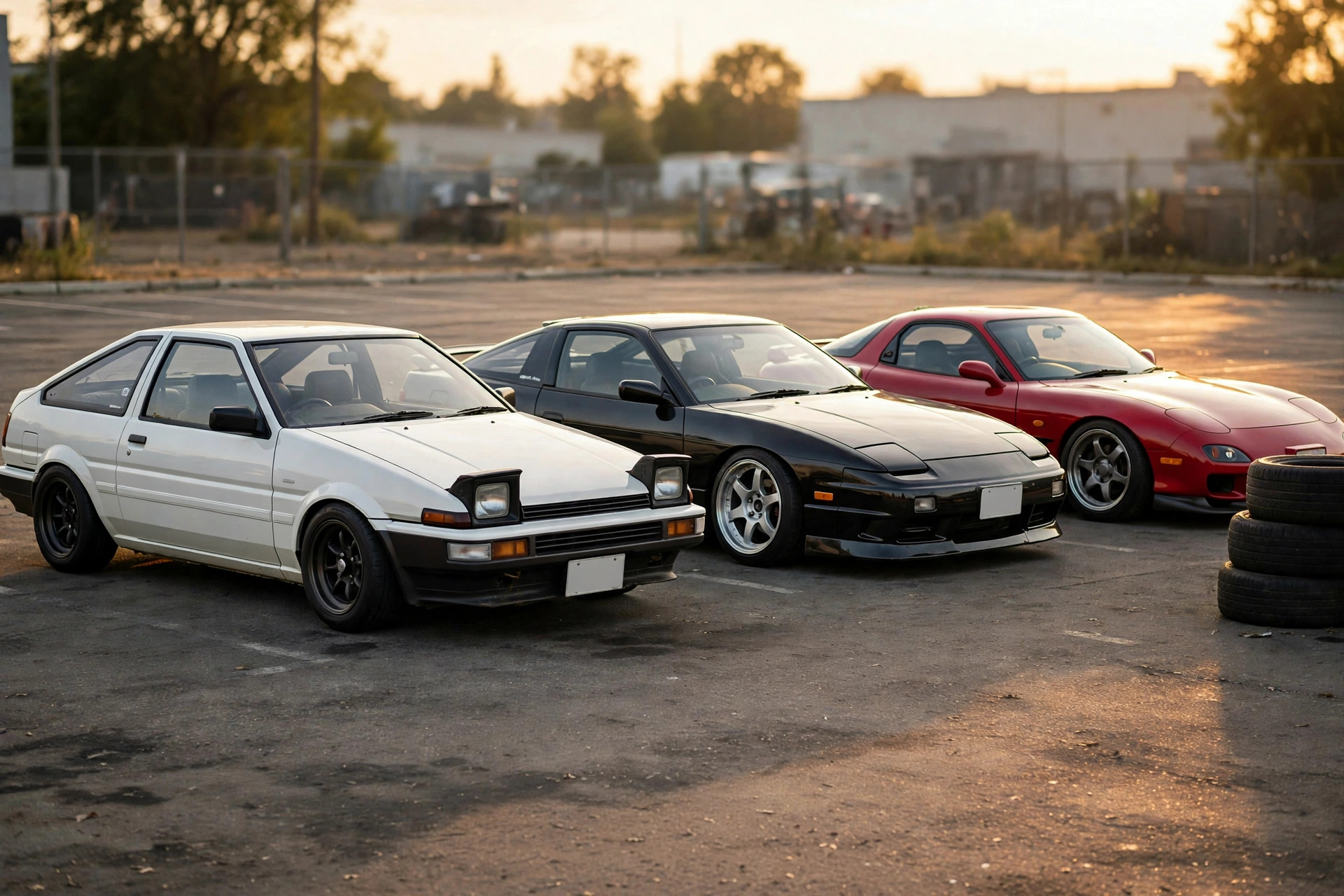
If you are a beginner wondering what to buy, where to start, and how to learn drifting without draining your savings, choosing your first drift car is one of the most important decisions you will make in the sport. The right car forgives mistakes, teaches good habits, and keeps running while you learn. The wrong car fights you, breaks constantly, and drains your wallet before you ever link a full corner. For beginners, the formula is simple: rear-wheel drive, manual transmission, decent aftermarket support, and a purchase price that leaves money in the budget for tires and maintenance.
You do not need a powerful or expensive car to learn drifting. In fact, lower-powered cars are often better teachers because they force you to master momentum, weight transfer, and clutch control instead of relying on horsepower to mask bad technique. The cars below have all proven themselves as beginner platforms over decades of grassroots drifting, and each can be found cheap enough to leave room in the budget for the consumables that drifting devours.
What Makes a Good Beginner Drift Car
A good beginner drift car starts with rear-wheel drive and a manual gearbox. Rear-wheel drive lets you break the rear tires loose with the throttle, which is the foundation of every drift technique. A manual transmission gives you the clutch control needed for clutch-kick initiations and lets you choose gears to keep the engine in its powerband. Automatics can drift, but they make learning significantly harder and remove one of your most important control tools.
Weight balance and chassis rigidity matter more than horsepower for learning. A well-balanced car with around 150 to 250 horsepower is the sweet spot: enough power to sustain a slide, not so much that mistakes become violent. Cars with strong aftermarket support are also essential, because you will need replacement parts, and obscure platforms turn every broken component into a scavenger hunt. Finally, consider parts interchangeability and community knowledge: a car with an active forum and cheap used parts will keep you on track while an exotic choice keeps you in the garage.
Reliability deserves special emphasis. Your first drift car will take abuse as you learn, and a fragile platform will punish every mistake with a repair bill. The best beginner cars have simple, overbuilt drivetrains that tolerate clutch kicks, rev limiter bounces, and the occasional off-track excursion. Buy the most reliable example of a proven platform you can afford, and save the exotic project car for your second build.
Japanese Platforms That Teach You Properly
Nissan 240SX (S13 and S14)
The Nissan 240SX, known as the Silvia in Japan, is the definitive beginner drift car and has been for thirty years. The S13 hatchback and coupe and the S14 coupe offer a near-perfect front-engine, rear-drive layout with excellent weight balance and one of the largest aftermarket catalogs in the sport. The chassis responds beautifully to basic modifications, and the community knowledge base is enormous: whatever breaks, someone has documented the fix.
Prices have climbed as drift tax hit the market, but rough-but-running examples still appear at achievable prices if you search patiently. The naturally aspirated KA24 engine is not powerful, but it is tough and torquey enough to learn on, and the popular SR20DET swap path means the chassis can grow with your skills. Rust is the main enemy, so inspect frame rails, strut towers, and floor pans carefully before buying.
For a beginner, a stock or lightly modified 240SX with a welded differential and decent coilovers is all you need for your first season. Resist the urge to build a 400-horsepower monster immediately; the stock car’s limits are exactly what teach you car control. Many professional drivers started in nearly stock S-chassis cars, and the fundamentals they learned there carried them all the way to the top.
Mazda Miata MX-5
The Mazda Miata MX-5 might seem like an odd drift car, but it is secretly one of the best learning tools in existence. It is light, perfectly balanced, rear-wheel drive, and available with a manual gearbox in huge numbers. The low power output, usually around 115 to 140 horsepower depending on generation, forces you to learn momentum conservation and precise weight transfer because you cannot power your way out of mistakes.
Drifting a Miata teaches smoothness above all else. The car rewards delicate inputs and punishes ham-fisted throttle stabs, which builds habits that transfer directly to more powerful cars later. Parts are cheap and plentiful, the engines are nearly indestructible, and the convertible top means every practice session feels like an event. Many driving schools use Miatas for car control training for exactly these reasons.
The main limitation is power: on faster tracks, a stock Miata struggles to maintain long slides. For parking lot practice, skid pads, and tight technical courses, though, it is nearly perfect. A welded differential transforms the car, and that single modification plus decent tires is enough to start learning. If your goal is to become a technically excellent driver rather than just make smoke, the Miata deserves serious consideration.
Lexus IS300 and Toyota Chaser
The Lexus IS300 brings Toyota reliability to the beginner drift scene with its 2JZ-GE straight-six engine and rear-wheel-drive chassis. Manual transmission examples are the ones to hunt for, as they are rarer but transform the car into a proper drift platform. The chassis shares DNA with the Toyota Altezza, which has a rich drifting heritage in Japan, and the aftermarket offers everything from angle kits to turbo kits for later.
The related Toyota Chaser, particularly the JZX100 generation, is a legend in its own right. These four-door sedans combine practical daily drivability with a chassis that professional drifters have campaigned at the highest levels. The JZX100 Chaser drift legend status is well earned: the 1JZ engine responds beautifully to modifications, and the longer wheelbase makes the car stable and predictable at angle.
Both cars benefit from Toyota’s reputation for durability, which matters enormously when you are learning. Clutch kicks and sustained high-RPM running punish drivetrains, and these platforms absorb that abuse better than most. Prices vary by market, but in regions where they are common, they represent some of the best value in grassroots drifting.
Nissan 350Z
The Nissan 350Z sits at the upper end of the beginner budget but justifies it with a fantastic starting package. The 3.5-liter V6 makes around 280 horsepower, the chassis is stiff and well-balanced, and the factory limited-slip differential in many trims means one less modification to buy. It is a car you can drive to the track stock, drift all day, and drive home.
The 350Z’s weight and tire consumption are the trade-offs. It is heavier than a 240SX or Miata, and the V6’s torque eats rear tires enthusiastically. But the driving experience is a step above cheaper options, with precise steering and a chassis that communicates clearly at the limit. For beginners who can stretch their budget, it shortens the path from first slide to confident drifting.
Reliability is generally good, though oil consumption on higher-mileage VQ engines deserves checking before purchase. The aftermarket is mature, with angle kits and suspension options at every price point. Many drivers consider the 350Z the best all-around value when purchase price, capability, and running costs are weighed together, and its modern Japanese sports coupe rivals have nothing on its bang for the buck in the used market.
European and American Value Picks
BMW 3 Series (E36 and E46)
The BMW E36 and E46 3 Series have become the default answer to the beginner drift car question in many regions, and for good reason. They are plentiful, cheap, rear-wheel drive, and available with manual transmissions. The straight-six engines are smooth and durable, the chassis balance is excellent, and the aftermarket has caught up with affordable angle kits, coilovers, and differential solutions.
The E36 is the simpler and cheaper option, with a huge used parts supply and straightforward mechanics. The E46 is more refined and slightly more expensive to maintain, but offers a better interior and a more modern feel. Both respond well to the classic beginner recipe: welded or limited-slip differential, coilovers, and an angle kit. The stock handbrake works fine for learning, though many drivers eventually upgrade to a hydraulic setup.
Watch for cooling system weaknesses, which are the Achilles heel of both generations. Replace the water pump, thermostat, and expansion tank as preventive maintenance before your first event, because drifting generates enormous heat and a cooling failure will end your day. With that sorted, a 3 Series is one of the most cost-effective ways to get sideways, and you can see them holding big angle in photos like the classic BMW drift shots that fill enthusiast galleries.
Ford Mustang (SN95 and New Edge)
For American beginners, the SN95 and New Edge Ford Mustang offers unbeatable value. The 4.6-liter V8 provides effortless torque for power-over initiations, the solid rear axle is nearly indestructible, and parts are available at every auto parts store in the country. Running examples regularly sell for a fraction of what Japanese drift platforms cost, leaving plenty of budget for tires and track fees.
The Mustang’s weight is its main drawback: at over 3,300 pounds, it is heavier than ideal and consumes tires and brakes faster. The stock suspension is soft and vague, so coilovers or at minimum good shocks and springs are a priority. But the fundamentals are all there: rear-wheel drive, manual transmission availability, a torquey V8, and a chassis that the aftermarket has supported for decades.
A New Edge GT with a welded differential, basic suspension upgrades, and sticky front tires is a genuinely capable grassroots drift car. The V8 soundtrack is a bonus that makes every run feel special, and the car’s toughness means it shrugs off the abuse that would sideline more delicate platforms. For budget-focused beginners in the United States, it is hard to beat.
Cars Beginners Should Avoid
Just as important as knowing what to buy is knowing what to avoid. Front-wheel-drive cars cannot be drifted in the traditional sense, no matter what internet videos suggest; handbrake turns in a FWD car are a party trick, not drifting. All-wheel-drive cars can slide, but they teach different habits and consume drivetrain components at an alarming rate when driven sideways regularly.
Avoid cars with no aftermarket support, even if the purchase price is tempting. An obscure European coupe might be cheap to buy, but the first broken control arm or differential will cost more than the car is worth and take weeks to source. Similarly, avoid high-horsepower cars as a first drift build: 400 horsepower does not make learning easier, it makes mistakes faster and more expensive.
Be wary of heavily modified cars sold by strangers. A drift car that has been beaten on for years and is being sold cheap usually has hidden problems: cracked subframes, tired engines, and worn-out everything. A stock or lightly modified car with service history is almost always the better starting point, even if it costs slightly more upfront. You want to learn drifting, not learn advanced troubleshooting.
Beginner Drift Car Buying Checklist
When inspecting a potential purchase, start with the chassis. Check for rust in structural areas like frame rails, subframes, and strut towers, because rust repair is expensive and compromises safety. Look for evidence of crash damage: mismatched paint, uneven panel gaps, and wrinkled metal in the engine bay all suggest a hard life. A drift car will take hits, so starting with a straight chassis matters.
Test the drivetrain thoroughly. The clutch should engage smoothly without slipping, the transmission should shift cleanly through all gears, and the differential should not whine excessively. Listen for suspension clunks over bumps, check for oil and coolant leaks, and make sure the engine idles smoothly and pulls cleanly to redline. Bring a knowledgeable friend if you are not confident in your own inspection skills.
Work through this inspection list before any money changes hands:
- Check frame rails, subframes, strut towers, and floor pans for rust and crash damage
- Test that the clutch engages smoothly without slipping and the transmission shifts cleanly through all gears
- Listen for differential whine and suspension clunks, and check carefully for oil and coolant leaks
- Confirm the engine idles smoothly and pulls cleanly to redline
- Verify the paperwork and price out immediate maintenance such as a timing belt, tires, brakes, and a clutch
Finally, verify the paperwork and budget for immediate maintenance. A cheap car that needs a timing belt, tires, brakes, and a clutch is not actually cheap.
Price out the essentials before you buy, and keep a reserve fund for the surprises that every used performance car hides. The goal is to buy a car you can take to your first practice day within weeks, not a project that sits in the garage for a year. Even an iconic machine like the Paul Walker’s Supra started as a well-chosen platform before it became a legend, and your journey begins the same way: with a smart purchase and a full tank of enthusiasm.
Related posts:

Cars like these are part of a bigger Driving & Road Trips story — How to Find Drift Events and Practice Days Near You tells the next chapter.
Bookmark this guide — it will come in handy in the garage.

