
- Beyond the Basics: When Standard Sockets Are Not Enough
- Axle Nut Sockets: The Big Hexes of Driveline Work
- Oil Filter Sockets: Cap-Style vs Claw-Style
- O2 Sensor Sockets: The Slotted Solution
- Thin-Wall Lug Sockets and Wheel Locks
- Other Specialty Sockets Worth Knowing
- Buying Specialty Sockets: Individual, Not Sets
- The Verdict: Specialists for Special Jobs
Beyond the Basics: When Standard Sockets Are Not Enough
A good general socket set handles perhaps ninety percent of the fasteners on a car. The remaining ten percent are the fasteners that make mechanics buy specialty sockets: axle nuts too large for standard sets, oil filters that need a dedicated cap wrench, oxygen sensors with wires that a normal socket would crush, and wheel locks designed to resist ordinary tools. Each of these has a purpose-built socket, and using the right one turns a frustrating job into a routine one.
Specialty sockets share a philosophy: they solve one problem extremely well. They are not versatile, they are not cheap per use if you only need them once, and they take up space in the toolbox. But when you need one, nothing else works, and improvising with the wrong tool risks expensive damage. This guide covers the specialty sockets every car owner is most likely to encounter, explains what makes each design special, and helps you decide which ones deserve a permanent spot in your kit.
The buying strategy for specialty sockets is different from general sockets. You buy them individually, as needed, in good quality, rather than as sets. A specialty socket you use twice a year should still be a good one, because the jobs that need it tend to be the jobs where failure is expensive.
Axle Nut Sockets: The Big Hexes of Driveline Work
The axle nut, also called the spindle nut or hub nut, is the large nut at the center of each driven wheel’s hub, holding the axle shaft to the wheel bearing. These nuts are big, typically 24mm to 36mm depending on the vehicle, torqued to 150 foot-pounds or more, and often staked or cottered to prevent loosening. They are far beyond the range of a standard socket set.
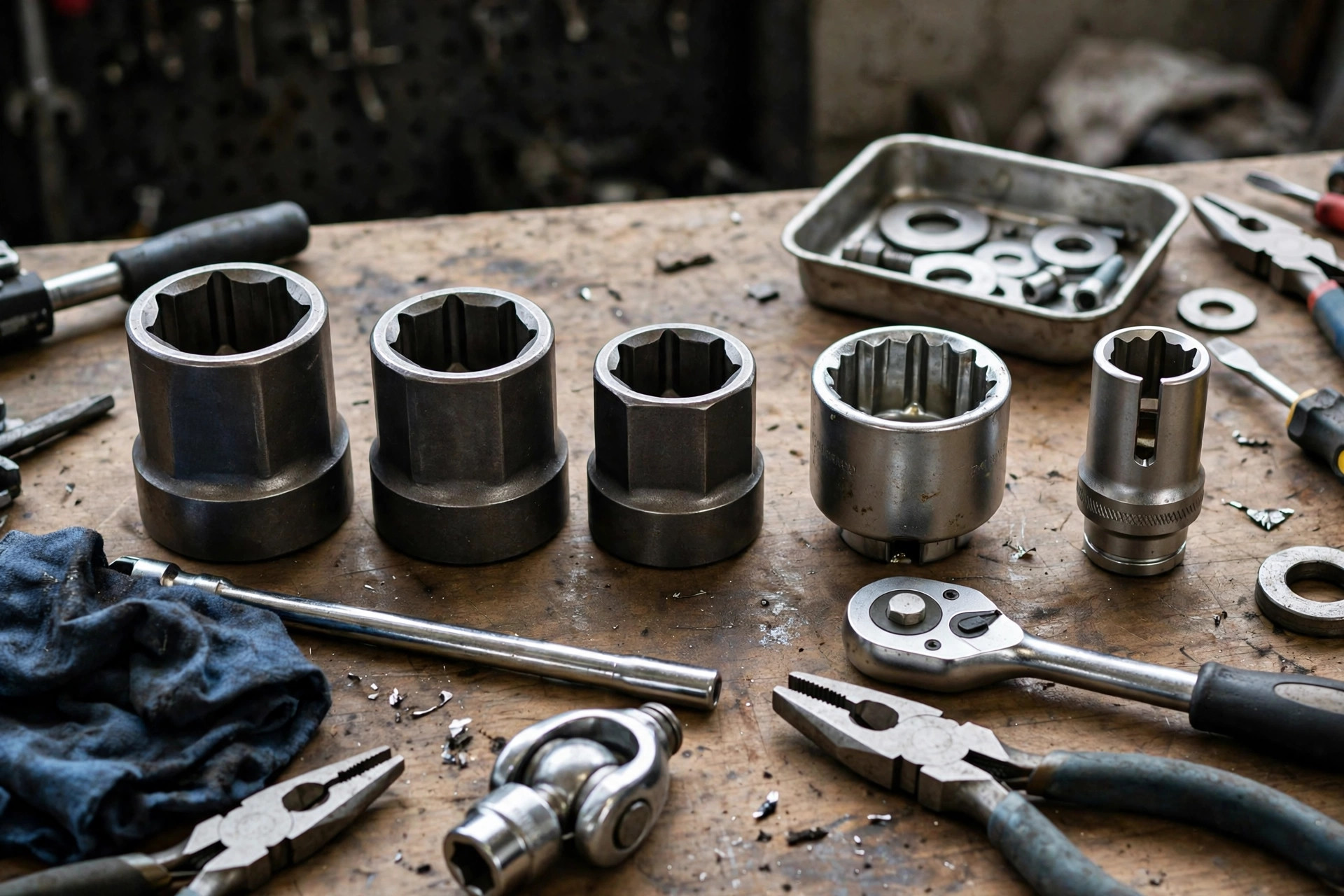
Axle nut sockets are large, deep, 6-point impact-rated sockets, usually in 1/2-inch drive, sold individually in the common sizes. The 6-point design is essential here: at these torque levels, a 12-point socket is a rounding risk you cannot afford, and the impact rating handles both impact wrench use and the shock of breaker-bar loosening. Buy the size your vehicle uses, which you can find in the service manual or by measuring the nut.
Axle nut work almost always accompanies wheel bearing or CV axle replacement, which are among the more involved DIY jobs. The nut must be torqued precisely on reassembly, since bearing preload depends on it, so this is a job where a torque wrench is mandatory, not optional. For the full picture of what surrounds this fastener, see our DIY wheel hub replacement tools and cost guide and our article on hub puller tools for stuck wheel hubs, which covers the next tool you will need when the hub does not want to separate.
Oil Filter Sockets: Cap-Style vs Claw-Style
Modern cars increasingly use cartridge-style oil filters housed in a plastic or metal cap, or spin-on filters tucked into tight spots where a strap wrench cannot swing. The oil filter socket, also called a cap wrench, is a large, shallow socket that fits over the filter cap’s flutes or the spin-on filter’s end, letting you turn it with a ratchet like any other fastener.
Cap-style filter sockets are sized to specific filter applications, common sizes include 64mm, 65mm, 73mm, and 76mm with various flute counts, so you buy the one that fits your car’s filter. The fit should be snug: a loose cap wrench rounds the plastic flutes on cartridge housings, and replacing a damaged housing costs far more than the correct socket. Check your filter size before buying, since close-but-wrong sizes are the main cause of damaged housings.
Claw-style filter wrenches, which grip the filter with spring-loaded jaws, are the universal alternative. They fit a range of filter sizes and work well on spin-on filters in open areas, but they can crush cartridge housings and struggle in tight spots. For most car owners, the dedicated cap socket for their specific vehicle is the better buy: it is cheaper than a housing, faster to use, and impossible to misuse once you have the right size. Our engine oil change intervals and DIY guide puts filter service in its full maintenance context.
O2 Sensor Sockets: The Slotted Solution
Oxygen sensors thread into the exhaust with a wiring harness permanently attached, which creates an obvious problem: a standard deep socket cannot fit over the sensor because the wires are in the way. The O2 sensor socket solves this with a slot cut down one side of the socket wall, through which the wiring passes while the socket engages the sensor’s hex.
The standard size is 7/8-inch, or 22mm, and the sockets come in both standard and offset designs. The offset version angles the drive to clear nearby exhaust plumbing, which matters because O2 sensors live in some of the most crowded real estate on the car. Like axle nut sockets, these are typically 6-point and often impact-rated, since exhaust fasteners are heat-cycled and corroded by nature.
Technique matters as much as the tool. O2 sensors should be removed from a warm, not hot, exhaust when possible, since heat cycling loosens the threads’ grip, and anti-seize on the new sensor’s threads, applied carefully to avoid contaminating the sensor tip, prevents the next replacement from becoming a nightmare. Penetrating oil applied well in advance helps with sensors that have been in place for a decade. The slotted socket is the enabler; patience is the method.
Thin-Wall Lug Sockets and Wheel Locks
We covered thin-wall sockets generally in our tight-engine-bay guide, but lug nuts deserve their specialty mention because wheel locks add a twist. Many cars use locking lug nuts with a unique pattern that requires a matching key, a splined or patterned socket that fits only that lock design. The key is usually stored with the spare tire, and losing it turns a flat tire into a crisis.
Thin-wall lug sockets with protective sleeves are the standard for alloy wheels, and they come in the common lug sizes, 17, 19, and 21mm covering most applications. The sleeve prevents the socket from scratching expensive wheel finishes, which matters because lug holes position the socket in constant light contact with the wheel. If you have aftermarket wheels, verify your lug socket fits the specific lug holes before you need it on the roadside.
Wheel locks themselves are a debated accessory: they deter casual wheel theft but add a failure point, since the key can wear, strip, or get lost. If your car has them, know where the key is, verify it fits before every tire rotation, and consider whether the theft risk in your area justifies the hassle. Our wheel locks and lug nut theft prevention guide examines both sides of that decision.
Other Specialty Sockets Worth Knowing
Beyond the big three, several specialty sockets appear often enough to recognize. Triple-square, also called XZN, sockets fit the 12-point star fasteners common on German cars, particularly VW and Audi, for CV joints, head bolts, and brake components. They look like Torx but are not, and using a Torx bit in a triple-square fastener damages both. If you own a German car, a triple-square set is essential.
Tamper-resistant Torx sockets, with a hole in the center to clear the security pin, appear on mass airflow sensors, some throttle bodies, and various anti-tamper fasteners. External Torx, or E-Torx, sockets fit the inverted star heads found on some engine and transmission fasteners. Neither is expensive, and both prevent the improvisation that damages fasteners.
Large hex-bit sockets, 10mm and up, handle drain plugs, some caliper bolts, and differential fill plugs. A set of hex-bit sockets in 3/8 and 1/2-inch drive is one of the most-used specialty purchases in a home garage. Buy them as needed for your vehicles, prioritizing the sizes your service manual actually calls out.
Buying Specialty Sockets: Individual, Not Sets
The economics of specialty sockets favor individual purchases. A complete specialty set bundles sockets for German, Japanese, and American applications, most of which you will never use. Buying the three or four specialty sockets your actual cars need costs less and wastes no space. Let your vehicles’ service manuals be the shopping list.
Quality matters disproportionately for specialty sockets because they are used in high-stakes situations: heat-cycled exhaust fasteners, high-torque axle nuts, fragile plastic filter housings. A cheap O2 sensor socket with sloppy tolerances rounds the sensor hex and turns a twenty-minute job into an exhaust-manifold nightmare. This is a category where the mid-range reputable brand is the minimum sensible buy.
Store specialty sockets with the job they serve, not mixed into the general socket case. The axle nut socket lives with the driveline tools, the oil filter socket lives with the oil change supplies, the O2 sensor socket lives with the exhaust tools. Specialty sockets are defined by their applications, and storing them by application means they are found when needed.
The Verdict: Specialists for Special Jobs
Specialty sockets are the tools you buy when a general socket set meets its limits: axle nuts too big, filters too fragile, sensors with wires in the way, locks with unique patterns. Each one solves a specific problem completely, and each one is bought individually, in good quality, for the vehicles you actually own.
Start with the ones your cars demand: the oil filter socket for your filter size, the axle nut socket if you do driveline work, the O2 sensor socket when exhaust service looms. Add triple-square or E-Torx if your vehicles call for them. A small collection of the right specialists, stored with their jobs and bought in quality that matches their stakes, completes a socket kit that a general set alone cannot finish.
Related posts:



This is one stop in the Maintenance & Repair garage. Plenty more models, guides and stories are parked in the same category.
Share this with a fellow driver or enthusiast who needs to see it.

