
- Why Loose Tools Are Genuinely Dangerous
- Tool Rolls vs Boxes vs Bags: Picking Your Container
- Securing Heavy Items: The Non-Negotiables
- Silencing the Rattle: Foam, Felt, and Fit
- Small Parts: Sockets, Bits, and Fasteners
- Visibility, Access, and the Everyday Kit
A trunk full of loose tools is a hazard wearing a disguise. Every wrench, hammer, and screwdriver becomes a projectile in a sudden stop, and the collective rattle drives even patient drivers to distraction. Yet plenty of us carry tools daily: the DIY enthusiast heading to a weekend project, the homeowner who likes being prepared, the hobbyist whose trunk doubles as a mobile workshop. The challenge is keeping tools accessible, silent, and safe without turning the trunk into a toolbox that eats the whole cargo area.
This guide covers practical tool storage for trunks: choosing between tool rolls, boxes, and bags, securing heavy items so they cannot move, silencing the rattle, and organizing small parts so you can actually find the right socket. Safety runs through everything here, because unsecured tools are genuinely dangerous. For the broader principles of keeping heavy cargo put, see our guide to securing cargo safely, and our breakdown of cargo nets and tie-down anchors for the hardware that holds it all down.
Why Loose Tools Are Genuinely Dangerous
The physics of a crash do not care that your hammer was just sitting there. In a 30-mph collision, a five-pound tool can strike with hundreds of pounds of force, and the trunk is directly behind the passenger compartment in most vehicles. Even without a crash, a hard brake sends unsecured tools flying forward, where they can smash through the rear seat or shatter the rear glass. This is not theoretical; emergency rooms see these injuries.
Beyond safety, loose tools destroy trunks. Metal edges gouge plastic trim, dent the trunk floor, and tear liners. The rattle is the audible symptom of tools hammering your car to pieces one bump at a time. Every tool in your trunk should have a designated home that holds it still. If you can hear your tools while driving, your storage has already failed, and the fix is containment, not tolerance.
Tool Rolls vs Boxes vs Bags: Picking Your Container
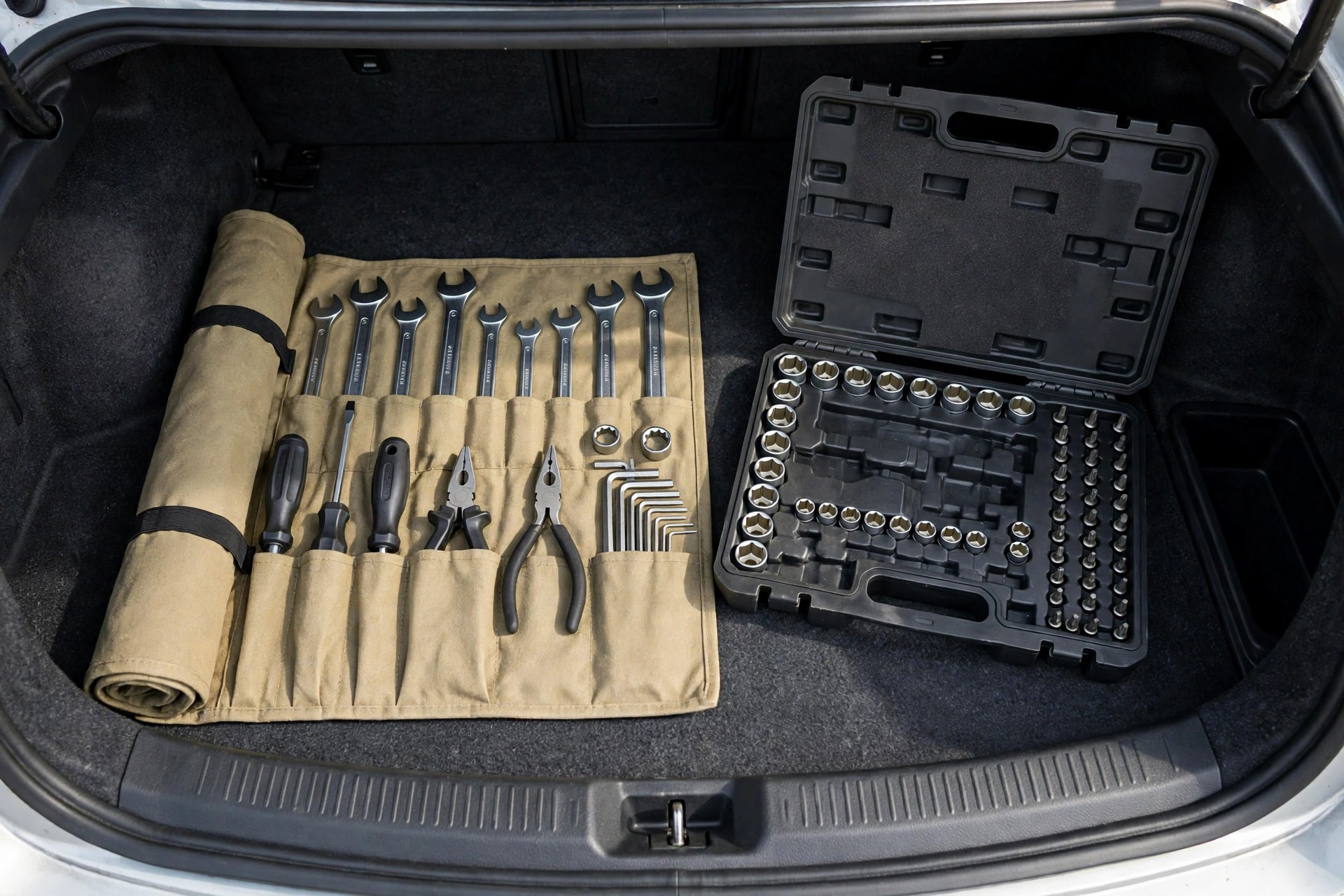
Tool rolls are the minimalist’s choice: canvas or leather wraps with individual pockets that roll into a compact bundle. They excel for wrenches, sockets, and screwdrivers, keeping each tool separated and silent, and they conform to odd trunk corners. Their weakness is capacity; a roll holds a curated kit, not a workshop, and heavy items like hammers do not roll well.
Hard toolboxes offer the most protection and the best small-parts organization, with molded compartments that keep sockets sorted. But a traditional cantilever toolbox is bulky and its metal latches rattle. Modern plastic toolboxes with soft-close latches are quieter and lighter. Tool bags, the soft-sided middle ground, swallow irregular loads and squeeze into gaps, but let heavy tools shift unless packed tightly. For most trunk kits, the winning combo is a tool roll for hand tools plus a small hard case for sockets and bits.
Securing Heavy Items: The Non-Negotiables
Anything over a few pounds needs positive restraint, not just containment. A toolbox sitting loose in the trunk is a container full of projectiles; strapped down, it is cargo. Run a cam strap through the toolbox handle and anchor it to a factory tie-down point. Heavy items like floor jacks, breaker bars, and battery packs belong on the trunk floor against the back seat, the lowest and most forward position, where physics is kindest in a frontal impact.
Never stack heavy tools on top of light ones where they can fall, and never place heavy items where they can slide sideways into the wheel wells. If your trunk lacks useful anchor points, that is a solvable problem; adding proper hardware is covered in our guide to cargo nets and tie-down anchors. Before any trip with a loaded tool kit, a quick pass through our pre-trip inspection checklist is cheap insurance that the car is as ready as the cargo.
Silencing the Rattle: Foam, Felt, and Fit
Rattle comes from metal hitting metal or metal hitting hard plastic, so the cure is separation and padding. Kaizen foam or pick-and-pluck foam inserts, cut to fit your toolbox drawers, hold each tool in its own pocket and eliminate movement entirely. It is the single biggest upgrade you can make to a rattling kit. For tool rolls, the individual pockets already solve the problem; just make sure the roll is cinched tight.
For the container itself, line the trunk floor under the toolbox with a rubber mat or a section of non-slip shelf liner. Wrap rarely-used heavy items in old towels or felt bags. Check latches and hinges, which are common rattle sources independent of the tools inside; a strip of adhesive felt on a rattling latch works wonders. The goal is a simple test: shake the loaded container. If you hear anything, something still has room to move.
Small Parts: Sockets, Bits, and Fasteners
Small parts are where tool kits go to die. A jumbled pile of sockets means every job starts with a treasure hunt, and loose fasteners migrate into trunk carpet forever. Use a socket rail or a molded socket organizer that holds each size in order; the visual gap where a socket should be also tells you instantly if one is missing. Label the rails if you carry both metric and SAE to avoid the classic wrong-socket frustration.
For fasteners, screws, and bits, small compartment boxes with secure latches beat zip bags, which split and spill. Keep one box for the fasteners you actually use and resist the urge to carry a hardware store. A magnetic parts tray in the trunk is a small luxury that pays off every time you remove a bolt and need somewhere it cannot roll away from. At the end of each project, the rule is simple: every tool returns to its pocket before the trunk closes.
Visibility, Access, and the Everyday Kit
A tool kit you cannot find in the dark is a decoration. Store the everyday kit where you can reach it without unloading the trunk, ideally right inside the opening or in an underfloor compartment. A headlamp or a small flashlight stored with the tools matters more than any organizer feature; most roadside repairs happen in bad light.
Keep the everyday kit lean: the tools that solve 90 percent of problems, not the ones for jobs you might do someday. A compact socket set, a multi-bit screwdriver, pliers, a utility knife, zip ties, electrical tape, and a tire pressure gauge cover most roadside and DIY scenarios. The specialty tools live in the garage until a specific project calls for them. A trunk kit should be a first responder, not a warehouse, and keeping it lean keeps it quiet, light, and genuinely useful.
Rattle-free, safe tool storage is not complicated: every tool gets a pocket, every heavy item gets a strap, and the kit stays lean enough to actually use. Tool rolls and foam inserts silence the noise, cam straps neutralize the danger, and a disciplined return-to-pocket habit keeps the system working. Your trunk can carry a capable workshop without sounding like a toolbox in a cement mixer, and without turning every hard brake into a safety incident.
Related posts:



Cars like these are part of a bigger Maintenance & Repair story — Trunk Lighting Upgrades: LED Strips, Motion Sensors, and Battery-Safe Wiring tells the next chapter.
Found this useful? Pass it on to a friend who would appreciate it too.

