
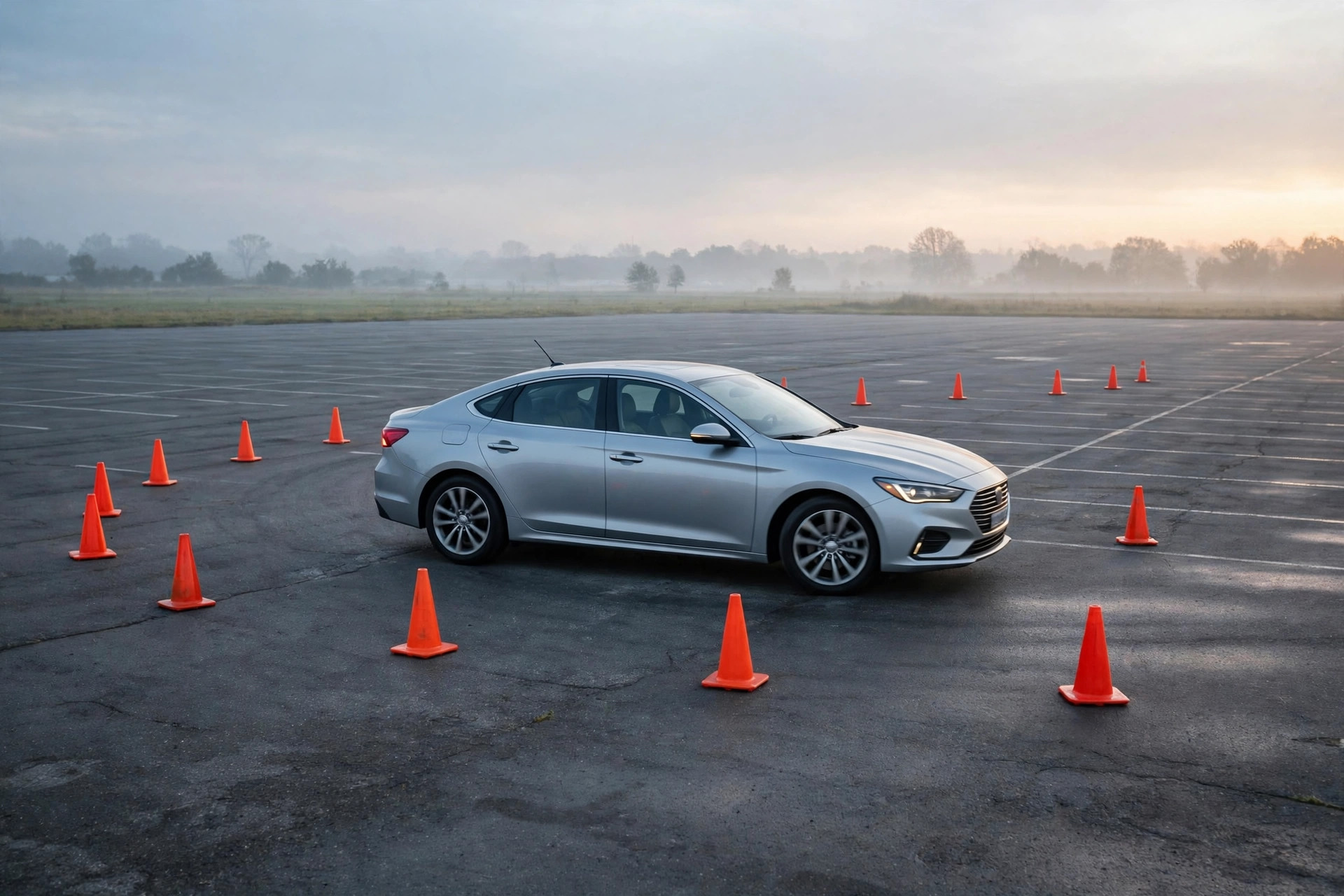
Before you ever pay for track time, the humble empty parking lot can teach you the foundations of car control, and this guide explains how beginners can use that space safely and legally, who needs to give permission, and which drills actually build skill. Every professional drifter started somewhere unglamorous, sliding around cones in an empty space, learning what their car does at the limit. With the right approach, a parking lot is the safest, cheapest classroom in motorsports.
The key words are safe and legal. This guide shows you how to practice car control in empty lots without breaking laws, endangering anyone, or giving the sport a bad name. Done right, parking lot practice builds the skills that make your first track day dramatically more productive.
Why Empty Lots Are Perfect for Learning
Empty lots offer what beginners need most: space, low speeds, and zero pressure. Without walls, other cars, or timing equipment, you can focus entirely on feeling the car. Mistakes cost nothing but pride; a spin in an empty lot is a lesson, while a spin at a track day can end your session.
This freedom to fail is what makes lot practice so valuable. The low speeds of lot practice are a feature, not a limitation. Car control fundamentals, weight transfer, throttle modulation, and counter-steering, are identical at 20 mph and 60 mph.
Learning them slowly means your reactions are trained before speed raises the stakes. Drivers who master low-speed control adapt to track speeds far faster than those who try to learn everything at once. The underlying principles are the same ones described in vehicle dynamics, just explored at a forgiving pace.
Lots are also free and available on your schedule. Track days require entry fees, travel, and scheduling; a parking lot session requires only permission and cones. This accessibility means you can practice frequently, and frequency is what builds muscle memory.
Three short lot sessions teach more than one exhausting track day for a raw beginner.
Staying Legal: Permission Matters
The most important rule of parking lot practice is simple: get permission. Practicing without permission is trespassing in most jurisdictions, and getting caught can mean fines, a towed car, or worse. Worse still, illegal street and lot sliding is what gets venues shut down and gives drifting a bad reputation in the community.
Always practice with the property owner’s explicit consent. Finding legal spots takes effort but is entirely possible. Industrial parks on weekends, closed businesses, and church lots on weekdays are classic options.
Approach the owners or managers politely, explain what you want to do, and offer to sign a liability waiver. Some will say no, but many will say yes, especially if you promise to keep it quiet, clean, and safe. Organized autocross clubs also rent lots regularly and welcome newcomers.
Document your permission. A text message or email from the property owner is enough to show law enforcement if they stop by. Practice during daylight hours, keep noise reasonable, and leave the lot cleaner than you found it.
The drivers who maintain good relationships with property owners keep their practice spots for years. Those who abuse the privilege lose them for everyone.
Essential Car Control Drills and the Figure Eight
Start with the circle drill: drive in a constant-radius circle, gradually increasing speed until the car begins to understeer, then practice balancing the throttle to hold the car at the edge of grip. This teaches you to feel the tires’ limits through the steering wheel and seat. Progress to deliberately inducing small slides with the handbrake and catching them with counter-steer.
The slalom drill builds steering precision. Set cones in a straight line and weave through them, first with grip driving, then with increasing aggression. Focus on smooth, early inputs rather than speed; the goal is to teach your hands to move the wheel quickly and accurately.
As you improve, try flicking the car into small slides between cones and catching each one. The emergency lane change drill teaches weight transfer management. At moderate speed, swerve around an imaginary obstacle and recover cleanly.
This drill reveals how your car behaves when weight shifts suddenly, which is exactly what happens during drift transitions. Practice until the recovery feels automatic, because automatic reactions are what save you when a real drift goes wrong. A simple practice session can be organised around a short set of drills:
- Circle drill: hold a constant-radius circle at the edge of grip and balance the car on the throttle.
- Handbrake slides: induce small slides deliberately and catch each one with counter-steer.
- Slalom: weave through cones with smooth, early steering, then add small slides between cones.
- Emergency lane change: swerve around an imaginary obstacle at moderate speed and recover cleanly.
- Figure eight: link a left slide and a right slide around two markers in one continuous run.
The figure eight is the single most valuable drill in drifting. Set two cones or markers about 50 feet apart and drive a continuous figure eight around them, transitioning from a left slide to a right slide at the center. This one drill teaches initiation, sustained sliding, transitions, and throttle control all at once.
Drivers at every level, from first-timers to professionals, practice figure eights. Start with grip driving the figure eight to learn the line, then introduce small slides at the turnaround points. Gradually increase the slide angle and link the transitions more tightly.
The key skill is the transition: as you pass the center, you must unwind the steering, let the car’s weight shift, and initiate the opposite slide smoothly. Jerky transitions spin the car; smooth ones feel like dancing. Time yourself informally to track progress, but prioritize smoothness over speed.
A slow, clean figure eight with linked slides is worth more than a fast, sloppy one. When you can run continuous linked figure eights for several minutes without spinning, you have the car control foundation to be productive at a real drift event. Many instructors consider this the graduation test for lot practice.
What Not to Do in Parking Lots
Never practice near other people, parked cars, or light poles. Choose the emptiest part of the lot and maintain generous margins from every obstacle. It takes only one misjudged slide to turn a practice session into an insurance claim.
Walk your practice area first and identify every hazard, including drainage grates, curbs, and uneven surfaces. Do not practice at night in unlit lots. Poor visibility hides obstacles and makes it impossible for others to see you.
Do not practice in the rain unless you specifically want to learn wet car control, and even then, be aware that wet lots hide their hazards. Do not invite spectators to stand near your driving area; an audience encourages showing off, and showing off causes crashes. Resist the urge to push beyond your skill level for fun.
The lot is for deliberate practice, not for impressing friends or filming content. Every crash in a practice lot is a crash that did not need to happen, and crashes have a way of ending practice spots permanently. Discipline in the lot builds the habits that keep you safe at the track.
Knowing When to Progress and Moving to the Track
Progress deliberately through skill stages. Stage one is car control: circles, slaloms, and catching small slides. Stage two is sustained sliding: holding a drift through a full circle and linking figure eights.
Stage three is precision: hitting specific marks, controlling angle, and transitioning on demand. Do not rush; each stage typically takes several sessions to consolidate. Honest self-assessment is essential.
Can you hold a slide for a full circle without spinning nine times out of ten? Can you transition both directions equally well? Most drivers have a strong side and a weak side; identify yours and drill the weak side until the gap closes.
Video your sessions and review them critically, because what you feel in the car often differs from what actually happened. Seek feedback when possible. An experienced driver watching from the sidelines can spot issues you cannot feel.
Many local drift communities have informal mentorship cultures; ask respectfully and offer to help with their car in return. A single afternoon with a good coach can correct habits that would otherwise take months to unlearn. You are ready for a track day when lot drills feel easy and boring.
If figure eights are automatic, if you catch slides without thinking, and if you are craving higher speeds and real corners, it is time. Your first track event will still humble you; tracks add speed, elevation, and other cars to the equation. But your lot-built foundation means you will spend the day learning the track instead of learning to slide.
Choose a beginner-friendly event for your debut. Look for practice days with instructor support and separate run groups for novices. Bring your cones mindset: focus on learning the line and building speed gradually.
The track rewards the same smoothness you practiced in the lot, just at higher velocity. Keep practicing in lots even after you start doing track days. Lots remain the best place to experiment with new techniques, test setup changes, and drill weaknesses without the pressure and cost of track time.
The best drivers never outgrow fundamentals; they just practice them at higher levels. Whether you dream of gymkhana-style precision or the underground energy of street drifting scenes, every master started with cones in an empty space. Simulation helps too; drifting simulators let you practice car control theory between real sessions, and even RC drift cars teach the same weight transfer principles at 1/10 scale.
Taken together, those habits turn an empty lot into far more than a convenient patch of asphalt. With permission secured, drills chosen deliberately, and progress judged honestly, lot practice gives you car control you can trust. That trust is what you carry with you when the cones are replaced by a real circuit.
Related posts:


Whether you wrench, drive or just admire, the Driving & Road Trips category has more miles to offer.
Share this with a fellow driver or enthusiast who needs to see it.

