
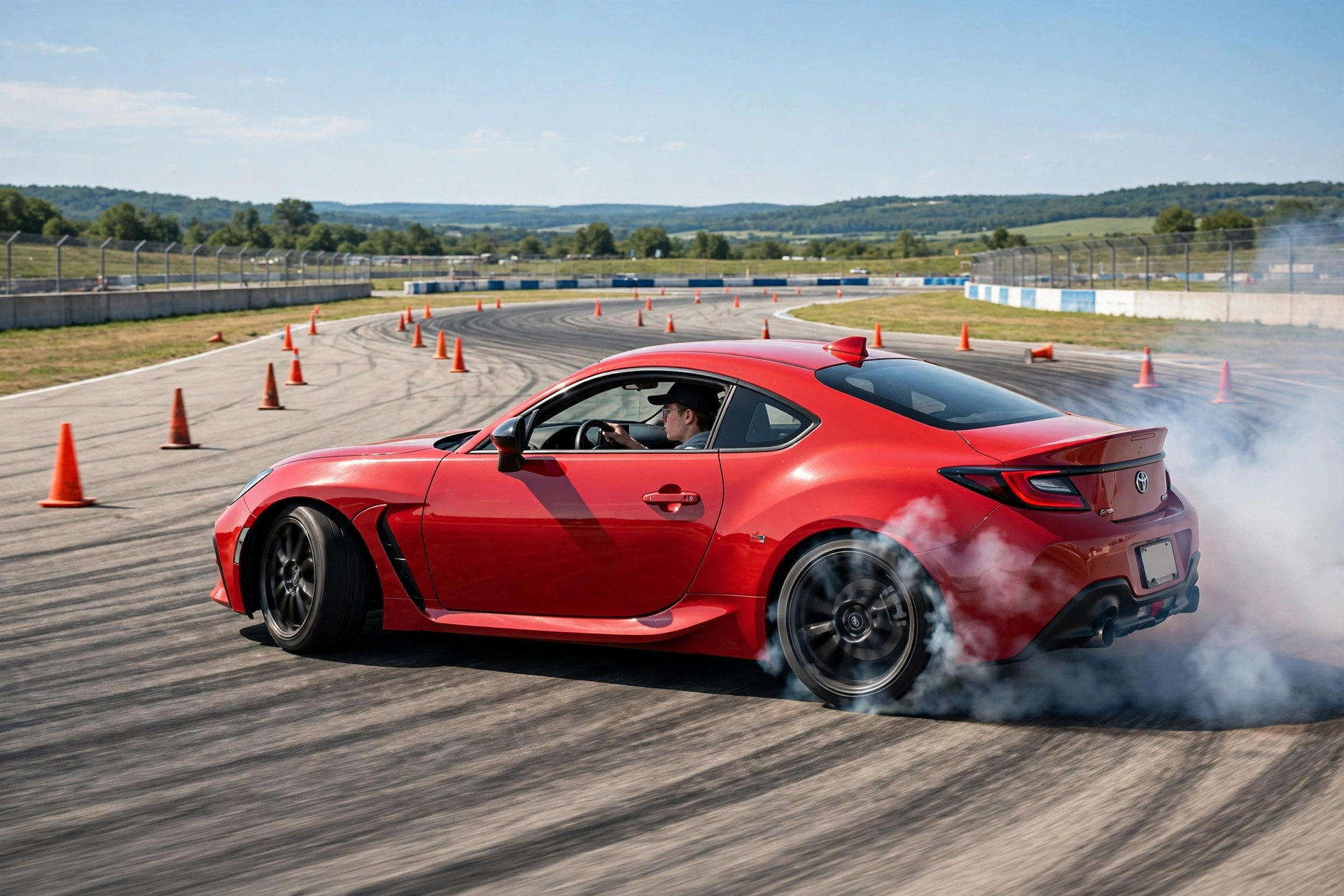
Every drifter makes the same mistakes when starting out, and a beginner who wants to improve quickly needs to know what those errors are, why they happen, and how to fix them before they become habits. The difference between drivers who improve quickly and those who plateau for years is not talent; it is how fast they identify and correct these classic errors. This guide catalogs the seven mistakes that plague nearly every beginner, explains why they happen, and gives you concrete fixes for each one.
Read this honestly and look for yourself in every section. The mistakes you recognize are the ones holding you back, and fixing them is the fastest path to better drifting.
Key Takeaways
- Mistake 1: Too Much Speed, and Mistake 2: Half-Hearted Initiations — Beginners almost always carry too much speed into corners.
- Mistake 3: Looking at the Wrong Place, and Mistake 4: Binary Throttle Control — Where you look determines where you go, and beginners look in all the wrong places: at the wall they fear, at the cone they just hit, at…
- Mistake 5: Fighting the Steering Wheel, and Mistake 6: Blaming the Car Setup — Beginners either saw at the wheel frantically or freeze with a death grip; both are wrong.
- Mistake 7: Letting Ego Drive — Ego is the most dangerous mistake because it causes all the others.
- A Framework for Fixing Any Mistake — Fix mistakes systematically with a simple framework.
Mistake 1: Too Much Speed, and Mistake 2: Half-Hearted Initiations
Beginners almost always carry too much speed into corners. It feels fast, it looks aggressive, and it ends with the car straightening, spinning, or sailing past the clipping point. Speed is seductive because it mimics what professionals do, but professionals carry speed because their car control supports it.
Without that foundation, speed just compresses your reaction time and magnifies every error. The fix is embarrassingly simple: slow down. Enter corners 10 to 15 mph slower than your instincts suggest and focus on executing the technique cleanly.
You will be amazed how much more angle and control you have when you are not rushing. Speed is the last ingredient to add, not the first; build the technique slowly, then let speed come naturally as your competence grows. Use a simple rule: if you spin or straighten more than once every few runs, you are going too fast.
Back the entry speed down until you can complete runs consistently, then increase speed in small increments. Consistent slow drifting always beats inconsistent fast drifting, both for learning and for judges’ scores. The tentative initiation, by contrast, is the hallmark of the beginner in a different way: a half-hearted handbrake pull, a timid clutch kick, a hesitant turn-in.
The car responds with a wobble instead of a slide, and the driver spends the rest of the corner trying to rescue something that never properly started. Drifting, as described in overviews of drifting (motorsport), rewards commitment; a decisive initiation that is slightly too aggressive is easier to manage than a timid one that never gets going. This mistake comes from fear, which is completely rational.
Initiating a drift means deliberately destabilizing your car, and your survival instincts object. The fix is to practice initiations as an isolated drill in a safe, open area until the motion feels routine. When the physical action is automatic, the fear loses its grip on your timing.
Commit to a simple mantra: initiate like you mean it. Turn in decisively, apply the technique firmly, and trust your hands to catch the result. You will spin sometimes; that is the tuition fee for learning.
But every committed initiation teaches you something, while every timid one teaches you nothing except how to wobble.
Mistake 3: Looking at the Wrong Place, and Mistake 4: Binary Throttle Control
Where you look determines where you go, and beginners look in all the wrong places: at the wall they fear, at the cone they just hit, at the hood of their own car. Your hands follow your eyes with uncanny precision, so looking at hazards steers you into them. This is not mystical advice; it is neurology, and it is the single most impactful fix most beginners can make.
Train yourself to look through the corner to the exit, even when the car is sideways and the exit seems impossibly far away. During transitions, look at where the next slide needs to go, not at the slide you are leaving. When you feel lost mid-drift, the answer is almost always to look further ahead.
A useful drill is to narrate your vision: as you drive, say out loud where you are looking. This conscious practice builds the habit of active vision management. Within a few sessions, looking ahead becomes automatic, and you will wonder how you ever drove while staring at your own front bumper.
Beginner throttle control tends to be binary: full throttle or no throttle, with nothing in between. Full throttle spins the car; no throttle kills the slide. The entire art of drift throttle control lives in the middle ground, the partial throttle positions that balance the slide.
If your right foot only knows two positions, your drifts will always be chaotic. The fix is to practice throttle modulation as a dedicated skill. In a safe area, hold a slide and experiment with tiny throttle adjustments, feeling how each change affects the car’s angle.
Learn the feathering technique: rapid small throttle pulses that maintain wheelspin without overwhelming grip. Think of the throttle as a dimmer switch, not an on-off button. Pay attention to your foot’s tension.
Beginners often brace their leg rigidly, which destroys fine control. Consciously relax your ankle and make inputs from the ankle joint rather than the whole leg. Smooth throttle is quiet throttle; if your engine note is constantly screaming and dying, your foot is working too hard.
Mistake 5: Fighting the Steering Wheel, and Mistake 6: Blaming the Car Setup
Beginners either saw at the wheel frantically or freeze with a death grip; both are wrong. Sawing creates jerky weight transfers that destabilize the car, while freezing prevents the quick corrections that slides demand. Good steering is smooth, deliberate, and relaxed, with inputs sized to match the slide.
The root cause is usually tension. When you are scared, your shoulders rise, your grip tightens, and your movements become abrupt. Consciously drop your shoulders, loosen your grip, and breathe.
It sounds like yoga advice because it is: relaxed muscles move faster and more precisely than tense ones. Practice letting the wheel work. With proper alignment, the steering naturally self-centers during transitions; guide it rather than forcing it.
Drill the hand shuffle until the big unwind motions feel fluid. And remember the vision connection: when your eyes are ahead, your hands calm down automatically. Fix the eyes, and the hands often fix themselves.
When beginners struggle, they often blame the car: it needs more power, more angle, better coilovers. Sometimes the car genuinely needs work, but far more often the driver needs seat time. A stock car with a welded differential is capable of far more than most beginners can extract from it.
Upgrading the car to compensate for skill gaps is expensive and counterproductive. The diagnostic question is simple: can a better driver drift your car? If an experienced driver can slide your car cleanly, the car is fine and the limitation is you.
This is actually good news, because skill is free to develop while parts cost money. Invest in seat time before parts, always. There is a time for modifications, but it comes after you can consistently perform the fundamentals.
When you genuinely outdrive the car, you will know, because the limitation will be specific and repeatable, not vague frustration. Until then, the best modification is practice. The drift missile ethos captures this perfectly: beat-up cars with sorted basics and skilled drivers embarrass expensive builds regularly.
The same discipline of separating a genuine fault from a skill gap applies when reading reports such as 2026 Lamborghini Truck Problems and 2026 Cadillac Convertible Problems. In drifting, the honest answer is usually seat time.
Mistake 7: Letting Ego Drive
Ego is the most dangerous mistake because it causes all the others. Ego makes you enter too fast to impress spectators, attempt tandem before you are ready, and refuse advice from better drivers. It turns practice days into performance anxiety and transforms other drivers from resources into rivals.
The drift community has a term for it: the fastest way to stop improving is to decide you have arrived. The fix is humility as a practice. Ask faster drivers for advice and actually listen.
Volunteer to ride along and feel what good driving is like from the passenger seat. Admit your mistakes out loud; saying “I spun because I entered too hot” is the first step to entering correctly next time. Remember why you started: because sliding a car is fun.
The moment drifting becomes about image rather than joy, you have lost the plot. The drivers everyone respects are not the flashiest but the most helpful, the most consistent, and the most honest about their own driving. Be that driver from day one, and the community will invest in your progress.
A Framework for Fixing Any Mistake
Fix mistakes systematically with a simple framework. First, identify: after each session, write down the one thing that went wrong most often. Be specific; “I suck at drifting” is useless, but “I spin on right-hand transitions” is actionable.
Video review makes this dramatically easier, so record whenever possible. Second, isolate: design a drill that targets the specific weakness. Spinning on transitions? Practice figure eights focusing only on the transition moment.
Binary throttle? Do an entire session at partial throttle. Isolated practice fixes problems ten times faster than just doing more laps hoping things improve. In practice, the framework looks like this:
- Identify: after each session, write down the one specific thing that went wrong most often and review video whenever possible.
- Isolate: design a drill that targets only that weakness, such as figure eights for transitions or a full session at partial throttle.
- Verify: test the fix under slightly harder conditions and confirm the improvement sticks before moving to the next weakness.
Third, verify: test the fix under slightly harder conditions and confirm the improvement sticks. Then move to the next weakness. This methodical approach is how professionals train, and it works at every level.
Study how the greats analyze their own driving, from Ken Block’s precision to the digital lessons in simulator training guides, and you will see the same pattern: identify, isolate, verify, repeat. Even the wildest missile-style builds are driven by people who fixed their mistakes one by one. Follow that same patient pattern yourself, and the mistakes in this guide stop being a verdict on your talent and become simply the next useful thing to work on.
Related posts:


Cars like these are part of a bigger Maintenance & Repair story — Drift Car Setup Basics: Suspension, Differential, and Angle Kits tells the next chapter.
Share this with a fellow driver or enthusiast who needs to see it.

