
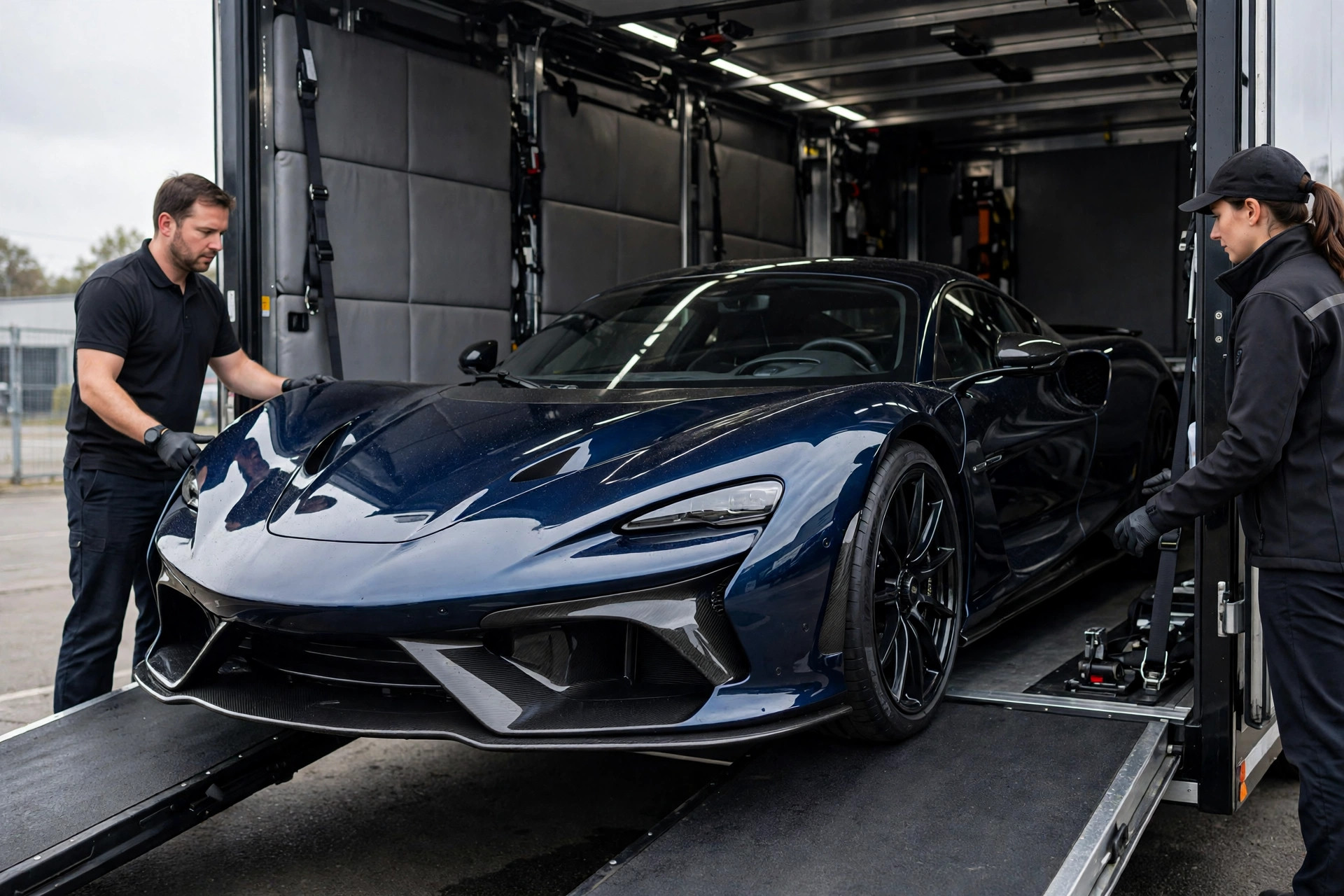
If you need to transport a show car without undoing hours of preparation, an enclosed trailer is how serious competitors do it, and this guide explains how to choose one, set it up, and use it safely. Every mile a show car travels under its own power is a mile of rock chips, bug strikes, and road grime working against your preparation. That is why serious competitors trailer their cars. The enclosed trailer has become as much a part of show culture as the buffer and the microfiber towel.
Trailering is not about being precious; it is about arriving with the car in the condition you prepared it in. But a trailer is only as good as how you use it. Poor tie-downs damage suspensions, bad loading scrapes splitters, and an overheated trailer cooks interiors. This guide covers choosing the right trailer, setting it up, loading and securing the car, and arriving ready to show.
For longer hauls, the planning discipline of a road trip planning guide applies just as much to trailer trips as to driving trips. The vehicle doing the hauling is, in the broad sense covered by Trailer (vehicle), a trailer setup that has to be matched to the load, the tow vehicle, and the distance. Getting that match right is where safe trips begin.
Key Takeaways
- Why Trailer Instead of Drive — The math is simple: a concours-level detail takes dozens of hours, and a single highway drive can undo the most vulnerable parts of it.
- Open Versus Enclosed Trailers — Enclosed trailers are the show standard for serious cars.
- Trailer Setup and Tie-Downs — The interior setup matters as much as the trailer itself.
- On the Road With a Trailer — Towing changes everything about driving: longer stopping distances, wider turns, reduced visibility, and constant awareness of the…
- Arriving Ready to Show — The payoff of trailering is the arrival: the car rolls out clean, and show morning is a touch-up, not a rescue.
Why Trailer Instead of Drive
The math is simple: a concours-level detail takes dozens of hours, and a single highway drive can undo the most vulnerable parts of it. Rock chips in fresh paint, rubber marks from highway debris, brake dust baked on during a long drive, and the general film of road travel all cost points or cost rework. Owners who have invested in a full classic car restoration understand this math best, because trailering protects work that took years to complete. For local shows, driving in and doing a touch-up is perfectly reasonable.
For judged events where you have invested serious preparation, trailering protects the investment. Weather is the other argument. A surprise rainstorm on the way to the show turns a detailed car into a spotting nightmare, and hail is the nightmare scenario that keeps trailer owners smug. An enclosed trailer is climate-controlled peace of mind: the car arrives exactly as it left the garage, regardless of what the sky did in between.
For owners who have spent months preparing, that certainty is worth the trailer’s cost. There is also the mechanical kindness. Trailer queens stay trailer queens partly because trailering avoids the wear of highway miles: no stone chips, no heat cycles on fresh paint, and no risk of a roadside failure far from home. None of this means a show car should never be driven; many competitors drive their cars locally and trailer only to major events.
The trailer is a tool for the events that matter most. Open trailers are affordable, light, and easy to tow, but they leave the car exposed to weather, road debris, and prying eyes. For a driver-quality show car heading to local events, an open trailer is a reasonable compromise, especially with a quality car cover for the highway portions. The car will need a wipe-down on arrival, but the major protection against chips and breakdowns is there.
Open Versus Enclosed Trailers
Enclosed trailers are the show standard for serious cars. Full protection from weather and debris, security for the car and the spares inside, and a rolling garage that doubles as a preparation space at the venue. The downsides are cost, weight, and size: enclosed trailers need a capable tow vehicle, cost significantly more, and require storage space. For competitors doing a full season of judged shows, the investment pays for itself in preserved preparation.
Whichever you choose, buy for the car’s dimensions plus margin. Measure the car’s length, width including mirrors, and height, then add room for opening doors inside the trailer and for your equipment. A trailer that fits the car exactly is a trailer you will curse at every loading. The most common buyer regret is going too small; the second most common is going too cheap on the tie-down and interior fittings.
Towing figures matter just as much here as they do in any towing comparison, whether you are checking a guide such as 2026 Acura Convertible Towing Capacity or working through the questions raised in Towing Capacity Aston Martin Pickup: Reality and Analysis. The principle does not change with the vehicle. You need honest capacity, honest weight, and margin to spare.
Trailer Setup and Tie-Downs
The interior setup matters as much as the trailer itself. Install quality E-track or D-rings positioned for your car’s wheelbase, and use proper wheel nets or over-tire straps rather than hooking to suspension components. Strapping through the wheels or over the tires secures the car without stressing the suspension, which is how professionals do it. Axle straps are the fallback where wheel nets do not fit, but never hook to control arms, tie rods, or anything that can bend.
Protect the car’s finish inside the trailer. Soft straps with protective sleeves, fender covers for the loading process, and padding anywhere the car might contact the trailer walls all help. Keep the interior clean and organized: loose tools become projectiles in a panic stop, and a flying wrench does not care that the car is a showpiece. Everything in the trailer should be secured as carefully as the car.
Ventilation and climate deserve thought. Enclosed trailers get hot in the sun, and heat plus a fresh detail can mean outgassing on the glass and softening of fresh dressings. Roof vents help enormously, and parking the trailer in shade at the venue matters. In winter, make sure fluids are appropriate for the temperatures the trailer will see, because a frozen trailer is a cold soak the car was not prepared for.
Loading is where trailer damage happens, so make it a ritual. A careful loading and securing routine looks like this:
- Use long, gentle ramps to keep the approach angle shallow, especially for lowered cars, with a spotter guiding you slowly into place.
- Position the car for proper tongue weight: roughly ten to fifteen percent of the total trailer weight should rest on the hitch.
- Set the parking brake or leave the car in gear, then attach straps and tension them evenly.
- Do a final walk-around checking every strap, every door, the hood and trunk latches, and anything that could move.
Race ramps or extended ramp setups prevent the splitter-scraping that ruins show mornings. Have a spotter guide you, go slowly, and stop if anything looks wrong. The five extra minutes of careful loading beat the five months of repairing a scraped front end. Too little tongue weight causes dangerous trailer sway; too much overloads the tow vehicle’s rear.
Load the car slightly forward of the trailer axles as a starting point, then verify with a tongue weight scale until you know the setup. Mark the floor where the car sits when the balance is right, so every loading is consistent. On unloading, reverse the process with the same care. Most trailer incidents happen during loading and unloading, not on the highway, because that is when attention relaxes.
On the Road With a Trailer
Towing changes everything about driving: longer stopping distances, wider turns, reduced visibility, and constant awareness of the trailer’s behavior. Keep speeds moderate, increase following distance dramatically, and plan fuel stops at stations with trailer-friendly access. Check the straps, tires, and lights at every stop; straps loosen as the car settles. Catching a loose strap early prevents a disaster later.
Watch the weather and plan around it. High winds are the enemy of enclosed trailers, which present a big sail area to crosswinds. If the forecast shows severe weather on your route, delaying departure is always cheaper than recovering from an incident. The show will still be there tomorrow; the car might not be if you push through a storm.
Know your rig’s limits and your own. Trailer sway, tire blowouts, and brake fade are all manageable if you stay calm and know the procedures: ease off the throttle for sway, grip firmly and slow gradually for a blowout, and use engine braking on descents. A little training, whether from an experienced tower or a towing course, pays for itself the first time something unexpected happens.
Arriving Ready to Show
The payoff of trailering is the arrival: the car rolls out clean, and show morning is a touch-up, not a rescue. The arrival routine follows the same principles as any complete car detailing guide, just compressed into the hour before judging. Unload carefully, position the car in your assigned spot, and do the standard wipe-down to remove any dust from the trailer and the unloading process. Check the tire pressures, which change with temperature, and give the car a final walk-around before opening everything up for judging.
Use the trailer as your base of operations. It holds your detailing kit, your chairs, your spares, and your shade, keeping the display area around the car clean. Many competitors set up a small workstation inside or beside the trailer for last-minute touch-ups, which keeps supplies out of sight and the presentation sharp. The trailer earns its keep all weekend, not just on the highway.
Before the trip home, do a post-show inspection. Check for any new chips, verify the straps and trailer are still sound, and load with the same care as the outbound trip. The season is long, and the trailer program works only if the equipment is maintained. A well-run trailer operation becomes invisible: the car just always arrives perfect, and nobody thinks about why, which is exactly the point.
Related posts:
Finished here? Hitch Bike Racks for RVs and Travel Trailers: Ratings, Clearance, and Bounce is the most natural next drive from this page.
Bookmark this guide — it will come in handy in the garage.

