
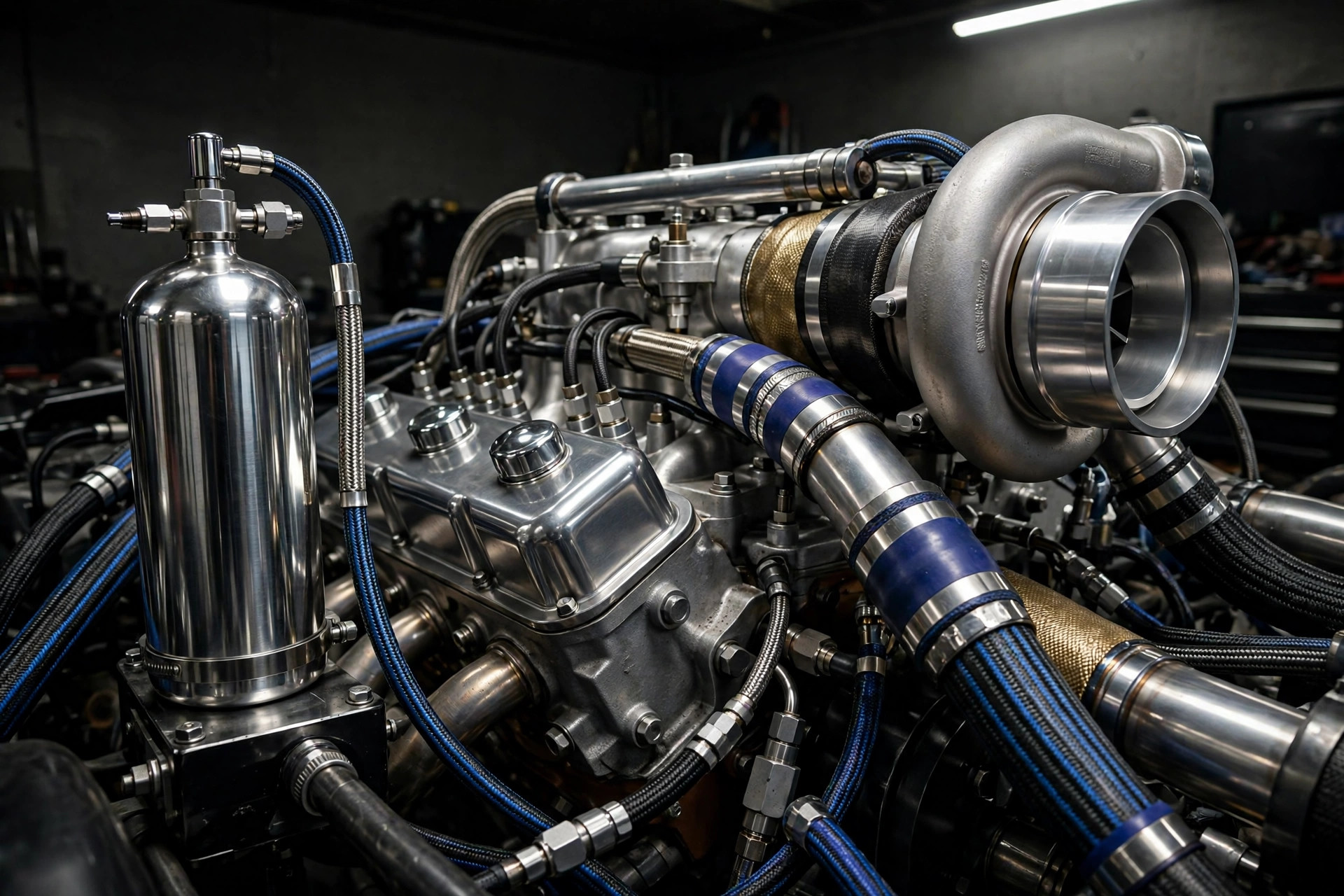
If you race at the drag strip, who you race against will eventually force the question this guide answers: when your naturally aspirated combination plateaus and rivals pull away at the far end, which power adder should you choose, why, and how much will it really cost? Nitrous oxide, turbocharging, and supercharging each promise transformative gains. They deliver those gains in very different ways, at very different prices, and with very different compromises.
This comparison looks at the three options head to head on what matters at the strip. It covers how each one makes power, how that power arrives at the tires, what it costs to buy and run, and how reliable each is over a season. There is no universal winner, but there is almost always a right answer for your specific car, class, and budget.
How Nitrous Oxide Works
Nitrous oxide is not a fuel; it is an oxidizer delivery system. When injected into the intake and heated in the combustion chamber, nitrous breaks down and releases extra oxygen, allowing the engine to burn significantly more fuel and make dramatically more power. A basic wet kit adds both nitrous and supplemental fuel through nozzles or a plate, with power levels set by jet sizes: a 100-shot adds roughly 100 horsepower, a 200-shot adds 200, and the scaling is nearly linear.
The power arrives instantly, at the push of a button or automatically at wide-open throttle. That immediacy is central to how a nitrous oxide engine behaves on track. For a deep dive into the hardware and tuning, a comprehensive nitrous oxide guide covers system types, and understanding nitrous purge systems explains the ritual you see at the starting line.
The appeal is the economics and simplicity. A complete nitrous kit costs a fraction of a turbo or supercharger system, installs in a weekend, and can be removed just as easily, returning the car to stock. The power is also on demand: you run naturally aspirated all the way down the return road and arm the system only for the pass, which keeps street manners intact.
The catch is that the bottle empties. Nitrous is a consumable, and refills, bottle warmers, and progressive controllers add up over a season of heavy use. Owners who daily-drive their cars between events know that whole-car upkeep matters just as much as the kit itself, whether that means staying ahead of issues like those covered in this guide to 2026 Cadillac Convertible Problems or following a structured routine such as this Chrysler Coupe Maintenance 2026: Expert Guide & Tips.
How Turbocharging Works
A turbocharger harvests energy from the exhaust stream to compress the intake charge, forcing more air into the engine than atmospheric pressure alone could deliver. Because it recovers waste energy rather than drawing crankshaft power, the turbo is thermodynamically the most efficient power adder. With the right sizing and supporting modifications, it is capable of doubling or tripling an engine’s output.
Modern turbo systems with proper intercooling and engine management deliver staggering power from small displacements. That is why turbocharging dominates so many racing categories. The hardware rewards careful matching far more than brute size.
The defining characteristic is boost response. Turbos need exhaust energy to spool, which creates lag: at low RPM the turbo is barely helping, then boost arrives in a rush as revs climb. At the drag strip, this is managed with techniques like brake-boosting, anti-lag, and two-step limiters that build boost on the starting line, and with careful turbo sizing that matches the powerband to the track.
A twin-turbocharger setup can broaden the powerband on larger engines, while the details of twin-turbo performance tuning show how complex the optimization gets. Turbos reward sophisticated tuning and punish guesswork. Their ceiling, though, is the highest of the three.
How Supercharging Works
A supercharger is a compressor driven directly by the crankshaft via a belt, forcing air into the engine in direct proportion to RPM. Unlike a turbo, it has no lag: boost is available instantly and rises linearly with engine speed. That gives a predictable, progressive power delivery that is easy to launch and easy to drive.
Positive-displacement blowers like Roots and twin-screw types make massive low-end torque. Centrifugal superchargers behave more like belt-driven turbos, with a rising boost curve. The two families feel different, but both share that direct, belt-driven connection to the crank.
The trade-off is parasitic loss: driving the compressor consumes crankshaft power, typically 10 to 20 percent of the gross gain, which is why superchargers are slightly less efficient than turbos at the same boost level. They also generate significant heat, making intercooling important for sustained performance. What they offer in return is simplicity of tuning, immediate throttle response, and the most street-friendly manners of the three adders.
Then there is the unmistakable soundtrack enthusiasts love, from the whine dissected in guides to supercharger sound to the visual drama of a blower through the hood. For a broader comparison of the two forced-induction families, see the breakdown of turbocharging versus supercharging.
Power Delivery Compared at the Strip
At the drag strip, power delivery shapes everything. Nitrous hits instantly and flat: arm it, go wide open, and the full shot arrives immediately, which makes for violent launches that demand excellent traction and chassis setup. The instant hit is nitrous’s greatest strength and its greatest demand; cars must be set up to handle the shock, often with progressive controllers that ramp the shot in over the first second or two to keep the tires hooked.
Superchargers deliver the most predictable curve, building boost with RPM in a way that naturally matches the traction available as speed rises. This makes them the easiest to launch consistently, a real advantage in bracket racing where repeatability beats peak power. Turbos deliver the most total power potential but the trickiest delivery: managing spool on the line and the boost surge as the turbo lights determines whether the run is a hero pass or tire smoke.
In terms of pure ET potential for a given investment in engine strength, turbos usually win. In terms of consistency per dollar, superchargers and well-controlled nitrous are hard to beat. The three headline differences look like this:
- Nitrous: instant, flat delivery at the push of a button, with power set by jet sizes — a 100-shot adds roughly 100 horsepower and a 200-shot adds 200.
- Turbo: the highest power ceiling of the three, capable of doubling or tripling an engine’s output, but with lag that must be managed on the line.
- Supercharger: no lag and boost that rises linearly with RPM, offset by parasitic loss of typically 10 to 20 percent of the gross gain.
Cost Comparison: Real Numbers
Nitrous wins the entry-cost contest by a landslide. A quality single-stage wet kit with the necessary safety accessories, bottle warmer, pressure gauge, and window switch typically runs well under two thousand dollars installed, and the power per dollar is unmatched. The ongoing cost is refills, which add up for frequent racers, plus the eventual need for progressive controllers and stronger internals as the shot size grows.
For a budget racer seeking a 100 to 200 horsepower gain, nothing else is close. Supercharger kits are the middle ground: complete bolt-on kits for popular platforms run several thousand dollars, install relatively simply, and include most of what you need. Turbo systems vary the most: a basic single-turbo kit can be comparable to a supercharger kit, but serious turbo builds with custom manifolds, big intercoolers, standalone engine management, and built internals escalate rapidly into five figures.
Factor in supporting modifications for all three: fuel system upgrades, tuning, gauges, and eventually stronger transmissions and rear ends, because big power finds weak links regardless of how it is made. The cheapest adder to buy is nitrous. The cheapest to run hard all season is often a well-sorted supercharger or turbo, since there are no bottles to refill.
Reliability and Maintenance
Reliability depends less on the adder type than on the tune and the engine’s preparation, but each has characteristic demands. Nitrous is actually gentle on the engine when used correctly, because it only adds stress during the pass, but it is brutally unforgiving of tuning errors: a lean nitrous hit can destroy pistons in seconds. Fuel supply, timing retard, and proper jetting are non-negotiable, and the maintenance burden sits in the consumables and in regularly checking solenoids, lines, and bottle pressure.
Turbos add heat and complexity: oil and coolant lines to the turbo, intercooler plumbing, boost control, and the tuning sophistication to manage it all. A well-built turbo engine is extremely reliable, but the build must be right, with proper clearances, fueling, and engine management. Superchargers are the lowest-maintenance of the three in daily use, with belt checks and oil changes for the blower unit being the main chores, though belt slip at high boost and heat soak are the characteristic issues.
Across all three, the universal rule holds: the tune makes or breaks the engine. Budget for professional tuning rather than learning on your race motor. That single decision protects everything else you have spent.
Choosing the Right Adder for Your Program
Match the adder to your goals, budget, and class. Choose nitrous if you want the biggest immediate gain for the smallest money, if your class allows it, and if you are disciplined about tuning and refills; it is the king of budget bracket racing. Choose a supercharger if you value instant response, street manners, and consistency, and you are willing to pay more upfront for a bolt-on solution; it is the friendly giant of power adders.
Choose a turbo if your goal is maximum power, you have the budget for proper supporting modifications and tuning, and you are prepared to manage boost response; it is the ultimate ceiling. Check class rules first, because some classes restrict or prohibit specific adders, and power-adder classes are often separated for fairness. Consider your engine’s foundation honestly: stock internals tolerate modest boost or a small nitrous shot, but big power from any adder demands forged internals, and there are no shortcuts.
Finally, think about your temperament as a racer. If you love tuning and data, the turbo’s complexity is a feature; if you want to race more than wrench, the supercharger’s simplicity or a conservative nitrous setup will make you happier. All three can win — the right one is simply the one that fits your program.
Related posts:

Every Maintenance & Repair article adds another tool to the shed. The related reads below are worth a spin.
Save this page and send it to your car group — good tips travel.

