
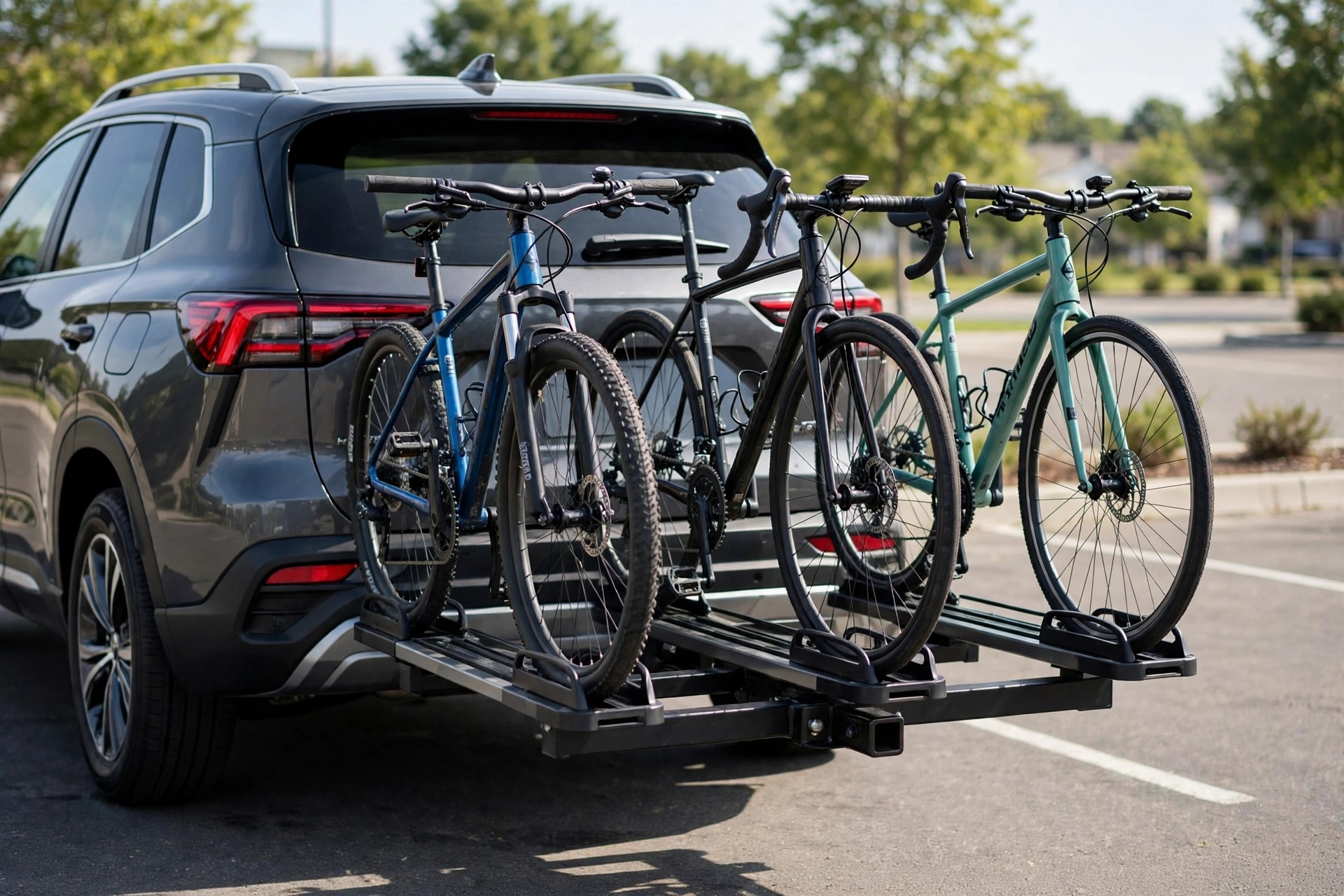
Shopping for a hitch bike rack eventually leads to one fork in the road: platform racks, where each bike sits in its own wheel tray, or hanging racks, where bikes dangle from their top tubes on support arms. Both styles mount to the same hitch receiver, carry your bikes down the highway, and have loyal fans. The difference is how they hold your bikes, and that difference ripples into everything from loading ease to frame safety to how many bikes you can carry — so anyone choosing a bicycle carrier needs the comparison before the purchase.
The mechanics diverge completely once the shank slides into the receiver and pins in place. A platform rack looks like a small trailer bed: horizontal trays cradle each wheel, an arm with a clamp grips the bike near the front wheel or down tube, and each bike stands upright on its wheels, fully supported from below. A hanging rack — also called a mast-style or cradle rack — is simpler: a vertical mast rises from the hitch, two arms stick out sideways, and bikes hang from those arms by their top tubes, secured with rubber cradles and straps.
Loading shows the split first. On a platform rack you roll the bike into a tray and tighten a clamp, which most people find intuitive and easy on their back. On a hanging rack you lift the bike over the arms and drop the top tube into cradles, hoisting the full weight of the bike to chest or shoulder height — no big deal for a 25-pound road bike, a serious lift for a 60-pound e-bike, and a possible deal-breaker for smaller riders. Both designs come in 1.25-inch and 2-inch receiver versions, in two-bike and four-bike sizes, across a wide price range, but their strengths suit different riders.
Platform Racks Explained
Platform racks win on bike security and versatility. Because each bike rests on its wheels in a dedicated tray, there is almost no bike-to-bike contact, and the clamp holds the frame without putting the bike’s full weight on the top tube. That makes platform racks the default choice for carbon frames, oddly shaped frames — step-through bikes, full-suspension mountain bikes with interrupted top tubes — and anything expensive enough that you wince at scratches.
The wheel trays also mean wheelbase adjustability: most trays slide to accommodate anything from a 20-inch kids bike to a long-wheelbase 29er. Fat tire bikes fit many platform racks as long as the trays and wheel straps are wide enough, and some brands sell fat-bike tray kits as accessories. E-bikes are where platform racks truly dominate, since many are rated for 60 to 70 pounds per bike and pair with loading ramps so you never have to deadlift the bike.
The downsides are weight, bulk, and price. A four-bike platform rack can weigh 60 to 90 pounds by itself, which matters when you are installing it solo or storing it in the garage. They are also the priciest category — expect to pay roughly double what a comparable hanging rack costs — and folded platform racks still occupy a lot of garage wall or floor space, with ground clearance that can be tight on sedans with low hitches.
Hanging Racks Explained
Hanging racks are the lightweight, budget-friendly veterans of the bike rack world. With fewer parts and a simpler mechanism, they typically weigh 20 to 35 pounds, cost far less than platform racks, and fold down compactly against the rear of the vehicle. Installation is a one-person, five-minute job, and when you are not using it, a hanging rack hangs neatly on a garage hook.
The trade-off is how bikes hang. Bikes suspended by their top tubes swing, sway, and bump into each other on rough roads unless you take the time to separate them with frame pads or anti-sway cradles. Carbon frames hate hanging racks: clamping forces and impacts on the top tube can damage composite layups that were engineered for riding loads, not rack loads, and bikes without a horizontal top tube — many step-through and full-suspension frames — need an adapter bar to create a temporary top tube, which adds fiddling and another failure point.
Hanging racks also struggle with heavy bikes. Most are rated for 35 to 45 pounds per bike, which rules out most e-bikes, and hoisting a bike onto the arms and threading straps through cradles is fine for light bikes but awkward for anything over 40 pounds. For families with basic aluminum hybrids and kids bikes, though, a hanging rack is often all the rack they will ever need.
Related Articles
- Seasonal Trunk Swaps: Rotating Gear for Winter, Summer, and Road-Trip Season
- Roof Platform Racks vs Crossbars: When a Full-Deck System Makes Sense
- Crossbar Spread Explained: Choosing the Right Bar Spacing for Your Load
Head-to-Head Comparison
Put side by side, the categories separate cleanly:
- Price: hanging wins, often by hundreds of dollars
- Rack weight: hanging wins again, at roughly half the weight
- Loading light bikes: roughly even, with a slight edge to platform trays
- Loading heavy bikes: platform, decisively, especially with a ramp
- Frame safety: platform, since bikes never hang by the top tube and barely touch each other
- Bike compatibility: the most lopsided category — platform handles carbon, fat tires, e-bikes, step-through frames, and kids bikes, while hanging racks max out around four bikes on 2-inch receivers
Fuel economy and aerodynamics slightly favor hanging racks because they sit tighter to the vehicle, though the difference is small once bikes are loaded. Rear access deserves its own mention: both styles come in tilt and swing-away versions that move the loaded rack aside so you can open the hatch, and both can obstruct your license plate and taillights when loaded. Platform racks are deeper, so they extend farther behind the vehicle and reduce ground clearance on steep driveways — something sedan owners should measure before buying, much as they would when weighing SUV Trunk Organizers vs Sedan Trunk Organizers: Buy for Your Trunk Shape.
Which Bikes Fit Which Rack
Start with your bikes, not the rack. If your stable includes a carbon road bike, a full-suspension mountain bike, or any e-bike, the answer is platform, full stop — hanging those frames from a top tube risks exactly the kind of damage that voids warranties. E-bike owners should additionally check per-bike weight ratings: a rack rated for 40 pounds per bike cannot safely carry a 55-pound e-bike even if the total capacity seems fine, and our breakdown of e-bike rack weight ratings walks through the numbers.
If you ride basic aluminum hybrids, cruisers, or kids bikes with standard diamond frames, a hanging rack does the job at a fraction of the cost; families carrying four modest bikes on a budget are the classic hanging-rack success story. Just add frame protection pads between bikes and anti-sway straps to keep them from knocking together, advice echoed in our guide to preventing rack sway and damage.
Mixed fleets — one e-bike plus two regular bikes, or a carbon bike plus a kids bike — push toward platform racks for the versatility. Some platform racks also accept add-ons that convert a two-bike base into a three- or four-bike carrier, which can be cheaper than buying the four-bike version outright, and our top bike rack picks for 2027 covers models that handle mixed fleets well.
Making the Final Call
Here is the short version. Choose a platform rack if you own e-bikes, carbon frames, fat-tire bikes, or step-through frames; if lifting heavy bikes overhead sounds miserable; or if your bikes are expensive enough that scratch-free transport is worth paying for. Choose a hanging rack if your bikes are basic, light, and diamond-framed; if you want the lightest, cheapest, most storable option; and if you will take five minutes to pad and strap the bikes properly.
Either way, buy for the receiver you actually have. A heavy four-bike platform rack belongs on a 2-inch Class III hitch; bolting it to a 1.25-inch Class I hitch through an adapter is asking for wobble and warranty trouble. When you are ready to mount it, our step-by-step hitch rack installation guide covers the process from unboxing to first drive, including the anti-rattle tricks that keep the whole setup quiet — and a post-ride cleanup routine from Compressed Air vs Vacuum for Car Interior Dusting: When to Blow and When to Suck will keep the car as happy as the bikes.
Related posts:



This is one stop in the Accessories & Gear garage. Plenty more models, guides and stories are parked in the same category.
Save this page and send it to your car group — good tips travel.

