
- How Collapsible Organizers Actually Work
- How Rigid Bins Handle the Same Job
- Capacity, Stability, and the Tip-Over Test
- Durability, Weather, and Long-Term Lifespan
- Vehicle Fit: Sedans, SUVs, and Hatchbacks
- The Verdict: Which Style Should You Buy
Walk into any auto parts aisle and you will see two tribes of trunk storage staring back at you. On one side sit the collapsible trunk organizers: soft-sided fabric boxes that fold flat when you do not need them. On the other side stand the rigid bins: hard plastic tubs and molded crates that refuse to bend, sag, or apologize. Both promise the same thing, an end to the chaos of groceries rolling around your trunk, yet they solve the problem in completely different ways. Choosing between them matters more than most drivers expect, because the wrong style either wastes the space you paid for or collapses under the first heavy load.
This guide puts collapsible trunk organizers and rigid bins through an honest head-to-head comparison. We will look at how each style handles real-world loads, from weekly grocery runs to sports gear and emergency kits, how they behave in sedans versus SUVs, and where each one quietly fails. If you are still weighing general options, our roundup of the best trunk organizers for sedans and SUVs is a good companion read. By the end, you will know exactly which camp your driving life belongs in, or whether the smartest answer is owning one of each.
How Collapsible Organizers Actually Work
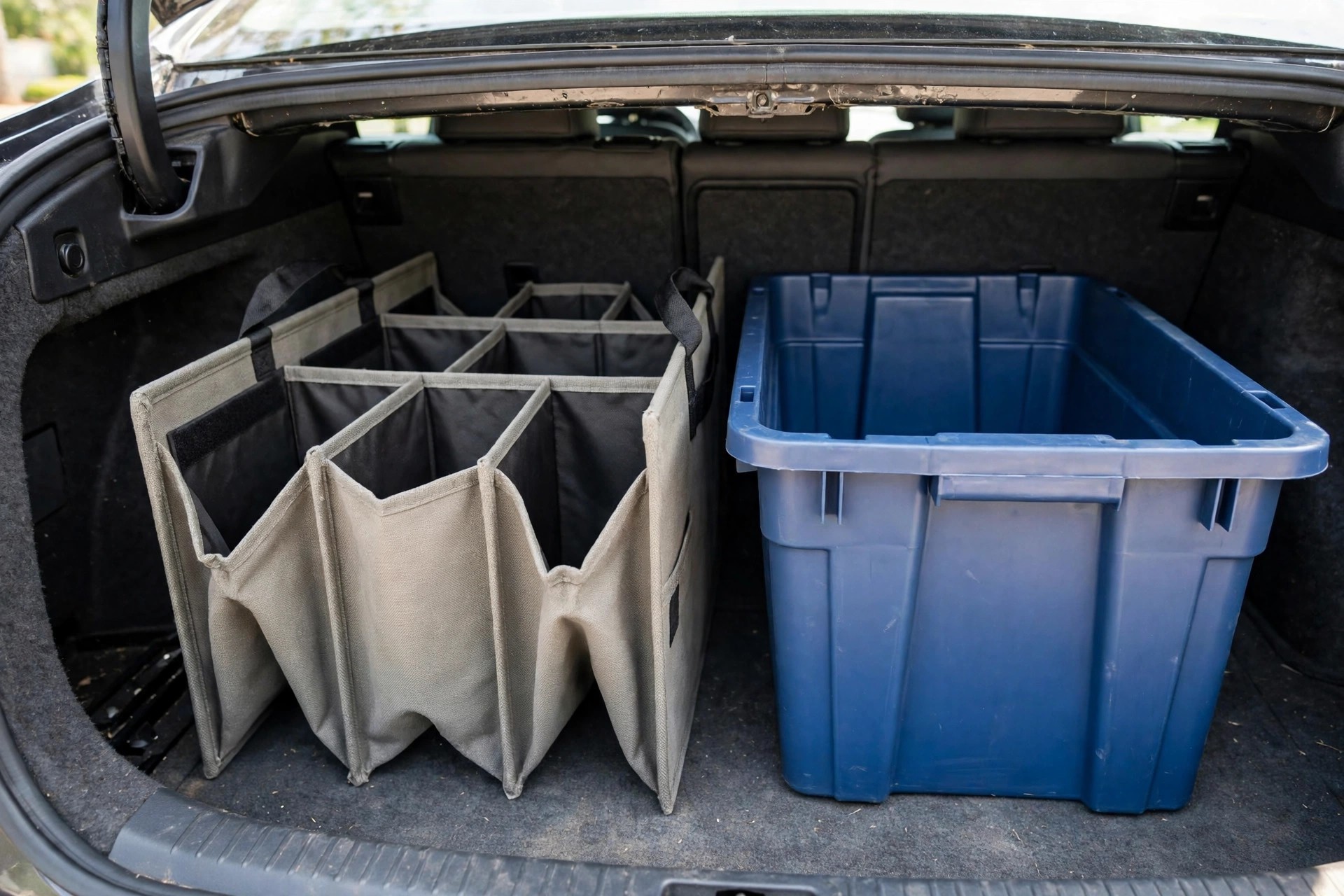
A collapsible trunk organizer is essentially a fabric box with a skeleton. Most use 600D Oxford polyester walls held upright by rigid base plates and removable divider panels, with hook-and-loop strips or snap fasteners that let the whole thing fold down to a flat slab about two inches thick. Open, a typical model offers two or three compartments totaling 40 to 70 liters. Closed, it slides under a seat or leans against the garage wall. That transformability is the entire pitch: full storage when you need it, nearly zero footprint when you do not.
In daily use, collapsible models shine for light and medium loads. Grocery bags slot neatly into the compartments, and the soft walls absorb rattles instead of amplifying them. Many include side pockets for small items, insulated cooler sections, and carrying handles so you can lift the whole organizer out and carry it into the house. The trade-off is structural honesty. Pile in a 40-pound bag of dog food or a toolbox, and the walls bow outward. Stack anything on top, and the fabric roof, if there even is one, sags. They are brilliant at organizing, but they are not load-bearing structures.
How Rigid Bins Handle the Same Job
Rigid bins take the opposite philosophy: they are always a box, whether you like it or not. Molded from high-density polyethylene or polypropylene, they hold their shape under loads that would flatten a fabric organizer. A 30-gallon rigid tote can swallow a full grocery run, a set of jumper cables, and a bag of salt for winter, then accept another bin stacked squarely on its lid. For drivers who haul heavy, awkward, or dirty cargo regularly, that permanence is a feature, not a bug.
The cost of that toughness is inflexibility. An empty rigid bin occupies exactly as much trunk as a full one, which stings in a compact sedan where every cubic inch counts. Hard plastic also transmits vibration, so loose items inside a rigid bin rattle louder than they would in fabric. Sharp corners can scuff trunk trim, and a bin that fits perfectly in an SUV may be too tall for a sedan trunk opening. Pairing rigid storage with a proper cargo liner or trunk mat protects both the bin and the carpet underneath from the grinding that happens over thousands of miles.
Capacity, Stability, and the Tip-Over Test
On paper, rigid bins usually win the capacity contest. A standard 27-gallon tote holds roughly 100 liters, while most collapsible organizers top out around 60 to 70 liters. But usable capacity is a different story. Fabric organizers subdivide their volume into compartments, so a dozen grocery bags stay upright instead of avalanching. A big open rigid bin holds more total volume, yet small items migrate to the bottom and disappear. For mixed loads, the organizer’s compartments often deliver more practical storage than the bin’s raw liters.
Stability favors whoever is loaded correctly, but rigid bins have the edge on slick surfaces. Their flat, grippy bases resist sliding during hard braking, while tall fabric organizers can tip if loaded top-heavy. That said, many collapsible models now ship with anti-slip bottoms and straps that anchor to factory tie-down points, closing the gap considerably. If you regularly carry tall items like milk jugs or wine bottles, look for either style with internal dividers or use a dedicated net; our guide to cargo nets and tie-down anchors covers the add-ons that keep any container honest in a panic stop.
Durability, Weather, and Long-Term Lifespan
Durability splits cleanly along material lines. A quality rigid bin shrugs off UV exposure, rain, muddy boots, and being dragged across asphalt. You can hose it out, leave it in a freezing trunk all winter, and it will look the same in five years. Collapsible organizers age faster. Fabric fades, hook-and-loop strips collect lint and lose grip, and the base plates can crack if you fold the unit carelessly in cold weather. Expect three to five years from a good fabric organizer versus a decade or more from a solid plastic bin.
Moisture is the great divider. Spill a gallon of milk in a rigid bin and you wipe it out. Spill it in a fabric organizer and the liquid wicks into seams and padding, leaving a smell that outlasts the stain. Some premium collapsible models use waterproof TPE linings that solve this, but they cost nearly as much as rigid bins. If your trunk regularly sees wet gear, garden supplies, or leaky groceries, the rigid bin’s washability is hard to argue with. For dry, everyday cargo, fabric holds its own and feels far more civilized.
Vehicle Fit: Sedans, SUVs, and Hatchbacks
Trunk geometry decides more than brand loyalty does. Sedans have low, wide trunks with narrow openings, which flatters collapsible organizers. A low-profile fabric unit slides in easily, and when folded flat it tucks under the trunk floor or behind the seat. Tall rigid bins often cannot clear a sedan’s trunk lip, and once inside they block access to the spare tire well. For sedan owners, collapsible is usually the default right answer.
SUVs flip the math. Tall cargo areas with flat load floors welcome rigid bins, milk crates, and stacked totes, and the higher roof means you can layer storage vertically. Collapsible organizers still work, but they can look lost in a cavernous SUV cargo hold unless you buy the extra-large sizes. Hatchbacks and wagons sit in the middle: measure your opening height before committing to anything rigid. Whatever you drive, thinking about how you actually pack for longer journeys helps; see our road trip packing guide for layering strategies that work with either storage style.
The Verdict: Which Style Should You Buy
Buy collapsible if your trunk mostly carries groceries, gym bags, kids’ gear, and other light-to-medium loads, and if you value a trunk that can return to empty in ten seconds. Buy rigid if you haul heavy tools, garden supplies, sports equipment, or anything wet and dirty, and if your vehicle has the space to dedicate permanently. Commuters and city drivers lean collapsible. Contractors, gardeners, and SUV road-trippers lean rigid.
The honest answer for many households is both. Keep a collapsible organizer as the daily driver for shopping and errands, and stash a rigid bin in the garage for the weekends when the trunk becomes a workhorse. Total cost for the pair is often less than a single premium organizer, and you stop asking one product to be two things. Whichever route you take, anchor it properly and protect the load floor, because the tidiest trunk in the world still slides in a panic stop without proper cargo securing.
Collapsible trunk organizers and rigid bins are not really competitors; they are answers to different questions. Fabric organizers win on flexibility, quietness, and everyday convenience. Rigid bins win on toughness, washability, and heavy loads. Match the tool to the job your trunk actually does most days, measure your trunk before you buy, and do not be afraid to run both. A trunk that stays organized is not about the perfect product. It is about the right product for the life you load into it.
Related posts:

This is one stop in the Accessories & Gear garage. Plenty more models, guides and stories are parked in the same category.
Found this useful? Pass it on to a friend who would appreciate it too.

