
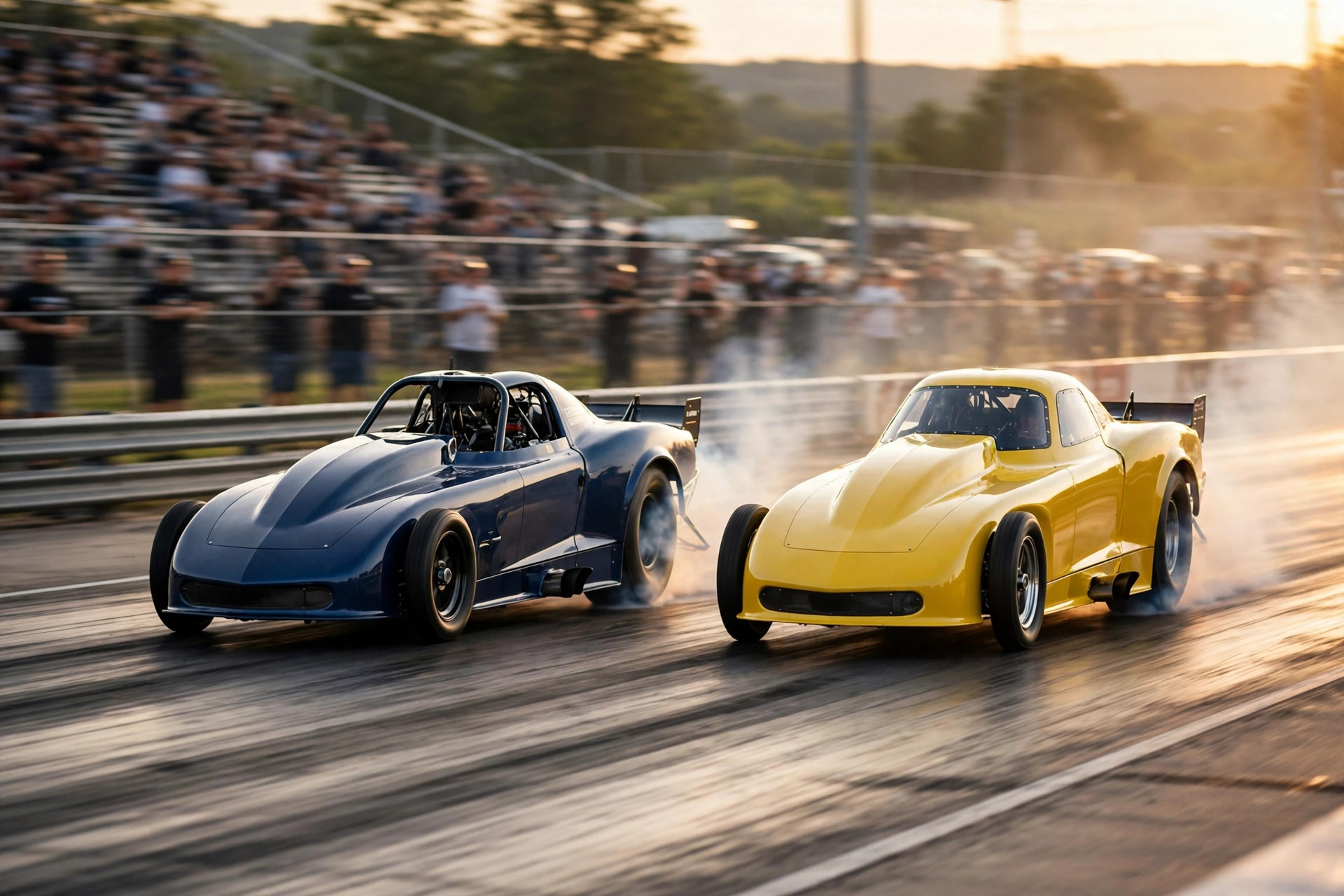
If you are asking how bracket racing works, why a much slower car can legitimately beat a faster one, and what a dial-in actually does, this guide explains the handicap system from the first prediction to the finish-line decision. Bracket racing is the great equalizer of motorsport. It is the format where a 16-second daily driver can line up against a 9-second tube-chassis monster and have a genuine chance to win, not through luck but through the elegant mathematics of the handicap system.
Understand the dial-in, the staggered tree, and the twin dangers of breaking out and red-lighting, and you understand bracket racing. Better still, you can start competing on your very first night at the track with whatever car you already own. The format rewards the driver far more than the machine.
Key Takeaways
- What Bracket Racing Is — The format was invented to solve drag racing’s oldest problem: heads-up racing always favors the fastest car, which means the richest racer…
- The Dial-In, Explained — Your dial-in is your honest prediction of what your car will run, expressed in seconds and hundredths, like 13.45 or 11.02.
- How the Handicap Tree Works — Once both dial-ins are entered, the timing computer calculates the difference and staggers the two green lights by exactly that amount.
- Breakouts and Red Lights: How Rounds Are Lost — A breakout happens when you run quicker than your dial-in, and it is an automatic loss, even if you cross the finish line first by a car…
- Real Bracket Racing Strategy — Beyond the basics, bracket racing has genuine strategy.
What Bracket Racing Is
The format was invented to solve drag racing’s oldest problem: heads-up racing always favors the fastest car, which means the richest racer usually wins. Bracket racing flips that logic by handicapping each race so that the contest is about driver skill and consistency rather than raw budget. You declare the elapsed time you expect to run, called your dial-in. The timing system then gives the slower car a head start exactly equal to the difference.
From that moment, horsepower matters far less than reaction time, staging discipline, and the nerve to run your number without going quicker than it. Entire seasons are won by racers in modest cars who simply do not make mistakes. That is the whole appeal of the format, as the history of bracket racing shows.
Bracket racing is a handicap form of drag racing where each driver predicts their own elapsed time before the race. The prediction is written on the car’s window with shoe polish or displayed on a dial-in board, and it becomes the benchmark the driver is judged against. Unlike heads-up classes where the fastest car wins outright, bracket racing crowns the driver who runs closest to their predicted time without going under it, combined with the best reaction time.
The format dominates grassroots drag racing at local tracks across America. It has deep roots in the sport’s history, growing alongside the professional categories chronicled in vintage drag racing history. Races are run in an elimination ladder, just like a tennis tournament.
Win your round and you advance; lose and you are done for the day, although many tracks offer buy-backs that let first-round losers re-enter for a fee. Fields are often split into brackets by ET range, such as a sportsman bracket for slower street cars and a pro bracket for quicker machines. You are therefore usually racing cars of roughly similar performance.
Entry fees are modest, and payouts can be surprisingly real at bigger events. The whole structure rewards showing up consistently more than spending lavishly. It is the most democratic form of motorsport ever devised.
The Dial-In, Explained
Your dial-in is your honest prediction of what your car will run, expressed in seconds and hundredths, like 13.45 or 11.02. Setting it is the central skill of bracket racing, and beginners usually get it wrong in one of two directions. Dial too soft, meaning slower than the car can actually run, and you will have to lift off the throttle or brake near the finish line to avoid breaking out. That is harder than it sounds at 100 mph.
Dial too aggressive, meaning quicker than the car reliably runs, and you will break out the moment conditions favor you. Cool evening air that makes the engine stronger is a classic example. The correct approach is to base your dial-in on real data from your own timeslips, not on your best-ever hero run.
A reliable way to set your number, pass after pass, looks like this:
- Take your last three to five passes in similar conditions.
- Throw out the obvious outlier.
- Dial the average, or a touch slower than the average if the air is getting better.
- Adjust through the day as temperature, humidity, and track temperature change.
That last step is a practice experienced racers call chasing the weather. Many keep a logbook with ET, weather, and lane for every pass. The racers with the best logbooks are usually the ones holding the trophy at the end of the night.
Honesty with yourself is the whole game here. The dial-in rewards self-knowledge, not optimism.
How the Handicap Tree Works
Once both dial-ins are entered, the timing computer calculates the difference and staggers the two green lights by exactly that amount. If you dial 14.00 and your opponent dials 12.50, you get your green a full 1.50 seconds before theirs. If both drivers cut identical reaction times and both run their dial-ins exactly, the cars cross the finish line in a dead heat. The win then goes to whoever was quicker by a thousandth, which the system can measure.
The visual effect is striking. The slower car launches first, and the faster car visibly hunts it down over the length of the track. This staggered start is what makes bracket racing a driver contest.
The faster car’s driver must judge the closing speed and decide whether to stay in the throttle and risk breaking out or lift slightly and protect the dial-in. The slower car’s driver must drive the finish line, meaning decide at the stripe whether to take it or dump it. That is a split-second judgment about whether the opponent is going to get there first.
Because each driver’s clock starts with their own green, reaction time counts fully. A 0.03-second advantage at the tree is a 0.03-second advantage at the stripe. Races are routinely decided by margins smaller than a blink.
Breakouts and Red Lights: How Rounds Are Lost
A breakout happens when you run quicker than your dial-in, and it is an automatic loss, even if you cross the finish line first by a car length. The rule exists to keep everyone honest: without it, racers would dial soft and sandbag their way to easy wins. If both cars break out in the same round, the one that breaks out by the smaller margin wins. That leads to the odd spectacle of two drivers both lifting at the stripe, with the win going to the lesser offender.
Learning to feel when your car is running under the number is one of the subtlest skills in the sport. You have to scrub just enough speed without giving away the race. It takes practice, and it starts with knowing your car honestly.
A red light, leaving before your green, is the other automatic loss, and it is the more common way beginners lose rounds they should have won. The temptation to anticipate the tree is powerful, especially when you are the slower car watching your opponent sit at the line while you launch. Discipline at the tree is non-negotiable. A red light wastes a good run, a good dial-in, and your entry fee in a single instant.
New racers should also know about the courtesy staging rule, where the first car to pre-stage is expected to wait for the other before both stage. Deep staging rules matter too, since some tracks prohibit it in certain brackets. Read your track’s rulebook before eliminations, not during them.
Why slower cars win so often
Slower cars win bracket races constantly, and it is not a fluke. A mild street car running 14.50s is inherently more consistent than a 9-second car on the edge of traction. Small changes in weather or track temperature move a 14.50 by a few hundredths, but they can move a 9.00 by a tenth or more.
Consistency is the currency of bracket racing, and the slower car usually holds more of it. The faster car also faces a harder driving job at the stripe, judging a rapidly closing gap at high speed. The slower car’s driver simply drives their own race and watches the mirror.
There is also a psychological edge. Nobody expects the daily driver to go rounds, so its driver races loose, while the favorite feels the pressure of a car that should win. Bracket racing history is full of champions in unglamorous machinery, and that is the point of the format.
If you own a reliable car that runs the same number every pass, you already own a bracket car. Affordable, dependable street cars make outstanding first race cars. That is one reason so many racers start with something like the sensible machines on a budget-friendly used car list rather than a purpose-built machine.
Real Bracket Racing Strategy
Beyond the basics, bracket racing has genuine strategy. The finish-line game is the heart of it: as the two cars converge at the stripe, each driver must decide in a fraction of a second whether to stay in it or lift. Take the stripe by too much and you risk breaking out. Give it up and you lose a race you might have won.
Experienced racers practice judging closing speed and learn to read their opponent’s behavior. Some drivers always take the stripe aggressively, while others always dump it early. Watching your future opponents’ earlier rounds is free intelligence.
Lane choice matters too
Lane choice matters too. Tracks have two lanes that are rarely identical: one may hook better, or the sun may hit one tree differently in the evening. Racers who pay attention know which lane suits their car. The higher qualifier, or the racer with lane choice in later rounds, will take it.
There is also the matter of dialing gamesmanship in later rounds, where a racer might dial slightly soft to force the opponent into the uncomfortable role of chaser. None of this replaces the fundamentals, though. Reaction time, a truthful dial-in, and clean staging win more rounds than all the strategy in the world. Beginners should master those before worrying about stripe games.
Getting started in brackets
Getting started is simpler than most people expect. You need a car that passes tech inspection, a helmet if your ET requires one, your entry fee, and a way to display your dial-in. Most tracks run a gambler’s race or trophy class on bracket nights that is explicitly beginner-friendly, and the regulars will explain the procedures if you ask.
Your first goal should not be winning but completing clean rounds. Stage the same way every time, leave on the last amber, run your dial-in honestly, and drive the stripe without drama. Prepare like any other first-time motorsport outing.
Walk the staging lanes before eliminations to learn the flow, and watch a few rounds from the starting line to see how the tree and dial-ins work in practice. Keep that logbook from your very first pass. A beginner’s guide to a first track day covers the general preparation mindset well even though it targets road courses.
The safety culture is just as serious at the drag strip, where even casual bracket cars must meet standards related to the safety equipment used in drag racing once they get quick enough. Show up, be consistent, and let the handicap do the rest. In bracket racing, the steadiest driver in an honest car is never really the underdog for long.
Related posts:
Cars like these are part of a bigger Driving & Road Trips story — Drag Racing Launch Techniques: RWD, FWD, and AWD Compared tells the next chapter.
Share this with a fellow driver or enthusiast who needs to see it.

