
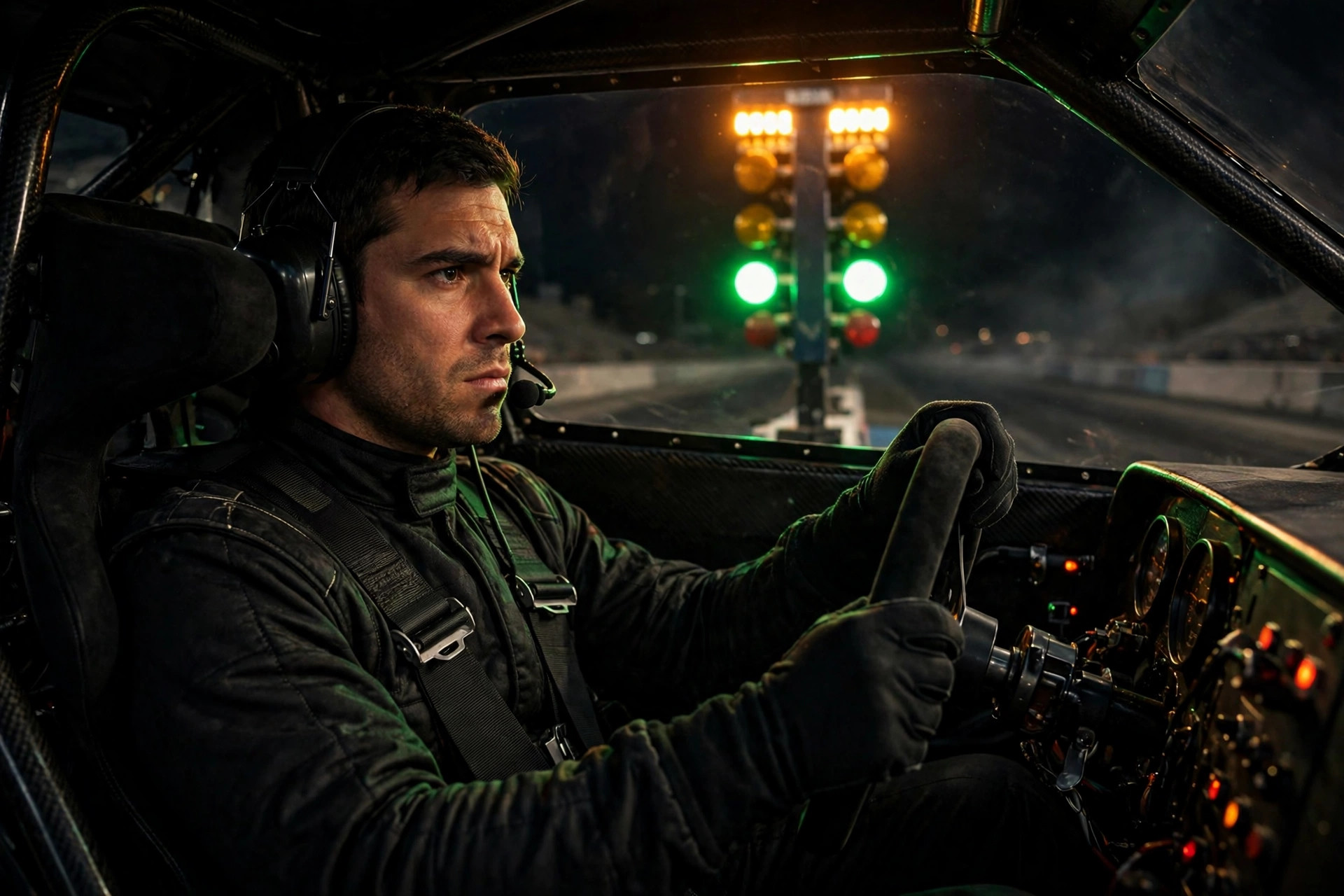
If you want to improve your reaction time at the drag strip — who measures it, what the number really includes, and how drivers train it without guessing — this guide breaks the skill down into staging, vision, and routine. Reaction time is the cheapest performance upgrade in drag racing. It costs nothing, requires no parts, and a driver who cuts 0.520 lights will beat a driver cutting 0.650 lights in an otherwise identical race almost every single time.
Yet reaction time is also the most misunderstood number on the timeslip, tangled up with myths about reflexes, anticipation, and staging tricks. Improving it is not about being born with cat-like reflexes. It is about understanding what the number measures, building a repeatable visual routine, and practicing deliberately until leaving on the light becomes automatic.
What Reaction Time Really Measures
Every hundredth of a second at the tree counts in full at the finish line, which makes reaction time uniquely valuable. Engine modifications might gain you a tenth at a cost of thousands of dollars, while the same tenth at the tree is free for anyone willing to practice. Professional racers treat the tree as a separate discipline from driving the car, and amateurs should too. The path from 0.650 to 0.530 is well traveled, the techniques are known, and the only real requirement is structured repetition.
Reaction time is the interval between your green light illuminating and your car breaking the starting-line beam. It does not include the time your car needs to physically move beyond that point. The clock starts when the light changes and ends when the beam is unbroken by the front tire rolling forward.
A perfect reaction on a Sportsman tree is 0.500 seconds, which reflects the half-second delay built into the tree between the last amber and the green. Leave in 0.499 and you red-light, which is an automatic loss. This is why the number looks strange to newcomers. Nobody actually reacts in half a second from a standing start, because the car needs time to move and the tire needs rollout before the beam breaks.
Understanding rollout is the key insight, and it is central to how reaction time works in this sport. Because the stage beam sits a few inches ahead of your tire’s leading edge when staged shallow, your car travels those inches before the clock even starts on your reaction. Your body can therefore begin moving before the green and still record a legal light. This is why drivers leave on the last amber rather than waiting for green: the human response plus the car’s initial movement fills the half-second gap almost exactly.
Your reaction time is therefore a combination of three things. It blends your visual processing, your physical response, and your staging depth. All three are trainable.
Pro Tree vs Sportsman Tree
The two tree types demand completely different techniques. On the Sportsman tree, the three ambers flash in sequence with half-second gaps, giving you a visible rhythm to time. Most drivers focus on the last amber and release the brake or clutch as it lights, letting their motion fill the final half second. It is learnable, repeatable, and forgiving of small errors, which is why every beginner program uses it.
A competitive Sportsman reaction is anything in the 0.51 to 0.56 range. Professionals in sportsman classes live in the 0.505 to 0.520 zone. The Pro tree could hardly be more different.
The Pro tree flashes all three ambers simultaneously, then the green four-tenths of a second later, which destroys the rhythm method entirely. There is no countdown to time; you must respond to the flash itself. That makes the Pro tree a pure test of visual reaction and prediction.
Perfect is 0.400, and anything under it is red. Most beginners will never see a Pro tree outside of professional exhibitions, but knowing the difference matters when you watch events like the Top Fuel categories and wonder why the starts look so violent and immediate. Train on the tree you will actually race on, and do not mix techniques between the two.
How Staging Depth Changes Your Reaction
Staging depth is the hidden variable in every reaction time. Stage shallow, with the tire just barely breaking the beam, and you get maximum rollout: the car travels further before unbreaking the beam, which slows your recorded reaction but quickens your ET. Stage deep, rolling in until the pre-stage bulb flickers out, and rollout shrinks. Your reaction sharpens dramatically, sometimes by three or four hundredths, at the cost of ET.
Neither approach is right or wrong in absolute terms. Inconsistency between the two is a disaster, though, because your brain calibrates its timing to a specific rollout distance. The practical rule for beginners is to pick one staging depth, shallow, and repeat it exactly every pass.
Shallow staging gives you more margin against red-lighting and keeps your ET honest, which matters for dial-in racing. As you advance, you can use deep staging deliberately as a tool. If you are consistently 0.03 slow at the tree, staging a touch deeper may fix it without changing your visual timing at all.
The critical discipline is staging the same way under pressure, in eliminations, with an opponent beside you. Adrenaline makes everyone want to creep. Creeping changes everything.
Seeing the Light vs Anticipating It
The central debate in reaction-time craft is whether to react to the light or anticipate it. Pure reaction, waiting until you see the last amber and then moving, is too slow for most humans to hit 0.500. Visual processing plus physical movement typically takes two to three tenths before the car even begins rolling. Pure anticipation, guessing when the light will come, produces red lights.
The working answer used by good drivers is a hybrid. You time the rhythm of the tree so your body is already beginning to move as the last amber illuminates. That is anticipation disciplined by the visible countdown.
This is legal and expected on the Sportsman tree, because the staggered ambers give you a metronome. Focus your eyes on the last amber bulb specifically, not the whole tree. Some drivers narrow their visual field or use a blinder on the helmet to block distractions.
On the Pro tree, anticipation is far riskier since there is no rhythm, and drivers rely on intense focus and practice. Either way, the mental model is the same. You are not waiting for permission to go; you are executing a timed movement synchronized to a light you are watching with total concentration.
Practice Methods That Actually Work
The best practice tool is a practice tree, a handheld or app-based device that simulates the Christmas tree sequence and scores your reactions. Serious bracket racers own one and use it daily, treating it like a musician treats scales. Ten focused minutes a day on a practice tree will move your average more in a month than a season of casual racing. It isolates the visual-motor skill from everything else.
Vary the delay settings if your device allows it, since real trees are never perfectly consistent. Practice both with and without distractions. At the track, turn time trials into tree practice by deciding before each run that the reaction is the only goal, even if it costs you the run.
Many racers waste time trials chasing ET when they should be calibrating their eyes. Between rounds, visualize the sequence: see the ambers, feel the release, imagine the car moving. Sports psychology research supports this kind of mental rehearsal, and racers who do it report more consistent lights.
Finally, review your timeslips honestly. A driver averaging 0.58 with occasional 0.51s has a focus problem, not a reflex problem. The fix is routine, not talent.
Why drivers red-light (and how to stop)
Red lights have causes, and each has a fix:
- Staging deeper than usual under pressure, which shortens rollout and turns your normal timing into a red light — fix it with a pre-stage routine that forces identical staging depth every time.
- Over-eagerness against a slower opponent’s earlier green, where you jump because you see movement in the other lane — fix it with eyes locked on your own tree, and a helmet blinder if needed.
- Changing your technique mid-event, like switching from leaving on the amber to trying to see green, which scrambles your calibration completely.
Mechanical factors matter too. A car that creeps at the line because the brakes are hot or the idle is high will roll through the beam before you intend to move. Check idle speed and brake holding power during time trials.
Tire spin at the hit can also unbreak the beam oddly, though that usually shows as a slow light rather than a red. If you red-light twice in one event, stop and diagnose instead of pressing harder, because pressing harder is what caused it. The drivers with the best reaction averages are not the most aggressive; they are the most repeatable, and repeatability comes from doing the same thing every single time.
A race-day routine for the tree
Build a pre-stage routine and never deviate from it. An example: roll in slowly, light pre-stage, pause, bump in with tiny brake releases until stage lights, stop immediately, take a breath, focus eyes on the last amber, and go through your mental cue. The routine’s purpose is to make staging depth identical and to put your mind in the same focused state every pass. That is exactly what a first track day preparation guide teaches for road courses, applied to the drag strip’s unique demands.
Rituals feel superstitious, but they are really just consistency devices. Between rounds, protect your focus. Avoid long debates about dial-ins while waiting in the lanes, stay hydrated, and keep your practice-tree warm-up short and sharp rather than exhausting.
When you are paired against a much faster or slower car, remind yourself that your tree is independent of theirs; their green timing does not change yours. Remember too that reaction time improvement compounds with everything else you learn, from staging discipline to understanding how drag racing safety systems let you commit fully to the run without hesitation. Confidence at the tree comes from preparation everywhere else, and the light rewards the prepared.
Related posts:
Into this kind of machine? Drag Racing Launch Techniques: RWD, FWD, and AWD Compared covers a close cousin worth your garage time.
Save this page and send it to your car group — good tips travel.

