

If you want to know how drag racing works, who can take part, and what actually happens between rolling up to the line and crossing the finish, this guide walks through a complete run step by step. Drag racing looks simple from the grandstands: two cars, a straight strip of pavement, and whoever crosses the finish line first wins. Underneath that simplicity sits a surprisingly rich sport with its own language, rituals, and strategy.
Understanding the basics before your first visit changes the experience completely. Almost everything that matters happens in the first sixty feet, long before the big speed numbers at the far end. The Christmas tree, the staging process, and the timing system are the three pillars of the sport, and every beginner should learn them in order.
What Drag Racing Actually Is
At its core, drag racing is an acceleration contest over a measured distance. The classic distance is the quarter mile, which is 1,320 feet, although many tracks now run the eighth mile (660 feet) for street-car programs and some classes. Two lanes run side by side, each with its own set of timing beams, and each car races against both the clock and the opponent in the other lane.
Modern drag racing is organized by the NHRA in the United States and similar sanctioning bodies worldwide. The fundamentals you learn at a local test-and-tune night are the same ones used at the professional level. The sport grew out of informal street contests in the 1940s and 1950s, a history you can trace through the evolution of vintage drag racing, and its basic format has barely changed since.
A drag race is a standing-start sprint between two vehicles on parallel lanes. Both cars start from a dead stop, and timing equipment records how long each takes to cover the distance, a figure called the elapsed time or ET. The car with the quicker ET wins, but the race is not quite that simple. The clock for each driver starts when their own car leaves the starting line, not when the green light flashes.
This detail matters enormously. If you sit at the line for half a second after the green before moving, that half second is added to your elapsed time. Your opponent gains a real advantage that the scoreboard shows as a head start.
Why reaction time is scored separately
That quirk is exactly why reaction time is scored separately from elapsed time. Your reaction time measures the gap between the green light and your car breaking the starting-line beam, while your ET measures the run itself. In bracket racing, which is the most common format for amateurs, each driver declares a dial-in time before the race. The timing system then staggers the green lights so that the slower car gets a head start equal to the difference between the two dial-ins.
If both cars run exactly their dial-ins with identical reactions, they cross the finish line at the same instant. This handicap system means a 15-second family sedan can race a 10-second purpose-built car on genuinely even terms. That fairness is why bracket racing remains the backbone of grassroots drag racing.
Reading the Christmas Tree
The Christmas tree is the tall pole of lights between the two lanes that controls every start, and the Christmas tree used in drag racing follows the same layout at tracks everywhere. From top to bottom, you will see two small amber staging bulbs, then three large amber bulbs, then a green bulb, then a red bulb. The two small bulbs at the top are the pre-stage and stage indicators, and they light up as your car rolls into the starting-line beams. The three big ambers are the countdown, the green means go, and the red means you left too early and are disqualified for that round.
Read from top to bottom, the tree tells one clear story on every pass:
- Pre-stage bulb: your front tire has broken the first starting-line beam.
- Stage bulb: your front tire has broken the second beam, and you are ready to race.
- Three large amber bulbs: the countdown, flashing together or in sequence depending on the tree type.
- Green bulb: go — your clock starts when your car leaves the beam.
- Red bulb: you left too early, and the round is lost.
There are two main types of tree. The Pro tree flashes all three amber bulbs at once, then the green just four-tenths of a second later, which demands an almost predictive launch. The Sportsman tree, sometimes called the full tree, lights the ambers one at a time with half-second gaps between them, so the sequence from the first amber to green takes a full second and a half.
Almost every beginner program uses the Sportsman tree because the rhythm is learnable, and professional classes like Top Fuel dragsters use the Pro tree. A perfect reaction on the Sportsman tree is 0.500 seconds, because that is the built-in delay between the last amber and the green, while a perfect Pro tree reaction is 0.400 seconds. Anything quicker than perfect is a red light.
Staging: Pre-Staged, Staged, and Deep Staging
Staging is the delicate dance of inching your car into the starting-line beams, and beginners consistently underestimate how much it affects their runs. As you roll forward, the top small bulb, pre-stage, lights first when your front tire breaks the first beam. Keep creeping and the second bulb, stage, lights when you break the second beam.
At that point both drivers are staged, the starter activates the tree, and the countdown begins. The distance between the pre-stage beam and the stage beam is only about seven inches. Staging is therefore a game of inches that rewards a light touch on the brakes.
How deep you stage changes both numbers
How deep you stage changes both your reaction time and your ET. If you barely trip the stage beam, known as shallow staging, your car has more rollout distance before the beam is unbroken. That makes your reaction time slower but your ET quicker, because the clock starts later relative to your actual movement.
Deep staging means rolling further in until the pre-stage bulb goes out. It shortens rollout and sharpens reaction time at the cost of ET. Most beginners should stage shallow and consistently, because consistency beats cleverness while you are learning.
Creeping through the beams after staging, called deep staging by accident, is one of the most common rookie errors. It will be covered again in the mistakes section below.
The Launch and the Quarter Mile
Once the tree runs, the launch is everything. The first sixty feet of the run, measured as your 60-foot time, predicts your final ET more reliably than almost anything else. A car that hooks up cleanly and leaves hard will run a strong number even with modest power. A powerful car that spins its tires at the line will post a disappointing slip.
Launch technique depends on your drivetrain, tire, and transmission, but the universal principle is to apply power at the exact limit of traction, no more and no less. Too little throttle and you bog. Too much and the tires spin, which shows up on the timeslip as a slow 60-foot and a run that never recovers.
After the launch
After the launch, the rest of the run is about clean shifts and staying in your lane, literally and figuratively. In a quarter-mile run, most street cars will shift two or three times, and every shift costs a fraction of a second if done lazily. Keep the car straight, because drifting toward the center line can trigger a disqualification. Stay in the throttle all the way through the finish-line beams.
A surprising number of beginners lift early because the finish line arrives sooner than expected, especially in the eighth mile. The timing system records your speed at the finish. Many tracks also record incremental times at 330 feet, the eighth mile, and 1,000 feet, which become invaluable data once you start chasing improvements.
How Races Are Won: Reaction Time, ET, and Breakouts
In heads-up racing, the winner is simply the first car across the finish line, and reaction time is part of the race because the win light goes to whoever physically arrives first. In bracket racing, each car gets its own green light staggered by the dial-in difference. The winner is the car that runs closest to its dial-in without going quicker than it.
Running quicker than your dial-in is called breaking out, and it loses the round automatically. That rule creates the beautiful tension of bracket racing: you must run as close to your number as possible while holding a little in reserve. You may need that reserve in case your opponent forces you to run it out the back door.
The red light is the other automatic loss. Leave before your green and the tree flashes red, ending your round regardless of how fast the car is. This is why experienced bracket racers say the race is often won at the tree rather than at the far end.
The numbers back that up. A driver with a 0.520 reaction and a car that runs its dial-in dead-on will beat a driver with a 0.650 reaction almost every time, even in a slower car. Beginners should internalize this early: for your first season, every tenth you find at the starting line is worth more than every tenth you find under the hood, and it costs nothing.
Your first night at the strip
Your first visit will almost certainly be a test-and-tune night rather than a competitive event, and that is exactly what you want. Test-and-tune sessions are open practice where you can make as many runs as time allows, usually for a flat entry fee. Arrive early, because the tech inspection line is shortest at opening. Bring your driver license, a helmet if the track requires one for your speed, and basic tools.
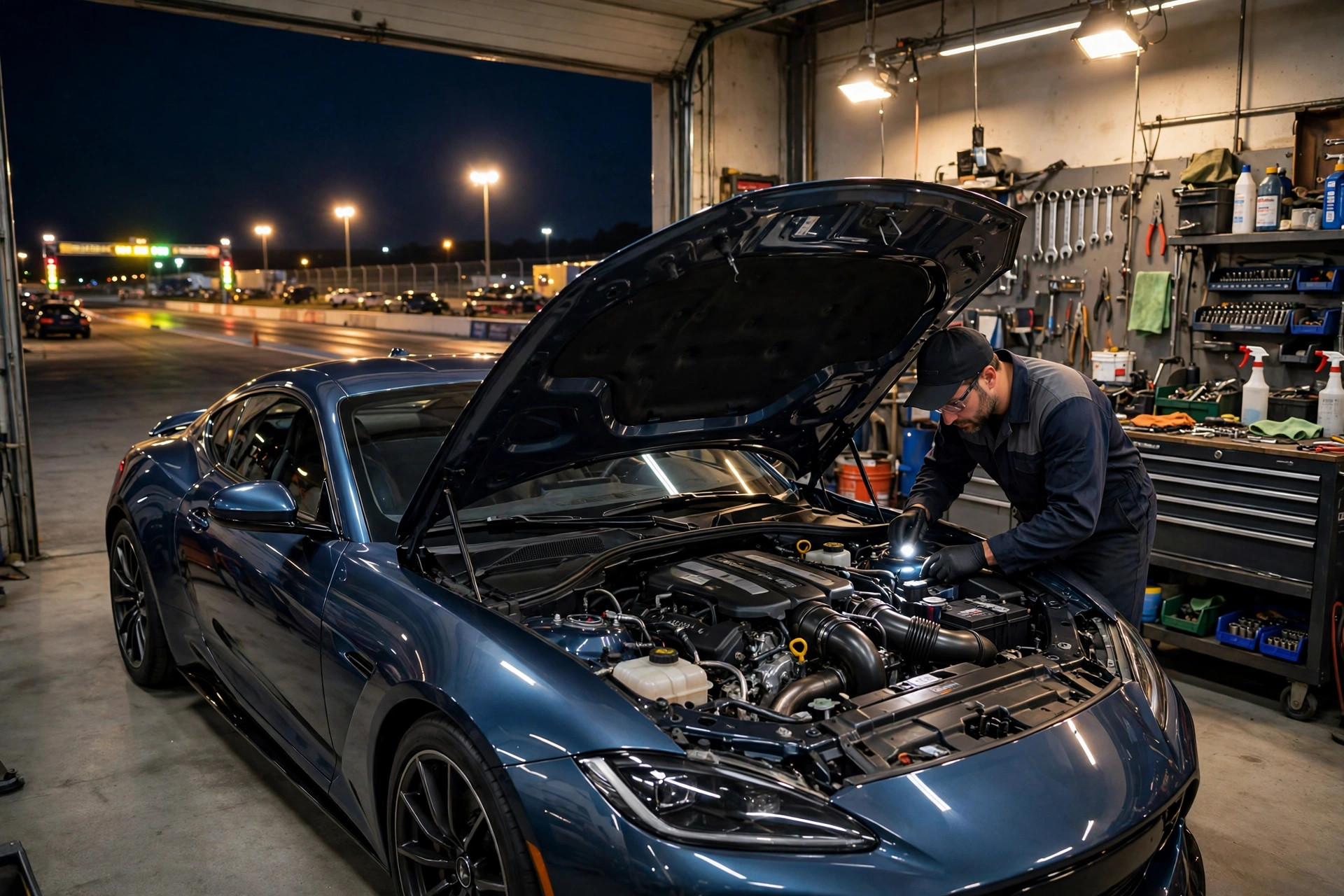
The tech inspector will check for fluid leaks, battery hold-downs, tire condition, and working lights. The check takes a few minutes on a street car in good shape. For your first pass, forget about winning anything and focus on procedure.
Do a modest burnout or skip it entirely on street tires, stage shallow, and leave on the third amber rather than waiting for green. Drive the car straight through the finish. Your goals for night one are a clean staging routine, a safe launch, and a timeslip with no red light.
Talk to the racers pitted near you, because drag racers are famously generous with advice for newcomers, and most tracks run a novice orientation. If you have never been to any motorsport event as a driver, reading a complete beginner guide to your first track day first will make the whole evening feel familiar instead of overwhelming.
Beginner mistakes to avoid
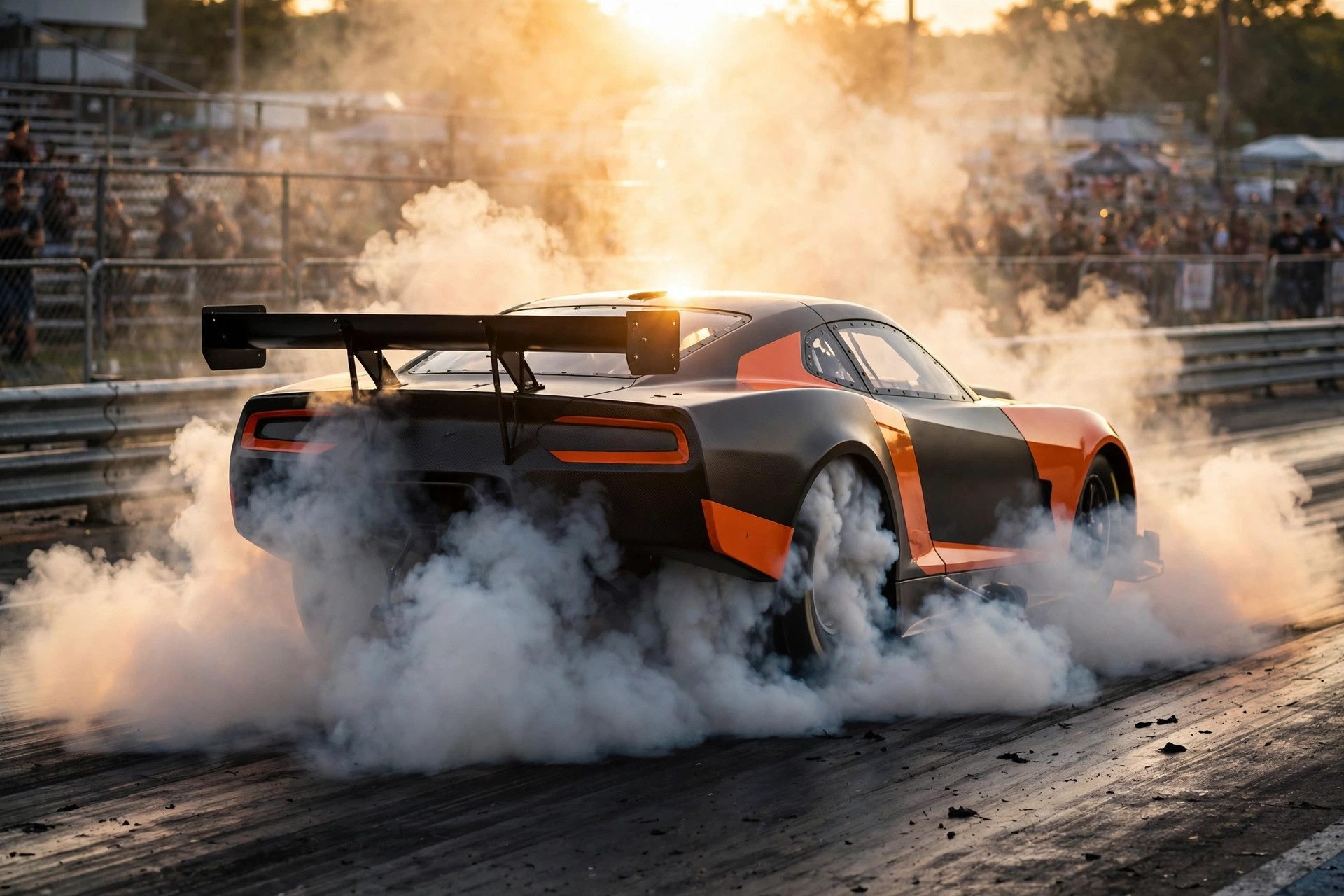
The classic rookie error is staging too deep or rolling through the beams after staging, which either red-lights you or ruins your reaction time. Fix it by staging with tiny brake taps and stopping the moment the stage bulb lights. The second classic is doing a giant smoky burnout on ordinary street tires. Street tires overheat and get greasy, so a big burnout actually hurts traction; a quick spin to clean the tires is plenty.
Third, beginners often forget that the dial-in board or their window number must be visible and correct in bracket events. A wrong dial-in turns a good run into a breakout loss. Two more mistakes deserve mention as well.
Many newcomers lift before the finish line because the speed feels alarming the first few times. That corrupts the data on their timeslip and teaches nothing. Almost everyone also neglects tire pressure, running street pressures at the strip when a small reduction at the drive wheels can transform the launch.
Keep a notebook from day one, because the racers who improve fastest are the ones who log every run. For perspective on how seriously safety is treated even at the casual level, look at how drag racing parachutes and safety systems work at the top of the sport. You will understand why local tracks are strict about even basic tech inspections.
Put it all together and a drag run stops looking like a simple sprint. It becomes a short, repeatable routine: stage the same way, read the same tree, launch at the limit of traction, and drive through the finish. Master that routine first, and the quicker elapsed times follow on their own.
Related posts:
Before you roll on, check out Bracket Racing Explained: Dial-Ins, Breakouts, and How Underdogs Win — it builds on exactly what you just read.
Share this with a fellow driver or enthusiast who needs to see it.

