

Why do so many people never try autocross? The most common reason people never try autocross is the belief that their car is not ready — not fast enough, not sporty enough, not modified enough. It is a completely understandable worry, and it is almost entirely wrong.
Your daily driver, exactly as it sits in your driveway right now, is almost certainly ready for its first autocross, provided it is in sound mechanical condition. The sport was designed around ordinary street cars, and the tech inspection exists to confirm safety, not performance.
That said, a little preparation goes a long way toward a smooth, fun first event. An hour in the garage the weekend before — checking fluids, torquing wheels, cleaning out the cabin — prevents the small issues that can sideline you at tech inspection or cost you runs. This guide covers everything worth doing before your first autocross, what you can safely skip, and how to think about upgrades once you are hooked.
Why Your Daily Driver Is Already Enough
Autocross courses are designed to reward handling balance and driver precision, not raw power. A well-driven economy car will embarrass a poorly driven sports car all day long, and instructors love using slow cars to prove the point: when the car cannot mask mistakes with horsepower, every improvement in technique shows up immediately in the times. Your first season is about learning, and a modest car is the best teacher you will ever have.
There is also a classing argument for starting stock. As explained in any classing guide, every modification nudges you toward faster competition. A stock daily driver lands in the friendliest possible class, surrounded by other beginners in similar cars, while a modified car lands among experienced drivers with developed setups. Starting stock is not settling — it is choosing the best possible classroom.
Finally, there is the simple economics
Finally, there is the simple economics of it. You already own the car, you already insure it, and you already know how it behaves. The marginal cost of your first autocross is the entry fee plus fuel.
Compare that with any other form of motorsport, where the vehicle alone is a five-figure commitment, and the appeal of the daily-driver path becomes obvious. Drive what you have, learn everything it can teach you, and modify later from a position of knowledge.
The Pre-Event Mechanical Inspection
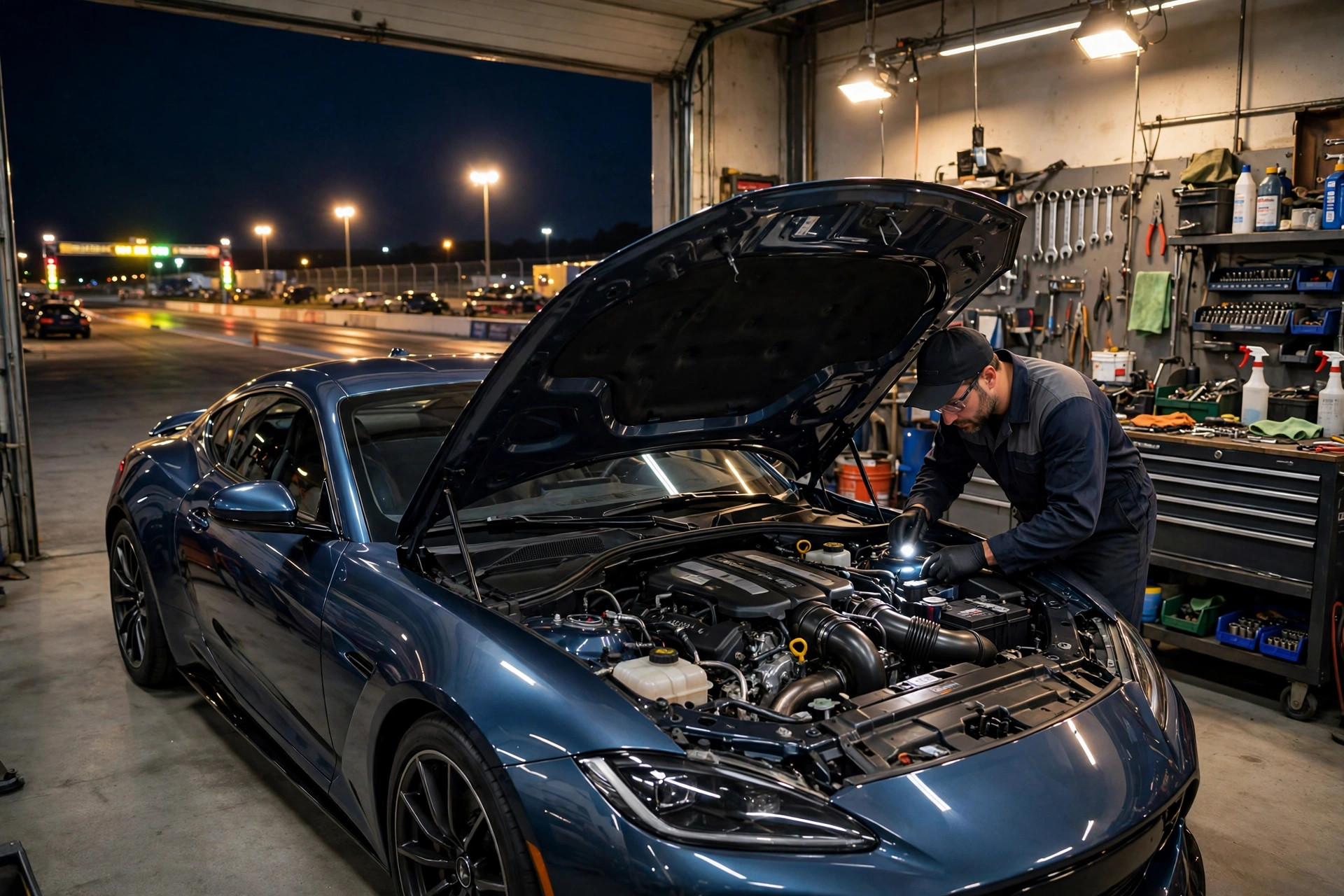
About a week before the event, give your car the same once-over you would before a long road trip. Check that the battery is firmly tied down — a loose battery is one of the most common tech failures — and that the terminals are clean and tight. Walk around the car and grab each wheel at the top and bottom, rocking it to feel for play that would indicate worn wheel bearings.
Press the brake pedal firmly and hold it: it should feel solid, not slowly sink toward the floor.
Pop the hood and check every fluid:
- Engine oil
- Coolant
- Brake fluid
- Power steering fluid
- Transmission fluid where applicable
Top up anything low and look for the telltale signs of leaks underneath — fresh drips on the driveway deserve investigation before event day. Verify that the throttle snaps shut crisply when released, that all the lug nuts are present and properly torqued, and that nothing in the engine bay is loose enough to become a projectile.
Inside the car, remove everything that is not bolted down: floor mats, phone mounts, water bottles, trunk junk, the spare tire if the rules allow, and especially anything on the rear parcel shelf. Tech inspectors will ask you to empty the car anyway, and a flying object under hard braking is genuinely dangerous. While you are at it, check that your seatbelts latch and retract properly and that the driver’s seat is firmly mounted. This whole inspection takes under an hour, and a car that passes it with ease is a car you can drive with total confidence.
Brakes, Fluids, and Cooling
Autocross is surprisingly gentle on brakes compared with track driving — runs are short, speeds are moderate, and there is plenty of cooling time between runs. Even so, your brakes must be in good working order, because the handful of hard stops on course demand full, predictable performance. Check pad thickness on all four corners: if any pad is below about a quarter of its original thickness, replace the set before the event. Glazed or cracked rotors deserve attention too.
Brake fluid is the detail most beginners overlook. It absorbs moisture over time, which lowers its boiling point and can cause a soft pedal under hard use. If your fluid is more than two years old or you cannot remember when it was changed, a fresh fill of quality DOT 4 fluid is cheap insurance. While you are choosing components, it is worth learning how different different brake pad materials behave — ceramic, semi-metallic, and organic compounds each trade noise, dust, and bite differently, and the right choice depends on whether the car also commutes on Monday.
Cooling and oil deserve a glance as well. Autocross runs are short enough that overheating is rare, but a marginal cooling system can still protest on a hot day with the air conditioning blasting between runs. Make sure the coolant is at the proper level and the radiator fans cycle correctly. Engine oil should be fresh and at the full mark — hard cornering sloshes oil around, and starting the day a quart low is asking for trouble you do not need.
Tires and Alignment Basics
Tires are the single biggest performance variable on any autocross car, and the good news is that you do not need race rubber to start. Whatever decent all-season or summer tires are already on the car will work fine for your first event. What matters is their condition: check for adequate tread depth, even wear across the tread, no sidewall damage or bulges, and no dry-rot cracking on older tires. Mismatched tires are legal but make the car’s handling unpredictable, so note it if your set is mixed.
Set your cold tire pressures to the manufacturer’s recommended values before you leave home, and bring a gauge and a portable inflator so you can experiment at the event — pressure tuning is a deep enough topic to deserve its own detailed guide. Also confirm that your wheel alignment is reasonably close to factory spec: a car that pulls hard to one side or wears one tire edge heavily will fight you all day. You do not need a performance alignment for event one, but you do need a car that tracks straight.
One practical tip: mark your valve stems or take a photo of your starting pressures, because you will be adjusting them through the day and it helps to know where you began. And if your tires are due for replacement anyway, consider timing the purchase before your first event — a fresh set of quality summer tires is the best performance upgrade a beginner can buy, and it transforms both autocross and everyday driving safety.
Weight Reduction and Cockpit Prep
Free speed exists, and it lives in your trunk. Every unnecessary pound you remove makes the car accelerate, brake, and turn marginally better — and while one pound is meaningless, the forty pounds of accumulated junk in the average daily driver is not. Empty the trunk completely, remove the rear seats’ worth of clutter from the cabin, and take out the spare tire and jack if your class allows it. Keep the jack and a few tools in the paddock, not in the car.
Cockpit setup matters more than most beginners expect. Adjust your seat so you can fully depress the clutch (or brake) with a slight bend in your knee, and position the steering wheel so your wrists rest on top of it with your shoulders against the seatback. You want to steer with your hands, not your shoulders — overreaching forces you to muscle the wheel, which kills the smooth inputs that fast autocross driving requires.
A firm, upright seating position also keeps you planted during hard cornering.
Finally, prepare the car the night before, not the morning of. Torque the lug nuts to spec in a star pattern, double-check that nothing loose remains inside, lay out your helmet and paperwork by the door, and get a good night’s sleep. Event mornings are busy enough without a last-minute scramble in the garage. Arrive early, pass tech on the first try, walk the course with a clear head — and then go enjoy the single most fun you can have in your daily driver without breaking the speed limit.
Related posts:

Every Driving & Road Trips article adds another tool to the shed. The related reads below are worth a spin.
Save this page and send it to your car group — good tips travel.

