
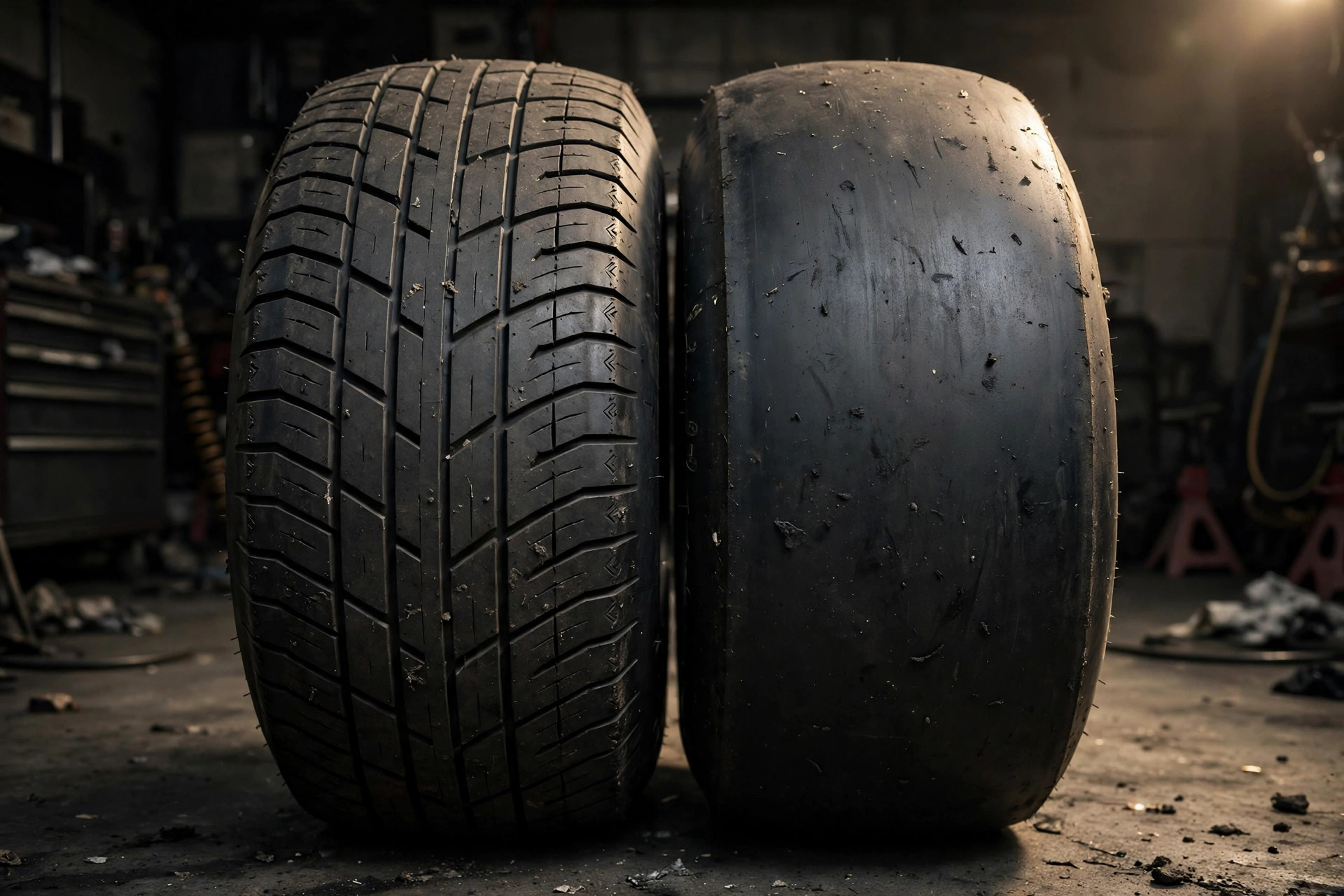
Choosing between drag radials and slicks comes down to how you use the car, how much power it makes, and where you race — and this guide explains what each tire is, how their traction really compares, and which one fits your program. Tires are the single most impactful modification for drag racing, worth more than almost any engine part at the same price. The contact patch is where every horsepower meets the track. The choice shapes your launch, your 60-foot times, your class eligibility, and your budget.
Both tires are purpose-built for straight-line traction, and both reward proper technique. Beginners often assume the stickiest tire is automatically the best tire, but the real answer depends on your car, your power level, your class rules, and whether you drive to the track. A drag radial on a street-driven car can be the perfect dual-purpose weapon, while a true slick on a trailered race car unlocks the last few percent of traction at the cost of convenience.
What Drag Radials Are
Drag radials are DOT-approved tires that combine a radial carcass, like a normal street tire, with a soft, sticky drag compound and minimal tread. The DOT approval means they are street legal, so you can drive to the track on them, race, and drive home. That makes them the default choice for street-car classes and test-and-tune regulars. Their sidewalls are softer than a street tire’s but stiffer than a true slick’s, giving a balance of launch compliance and high-speed stability that works well on cars that still see highway miles.
The compound is the magic. Drag radial rubber is dramatically softer and sticker than even a performance summer tire, designed to operate at elevated temperatures after a burnout. They need heat to work, which is why the burnout matters. They reward smooth, progressive power application rather than clutch dumps.
Modern drag radials have closed the gap to true slicks considerably. The best examples run within a tenth or two of slick 60-foot times on well-prepared tracks. For cars making up to roughly 600 to 800 horsepower at the wheels, a good drag radial is often all the tire you will ever need.
What Slicks Are
True slicks are treadless, bias-ply racing tires with no DOT approval, built for one purpose: maximum straight-line traction on a prepared surface. The bias-ply construction gives them tall, soft sidewalls that wrinkle dramatically on the launch, absorbing the initial shock and letting the contact patch grow as the tire distorts. That wrinkle-wall effect is the signature look of drag racing, and it is functional, acting like a spring that smooths power delivery to the track. Slicks are not street legal, must be trailered or swapped at the track, and are mandatory equipment in serious race classes — the classic slick tyre in its purest form.
Slicks operate at very low pressures, often in the low teens of PSI, and they demand a real burnout to bring the compound up to temperature. Their traction ceiling is higher than any drag radial’s, which is why every professional class runs them. They are also more forgiving of aggressive launches, because the sidewall absorbs mistakes that would spin a radial.
The trade-offs are real, though. They wear faster, they are unstable at highway speeds and in any wet condition, and they require dedicated wheels, since you will be swapping them at the track. Learning how racing slicks wear over their life helps you read their condition and replace them before they go off.
Traction Compared: Where Each Tire Wins
On a well-prepped track with a proper burnout, slicks win on outright traction, especially in the first sixty feet where races are decided. The bias-ply sidewall’s compliance lets a slicked car leave harder with less finesse. The larger effective contact patch at low pressure simply grips more.
The gap is biggest on marginal track surfaces, where the slick’s forgiveness keeps the car hooked while a radial might spin. For cars making big power, generally above 800 wheel horsepower, or running in classes that require them, slicks are not optional. Nothing else puts that much power down as forgivingly.
Drag radials win on versatility and, increasingly, on performance per dollar for moderate-power cars. Their radial construction gives better stability at the top end of the track, where bias-ply slicks can feel squirmy. Many racers also report that radials are more predictable once you learn their narrower window of optimal slip.
On a street-driven car that runs tens or elevens, the difference between the best drag radials and slicks might be a tenth in the 60-foot. Many racers gladly trade that tenth for the ability to drive to the track. If you are weighing tire choices for a street car more broadly, the breakdown of 2026 Nissan Convertible Tires shows how much intended use shapes the right pick. Match the tire to your power and your program, not to your aspirations.
Street Legality and Class Rules
Class rules often make this decision for you. True street classes, daily-driver shootouts, and most no-prep or street-style events require DOT-approved tires, which means drag radials or DOT-legal alternatives, not slicks. Conversely, dedicated race classes from bracket sportsman categories upward generally allow or require slicks. Some index classes specify one or the other, so always read the rulebook for the exact class you plan to run before buying tires, because the wrong purchase is an expensive mistake.
Street legality has practical dimensions beyond the rulebook. Drag radials, while DOT-approved, still have minimal wet traction and wear quickly in daily use, so most owners run a separate set of street wheels and swap at home or at the track. Slicks cannot be driven on public roads at all, which commits you to trailering or to swapping wheels in the pits.
Also check your track’s tech requirements: some tracks mandate specific tire condition standards. Understanding tire sidewall markings helps you verify sizes, load ratings, and date codes when buying used race rubber, which is a common budget move.
Wear, Lifespan, and Real Cost
Both tire types wear far faster than street tires, but in different ways. Drag radials typically last longer in terms of passes, with a good set delivering dozens of runs plus street miles. The radial carcass is inherently more durable, and the compound, while soft, is engineered for dual use.
Slicks have a shorter competitive life. They may still look fine long after their best traction is gone, a phenomenon racers call going off, where heat cycles harden the compound. Fast bracket racers replace slicks on a schedule measured in passes, not years.
Cost analysis should include wheels, since both options usually mean a dedicated set of rear wheels, and the swap logistics of getting them to the track. A set of drag radials on spare wheels that you bolt on at home is the cheapest serious setup. A slick program with a trailer, jack, and impact gun is a bigger commitment.
Budget racers should also factor in that stickier tires find the next weakest link. Transmissions, axles, and differentials that survived on street tires may not survive the shock loads of a hooking slick. The tire upgrade sometimes triggers a cascade of driveline upgrades.
Choosing for your car and goals
Start from your honest use case, and let it decide for you:
- Drive to the track, run a street class, and make under 700 wheel horsepower: buy the best drag radials in your size and never look back.
- Trailer a dedicated car, run a race class, or make big power: buy slicks sized to your power level, erring toward more tire rather than less, since an oversized slick is forgiving while an undersized one is a spin machine.
- Chase every hundredth in a competitive class: let the rulebook and the fast racers’ example make the call.
- Run test-and-tune for personal bests: choose the tire that maximizes your fun per dollar, which for most people is a drag radial.
Consider your drivetrain too. High-power RWD cars benefit most from the slick’s sidewall compliance, FWD cars often do very well on drag radials up front because the radial’s stability suits the loaded front axle, and AWD cars can use either but must respect driveline shock. When in doubt between sizes, talk to racers running similar combinations, because tire sizing wisdom is deeply empirical. Your 60-foot goal should drive the choice.
Care, storage, and pressure tips
Both tires demand proper care. Store them indoors, away from sunlight, ozone sources like electric motors, and temperature extremes, ideally in bags and off concrete. Heat-cycle them properly when new: most manufacturers recommend a moderate burnout and a cool-down rather than an immediate hero pass.
Keep a log of passes per set, because traction falloff is gradual and you will not notice it without data. Inspect sidewalls regularly for the cracking or checking that retires a tire regardless of tread appearance. Small habits like these decide how long either tire stays competitive.
Pressure tuning is where free performance hides. Start with the manufacturer’s recommendation, then adjust in half-PSI steps, logging 60-foot times as you go. Slicks typically run much lower pressures than radials, and both change with temperature through the day, so check pressures cold for a baseline and recheck between rounds.
A disciplined approach to tire pressure monitoring, even with a simple gauge and a notebook, pays off in consistency. Finally, respect the burnout: enough to clean and heat, not so much that you cook the compound. Overheated tires of either type get greasy and slow, so the right tire, cared for properly, will always beat the theoretically better tire that has been neglected.
Related posts:
This is one stop in the Tires & Wheels garage. Plenty more models, guides and stories are parked in the same category.
Save this page and send it to your car group — good tips travel.

