
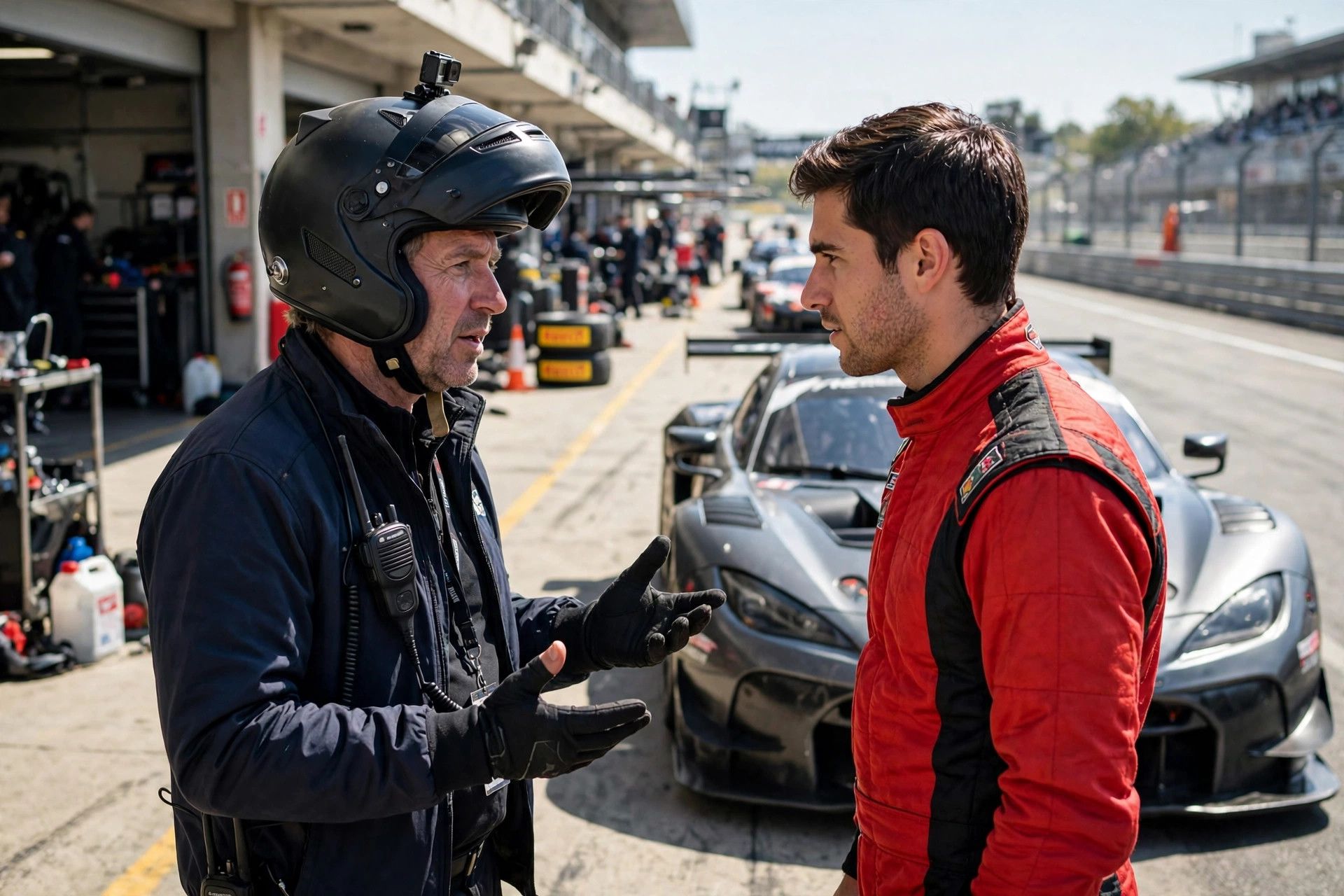
Why Even Fast Drivers Need Coaching
If you are booking a track day and wondering how to get the most from the instructor or coach beside you, this guide shows how that relationship works. It explains what happens in a first instructed session, why even fast drivers benefit from outside eyes, and how students can communicate, ask better questions, and know when they are ready to drive solo. Whoever you ride with, and wherever you are in your development, how you use that coaching decides how much you learn from every session.
Every professional racing driver has a coach, an engineer, or both analyzing their driving. If the best drivers in the world need outside eyes, a track day driver with five events under their belt certainly does. The reason is simple: you cannot observe yourself driving.
You feel what you feel, but feelings lie, habits hide, and the mistakes you make most consistently are the ones you are least aware of. A coach in the passenger seat sees your hands, your feet, your eyes, and your line simultaneously, and connects them to what the car is doing in ways you cannot from the driver’s seat.
Coaching also breaks plateaus
Coaching also breaks plateaus. Most drivers improve rapidly for their first several events, then stall as ingrained habits solidify. The plateau feels like the car’s limit or the track’s limit, but it is almost always the driver’s limit, built from technique flaws that felt fine at lower speeds.
A skilled instructor identifies the one or two changes that unlock the next level, often things that feel completely wrong at first, like braking later or looking further ahead. Without that outside perspective, drivers can spend years reinforcing the same limitations.
Instructors vs Coaches: What Is the Difference
At HPDE events, an instructor is typically an experienced volunteer assigned to guide you through the event’s curriculum, with emphasis on safety, fundamentals, and progression through the run groups. Instructors are excellent at teaching the track, the rules, and the core techniques, and their feedback determines when you are ready to advance. They work within the event’s structure and usually ride with several different students per day.
A coach, in the stricter sense, is someone you hire specifically to improve your driving, often working with you across multiple events with a deliberate development plan. Coaches use data, video, and structured exercises, and they tailor everything to your goals rather than a curriculum. The line blurs in practice: great instructors coach, and many coaches started as instructors.
For beginners, the assigned instructor is exactly what you need. As you advance and your needs get specific, private coaching becomes the tool for targeted improvement. Both roles share one trait: the best ones teach you to think, not just to follow instructions.
What Your First Instructed Session Looks Like
Your first session with an instructor usually starts in the paddock, not on track. The instructor introduces themselves, asks about your experience and goals, and explains how they communicate: what their hand signals mean, how they will talk you through corners, and what they want you to do if you feel overwhelmed. They check your seating position, mirror adjustment, and helmet fit, because fundamentals start before the wheels move. This briefing takes a few minutes and sets the tone for the whole day.
On track, the instructor typically starts conservatively, talking you through each corner well in advance: where to brake, where to turn in, where the apex is, when to apply power. The commentary pace matches your capacity; as you settle in, they say less and let you drive more, intervening for corrections and the occasional bigger lesson. They may ask you to try specific exercises, like braking earlier than feels necessary to feel the car’s balance, or looking further ahead than feels natural.
Between sessions, they debrief: what improved, what needs work, and one or two focus points for next time. If you want to arrive with solid fundamentals, reviewing core driving techniques beforehand means less classroom time and more driving time.
For wider background reading, the overview of a driving school shows how structured instruction works beyond the track as well.
How to Be a Good Student
The best students share a few traits, and none of them involve natural talent. They listen without arguing, trying what the instructor suggests even when it feels wrong, because feeling wrong is often what learning feels like. They ask questions instead of making excuses; there is a world of difference between asking why the car pushed wide in turn four and explaining that the tires were cold. They stay calm when corrected, understanding that real-time feedback during a session is the instructor doing their job, not criticizing their character.
- Listen without arguing, and try what the instructor suggests even when it feels wrong.
- Ask questions instead of making excuses.
- Stay calm when corrected during a session.
- Manage your ego, and aim for smoothness, consistency, and responsiveness to feedback rather than immediate speed.
Good students also manage their ego. Everyone wants to be fast immediately, but the drivers who improve fastest are the ones who accept being slow while they learn. Do not try to impress your instructor with speed; impress them with smoothness, consistency, and responsiveness to feedback.
Instructors have ridden with thousands of drivers and can spot potential instantly; what they look for is coachability, not pace. The fast laps come later as a byproduct of good technique, never as a substitute for it.
Communicating With Your Instructor
Clear communication makes instruction dramatically more effective. Before the session, tell your instructor your goals for the day and any specific concerns: a corner that frightens you, a habit you are trying to break, or a technique you want to practice. During the session, speak up if you are overwhelmed, confused, or uncomfortable; instructors would much rather slow down and rebuild than push a stressed student into a mistake. After the session, debrief honestly about what you felt and what confused you.
Learn your instructor’s communication style quickly. Some narrate constantly, others speak only for corrections; some use hand signals for specific inputs, others rely on voice. Adapt to them rather than expecting them to adapt to you, since they are managing your learning while also watching traffic and track conditions.
If something is not working, say so respectfully between sessions rather than suffering silently all day. And remember the relationship is professional: your instructor is responsible for your safety and theirs, so when they say slow down or pit, it is an instruction, not a suggestion.
Questions Worth Asking
Good questions accelerate learning enormously. Ask about specific corners rather than general speed: why am I slow in turn three, and what should I change? Ask about priorities: if I can only fix one thing this session, what should it be?
Ask about references: what markers do you use for braking and turn-in here? Ask about the car’s behavior: is that understeer from my entry speed or my line? Specific questions get specific, actionable answers; vague questions get vague encouragement.
Also ask about the bigger picture as you progress. What separates intermediate drivers from advanced drivers at this track? What should I practice between events?
What bad habits do you see developing in my driving? Instructors love these questions because they show a driver thinking long-term. Take notes after each debrief; the details blur by the end of the day, and written notes become your practice plan.
Reviewing technique guides between events, such as a trail braking tutorial, lets you arrive at the next event with homework already done.
Private Coaching: When and Why
Private coaching makes sense when you have specific goals that group instruction cannot address: preparing for a particular track, breaking a stubborn plateau, transitioning to a much faster car, or developing racecraft for time trials. A private coach works with you one-on-one, often for a full day or weekend, using your data and video to build a targeted improvement plan. The undivided attention means every session is about you, and the coach can run structured exercises that would be impossible in a normal instructed session.
Private coaching is not cheap, typically several hundred dollars per day plus the coach’s expenses, but it is the highest-return spending in driver development after seat time itself. One day with a great coach can advance your driving more than five events of unguided lapping. Choose coaches by reputation among drivers you respect, not by advertising; the best coaches are usually known within the paddock community. Be wary of anyone who promises specific lap time improvements; honest coaches promise better technique and let the times follow.
Remote and Video Coaching
Remote coaching has matured into a legitimate option. You send a coach your data and video from an event, and they return detailed analysis with specific recommendations, sometimes including annotated video and data overlays showing exactly where time is lost. It costs less than in-person coaching, works with any schedule, and lets you choose from coaches anywhere in the world rather than whoever is at your local track. For drivers in areas with few experienced coaches, remote analysis is transformative.
The limitation is real-time feedback: a remote coach cannot talk you through a corner as you drive it. The best approach combines both: in-person instruction for real-time guidance and remote analysis for deep, unhurried review between events. When selecting a remote coach, check that they are fluent with your data system and ask for a sample analysis; quality varies enormously, and a good sample shows you exactly what you are buying. Even informal video review with a faster friend, comparing your footage side by side, captures much of the benefit for free.
When You Are Ready to Drive Solo
Driving solo, without an instructor in the car, is a milestone that instructors grant when you demonstrate consistent, safe, aware driving. The criteria are about judgment more than speed: hitting your marks reliably, managing traffic courteously, responding correctly to flags, and showing the maturity to back off when something feels wrong. Speed without judgment keeps you in the instructed group; judgment with moderate speed earns the solo sign-off.
Going solo changes the learning dynamic. You gain freedom to experiment and develop your own rhythm, but you lose the real-time feedback that catches mistakes as they form. Smart solo drivers replace the instructor with other feedback systems: data logging, video review, and periodic check rides with instructors or coaches.
Many organizations encourage solo drivers to request an instructor ride-along whenever they want a tune-up. Consider structured car control education as ongoing maintenance for your skills; even experienced drivers benefit from revisiting fundamentals through advanced driving courses. The best drivers never stop being students; they just choose their teachers more deliberately.
Related posts:


Finished here? Track Day Costs Breakdown: What a Weekend at the Circuit Really Costs is the most natural next drive from this page.
Share this with a fellow driver or enthusiast who needs to see it.

