
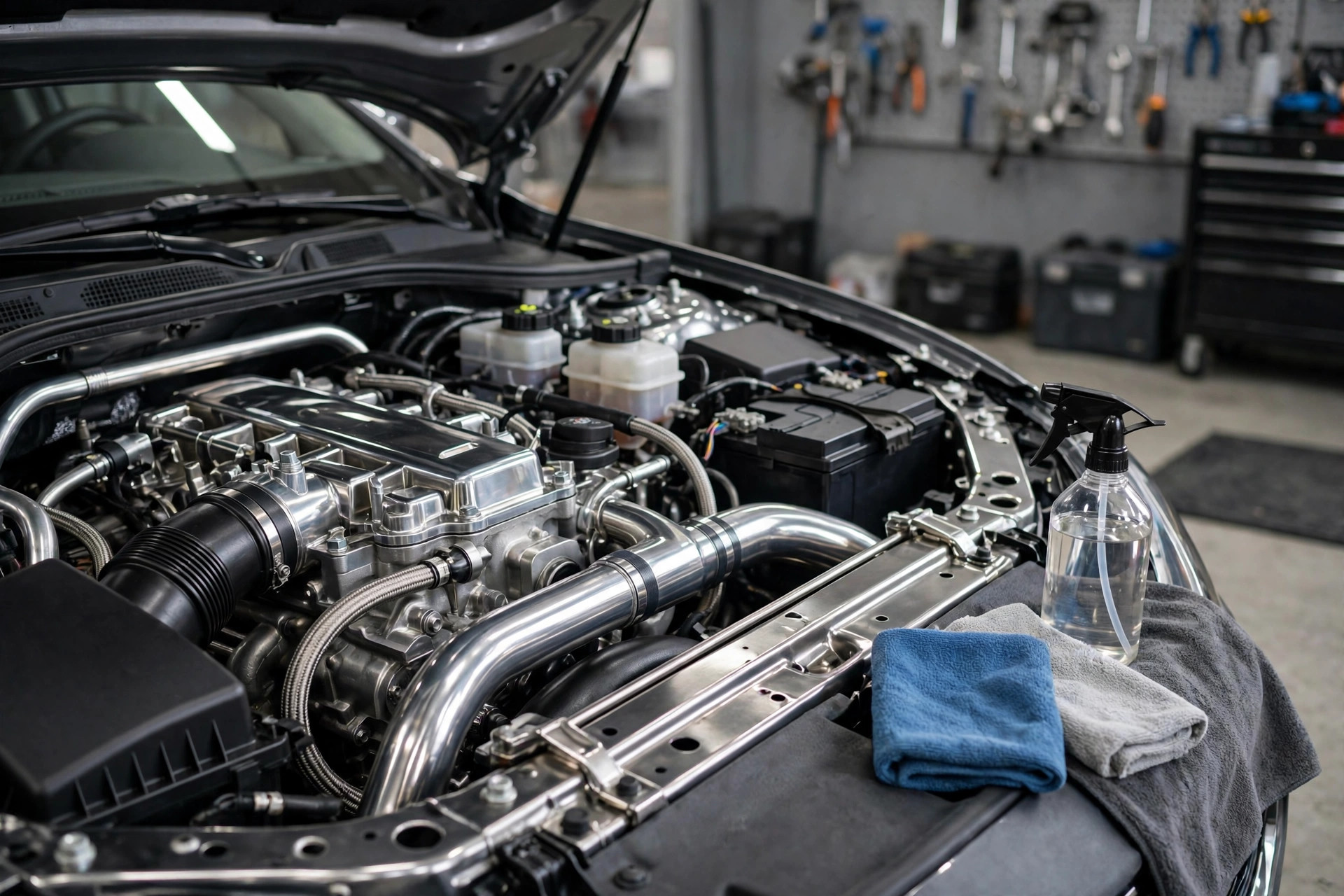
Before you detail, consider why engine bay detailing myths spread faster than facts, and how following bad internet advice can damage your car. From WD-40 as a dressing to pressure washer bravado, the most repeated engine bay detailing myths sound plausible until you understand what they actually do to rubber, plastic, and electronics. This guide debunks the most persistent myths with real chemistry and experience, so you can detail with confidence instead of learning expensive lessons firsthand.
Myth: WD-40 Is a Good Engine Bay Dressing
This is the most persistent engine bay myth on the internet, and it refuses to die because WD-40 does make plastics look dark and shiny immediately after application. The problem is what happens next.
WD-40 is a solvent-based penetrating oil, not a dressing, and its solvents attack certain plastics and rubber over time. The shine lasts days, then fades to a dull finish often worse than before, because the solvents have stripped the plastic’s own oils.
Worse, WD-40 attracts and holds dust aggressively. The oily film grabs every airborne particle, and within a week the bay looks dirtier than if you had done nothing. On rubber hoses, repeated WD-40 application can cause swelling and degradation, which is the opposite of detailing. It also creates a flammability concern: an oily film across a hot engine bay is not something any thoughtful detailer wants.
The truth behind the myth is that people want a cheap, one-step darkening product, and that desire is legitimate. The correct answer is a water-based trim dressing formulated for the purpose, which darkens without solvents, lasts longer, and does not attract dust. Cheap and correct beats cheap and damaging every time. For the full picture on what actually goes wrong in engine bays, our guide to expensive detailing mistakes covers this myth among others.
Myth: Tire Shine Belongs in the Engine Bay
Tire shine sprays are formulated for one job: making tire sidewalls glossy, and they achieve it with heavy silicone oils that sling, attract dust, and brown over time. Sprayed across an engine bay, that same silicone coats everything in a greasy film that grabs dust within days and turns brownish with heat cycling. The bay looks great for the photo and terrible a week later, which is the hallmark of a bad detailing product. For tire-related reading, our guide to 2026 Nissan Convertible Tires covers a different corner of car care.
Silicone overspray causes practical problems beyond appearance. It contaminates surfaces so thoroughly that future paint or trim restoration work will not adhere properly; body shops dread silicone contamination because it causes fisheyes in paint. In the bay, silicone on belts can cause slipping and squealing, and on hoses it creates a dust-magnet film that is miserable to remove. Once silicone is everywhere, the only fix is a thorough strip-down with strong cleaners.
Like the WD-40 myth, this one persists because the immediate result photographs well. Social media rewards the glossy after-photo, not the dusty reality a week later. Professional detailers judge products on the two-week result, not the two-minute result, and by that standard tire shine fails completely in the engine bay. Stick with dressings made for the environment, as our engine bay dressing guide recommends.
Myth: Pressure Washers Are Safe if You Are Careful
The careful pressure washer user exists, but the myth overstates how much care compensates for physics. A pressure washer concentrates enormous force into a small area, and in an engine bay full of aged seals, brittle connectors, and hidden intrusion points, the margin between careful and catastrophic is thin. Being careful reduces risk; it does not eliminate it, and the consequences of one mistake, a flooded ECU or a ruined alternator, are wildly disproportionate to the time saved.
The myth also ignores how pressure washer damage often appears. Water forced past a connector seal may not cause symptoms for weeks, until corrosion builds up enough to trigger intermittent faults. The detailer congratulates himself on a safe wash, then chases electrical gremlins a month later without connecting the two events. Delayed consequences make the risk feel smaller than it is.
The balanced truth is that pressure washers have legitimate uses on heavily soiled bays with strict settings and technique, which our steam cleaning guide discusses as a lower-risk alternative for deep cleaning. But the default tool for engine bays should be the gentler option, with pressure reserved for situations that genuinely require it, not as the everyday approach the myth suggests.
Myth: A Hot Engine Cleans Better
The logic seems sound: heat loosens grease, so a hot engine should clean more easily. In practice, washing a hot engine is one of the riskiest things you can do in detailing. Cold water on hot cast metal causes thermal shock that can crack exhaust manifolds and, in extreme cases, damage castings. The risk is low on any single wash but real across a lifetime of details, and a cracked manifold is an expensive lesson.
Heat also sabotages the chemistry. Degreasers dry almost instantly on hot surfaces, concentrating their active ingredients as the water flashes off and causing the etching and staining that proper dwell time is meant to avoid. You lose the very dwell time that makes gentle chemistry effective, forcing you toward harsher products to compensate. The hot engine myth creates a cascade of worse decisions.
The correct approach is a cool or slightly warm engine, never hot. Slightly warm, as in driven gently and then parked for thirty minutes, is the sweet spot where grime is a bit softer but products still dwell properly. If you have ever wondered why professional details happen on cool engines despite the intuitive appeal of heat, this is why. Our degreaser comparison guide notes the temperature recommendations on product labels, which universally specify cool surfaces.
Myth: More Degreaser Means a Cleaner Bay
Beginners consistently over-apply degreaser, reasoning that a heavier coat must clean more. In reality, excess product does not improve cleaning; it increases risk. Heavier application means more chemical to rinse, longer rinse times, more water forced into unwanted places, and greater residue left in textures and seams. The cleaning happens at the surface interface, and product beyond what wets the surface is wasted chemistry creating extra work.
Over-application also encourages the worst habit in engine bay detailing: compensating for poor technique with stronger chemistry. A light, even coat with proper dwell time and thorough agitation outperforms a flood of strong degreaser every time, with a fraction of the risk to rubber, plastic, and aluminum. The professionals who achieve the best results typically use milder products than amateurs, precisely because their technique does not need chemical brute force.
The fix is measurement and method: use dilution bottles, apply even mists rather than soaking streams, and let dwell time and brushes do the work. If a section needs more cleaning, do a second light application rather than one heavy one. This restrained approach is the foundation of every safe detailing workflow, including our step-by-step safe wash guide.
Internet Advice Worth Keeping: The Truths Behind the Myths
Not all internet advice is wrong, and some oft-repeated tips are genuinely excellent. These are the internet truisms that professionals endorse completely:
- Bagging the alternator and fuse box before washing is repeated everywhere because it works
- Working on a cool engine
- Using the least aggressive product that does the job
- Drying thoroughly afterward
The skill is distinguishing these from the myths above.
A useful filter is asking who benefits from the advice. Tips that save time or money at the expense of your car’s longevity, like WD-40 dressing or hot-engine washing, deserve skepticism.
Tips that cost a little extra effort for more safety, like masking electronics or working in sections, are almost always sound. When a tip sounds too good to be true, a quick search for long-term results usually reveals the catch.
Finally, treat your own experience as data. Photograph your bay after each detail and again two weeks later; the comparison reveals which products and techniques actually last. Over time you will build a personal playbook grounded in evidence rather than forum folklore, which is worth more than any single guide. Combine that habit with the myth-busting in this article, and you will detail smarter than most of the internet.
Related posts:
Whether you wrench, drive or just admire, the Tires & Wheels category has more miles to offer.
Save this page and send it to your car group — good tips travel.

