

If you are wondering who actually needs a sim racing shifter or handbrake, what each type does, and how to choose one, this guide has the answers. It explains how H-pattern, sequential, and handbrake options serve drifting, rallying, and historic racing, and how to buy without wasting money.
Paddle shifters handle modern race cars beautifully, but the moment you slide into a vintage Formula car, a rally stage, or a drift missile, you will reach for a proper shifter and handbrake that are not there. A gated H-pattern shifter with a mechanical clunk, a sequential lever that slams through gears, and a hydraulic-feel handbrake transform driving disciplines that paddles simply cannot serve. These add-ons are the most personality-rich purchases in sim racing, and also the easiest to get wrong.
This guide explains what each type does, who needs what, and how to buy for drifting, rallying, and historic racing without wasting money.
Do You Actually Need One?
Be honest about what you drive. If your garage is GT3 cars, Formula machinery, and modern prototypes, paddles are the correct control and a shifter would gather dust. But if you drift, rally, drive historic touring cars, cruise vintage road cars, or race anything with a manual gearbox built before the paddle era, a shifter is not optional equipment, it is the entire point.
The handbrake question is even more specific: it is essential for drifting and rallying, occasionally useful in rallycross, and dead weight everywhere else. These are specialist tools for specialist driving, which is exactly why they are so satisfying.
There is also the immersion argument. Rowing through the gears of a 1960s grand prix car with a gated shifter, heel-and-toeing into every corner, connects you to driving history in a way paddles never will. Our Assetto Corsa mods guide is full of historic cars that deserve proper controls, and the CarX drift techniques we have covered assume you can clutch-kick and handbrake like the real thing.
If those sentences excite you, keep reading. If they do not, spend the money on better pedals instead.
H-Pattern Shifters
The H-pattern shifter is the romantic choice: a lever moving through a gated pattern, ideally with a mechanical feel that tells your hand exactly which gear it found. Quality varies enormously. Cheap units use simple switches and feel like stirring a joystick; they work, but they teach nothing.
Mid-range shifters add proper gates, adjustable resistance, and a satisfying mechanical engagement. The best use real automotive-style mechanisms with strong detents, and shifting them feels genuinely like a well-maintained gearbox. Gated plates, the classic Ferrari-style metal grid, add both beauty and precision, guiding the lever unerringly into gear.
What to look for: adjustable throw length, so you can shorten shifts for racing or lengthen them for vintage feel; solid mounting with no flex, because a shifter that wobbles destroys the illusion; and a reverse lockout that prevents catastrophic mis-shifts. Skip or downshift protection is a personal preference, real cars will let you money-shift, and part of the discipline is learning not to. Pair your H-pattern with a proper clutch pedal and auto-clutch disabled, and practice the rhythm of heel-and-toe until it becomes unconscious.
- Adjustable throw length, so you can shorten shifts for racing or lengthen them for vintage feel
- Solid mounting with no flex, because a shifter that wobbles destroys the illusion
- A reverse lockout that prevents catastrophic mis-shifts
The first time you nail a perfect downshift sequence into a hairpin, you will understand why people obsess over these.
Sequential Shifters
Sequential shifters — the sim counterpart of the sequential manual transmission — serve rally cars, touring cars, and bikes: push forward to downshift, pull back to upshift, with a firm mechanical clack each way. Many H-pattern shifters include a sequential mode, flipping a switch or swapping a plate to convert the lever, which is the smart buy if you drive both disciplines. Dedicated sequential units offer shorter throws and stronger centering springs, tuned for the rapid-fire shifting of stage rally.
The feel should be positive and unambiguous; a vague sequential is worse than paddles.
The key spec is throw and force. Rally driving demands shifts you can fire off mid-slide without looking, so the lever must center crisply and engage with authority. Adjustable resistance lets you tune it to your hand.
Some units offer a combined H-pattern and sequential in one housing with a quick-change mechanism, and these hybrids are the value champions for drivers who split time between historic road racing and modern rally. Whatever you choose, mount it where your hand falls naturally: for most right-hand-drive-style sim setups, that is to the right of the seat at roughly hip height, angled slightly toward you. The rally car culture behind these machines is worth exploring once your hardware is sorted.
Handbrakes for Drift and Rally
The handbrake is the most technique-sensitive control in sim racing. Cheap handbrakes are simple on-off buttons: pull and the rear wheels lock instantly, which works for arcade-style drifting but teaches ham-fisted habits. A proper analog handbrake measures lever position or pressure progressively, letting you feather the rear brakes to adjust angle mid-drift exactly like a hydraulic handbrake in a real car.
The difference in car control is night and day, and it is the single biggest hardware factor in drift scores.
Look for a long lever with realistic travel, progressive resistance that builds through the pull, and a solid mount that survives enthusiastic yanking. Vertical-mount handbrakes mimic modern drift cars; horizontal layouts suit rally. Some units use load cells for pressure-based control, which pairs beautifully with the muscle memory from load cell brake pedals.
Whatever mechanism you choose, spend real practice time on the handbrake alone: initiate, modulate, release, repeat. Drifting is ninety percent handbrake and throttle finesse, ten percent everything else. The ice racing scene shows what car control looks like at the limit, and it all starts with precise rear-brake control.
Mounting and Compatibility
Shifters and handbrakes live or die by their mounts. A shifter bolted to a flexing desk edge feels terrible no matter how good the mechanism; the same unit rigidly mounted to a cockpit feels twice as expensive. Aluminum profile rigs accept shifter mounts on any T-slot, letting you position the lever exactly where your hand wants it.
Folding cockpits and wheel stands need dedicated add-on mounts, so check compatibility before buying. The mount should place the shifter close enough that your elbow stays bent and your shoulder stays relaxed; reaching for gears causes fatigue and missed shifts.
Compatibility is refreshingly simple: nearly all shifters and handbrakes are standalone USB devices that appear as generic controllers, working in every major sim on PC. Console compatibility is spottier, so PlayStation and Xbox drivers should verify support for their specific platform. In software, bind the controls in each sim, calibrate analog handbrakes for full progressive range, and disable any auto-clutch assists if you want the full manual experience.
One caution: USB device order can shuffle after reboots, so label your devices in Windows and in each sim’s controller profile to avoid rebinding everything monthly.
The same tidy approach helps in the real garage, too. Drivers setting up their space often pair projects like Trunk Lighting Upgrades: LED Strips, Motion Sensors, and Battery-Safe Wiring with DIY Tool Storage in the Trunk: Keeping Hand Tools Rattle-Free and Safe.
Best Value Picks by Discipline
For drifters: prioritize an analog handbrake above all else, pair it with a decent H-pattern or sequential shifter, and make sure your wheel has enough rotation and speed to catch slides. For rally drivers: a hybrid H-pattern and sequential shifter covers historic and modern machinery, and a progressive handbrake handles hairpins; add a sturdy mount because rally driving is violent. For historic racing fans: a gated H-pattern with real mechanical feel is the soul of the experience, and the handbrake can wait.
For everyone else: paddles are fine, and your money works harder in pedals or a better wheel base.
The smart buying order is shifter first if you drive manuals, handbrake first if you drift, and both together if you rally. Buy the mount at the same time as the device; a shifter without a solid mount is a decoration. And remember the hierarchy of upgrades: these add-ons amplify disciplines you already love, they do not create interest from nothing.
If you are still building your foundation, our beginner setup guide will keep your spending in the right order.
Related posts:


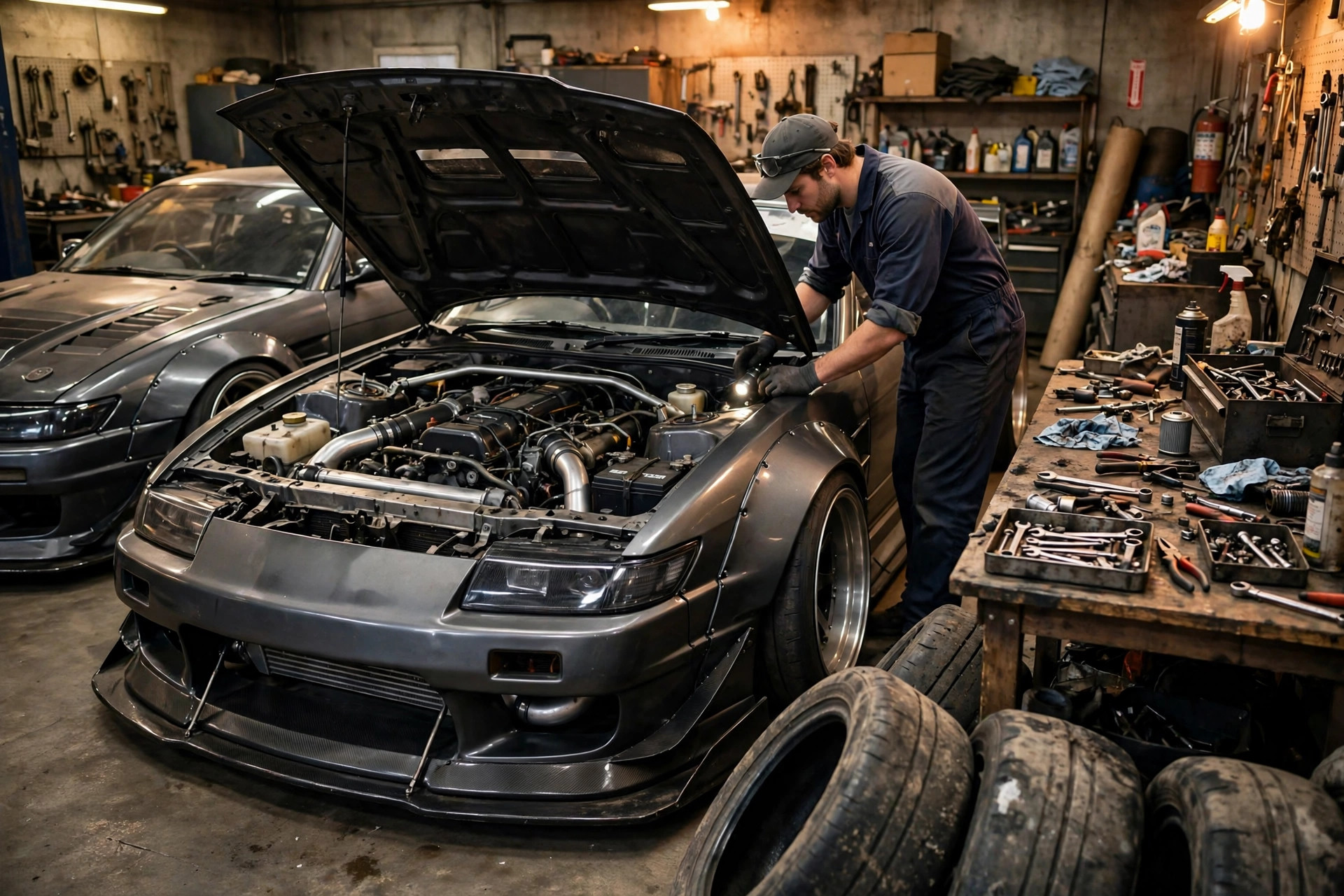
Cars like these are part of a bigger Maintenance & Repair story — Rally Car Maintenance: Servicing Between Stages and Seasons tells the next chapter.
Share this with a fellow driver or enthusiast who needs to see it.

