
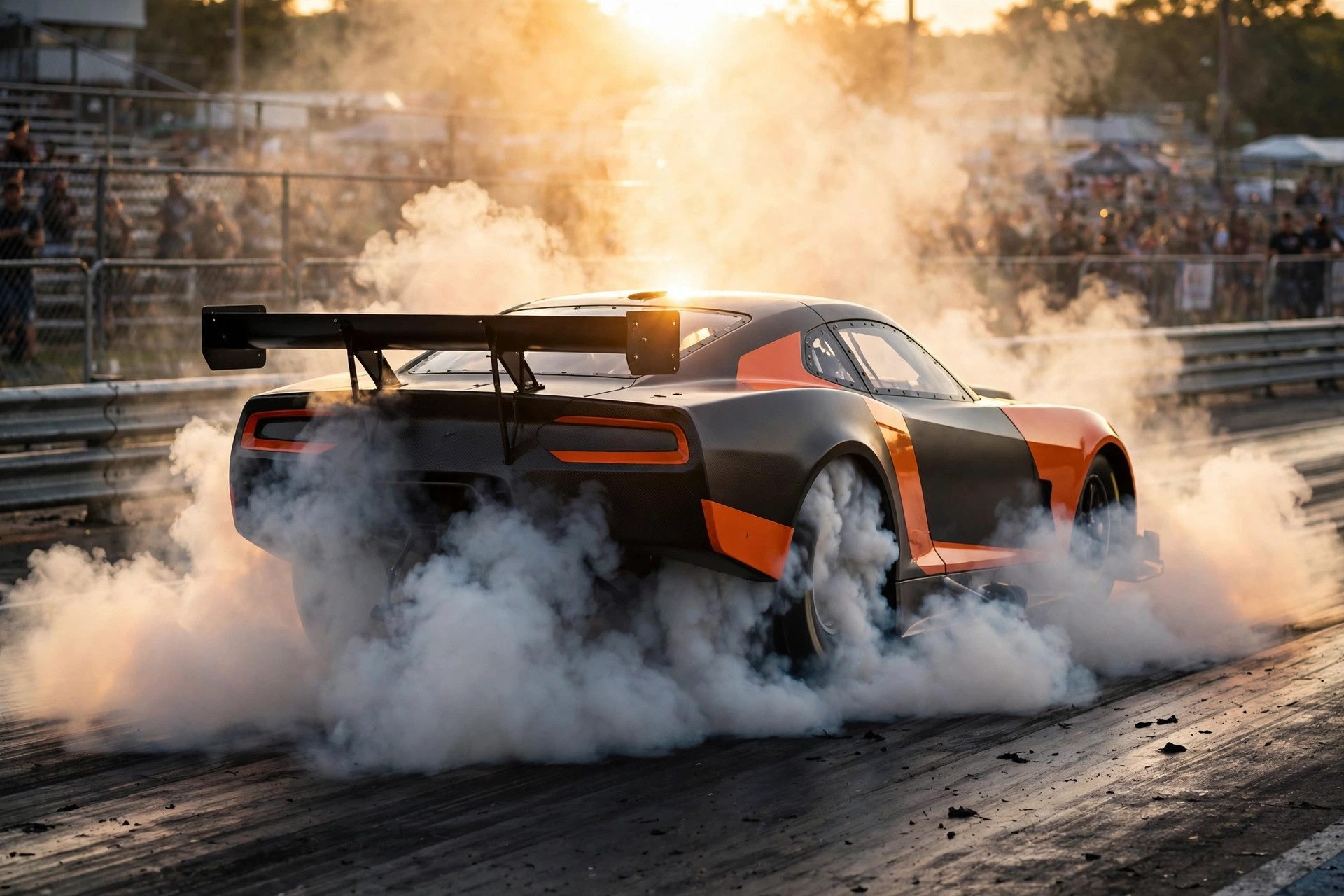
When a drag racer lights up the tires in the burnout box before staging, what looks like pure showmanship is actually precise race preparation, and understanding why, how, where, and when it works is what separates fast racers from frustrated beginners. Who does a burnout, from bracket veterans to first-time test-and-tune drivers, does it for the same two reasons: to clean debris off the tires and to bring the rubber compound up to its operating temperature. Done right, the burnout makes you faster and earns respect in the staging lanes. Done wrong, it wastes expensive rubber or leaves your tires slower than if you had done nothing at all.
This guide covers the physics of why burnouts work, the step-by-step technique for doing one safely, and the etiquette of the water box. It also covers the critical distinction between what drag tires need and what street tires need.
Key Takeaways
- Why Racers Do Burnouts: The Real Purpose — A burnout serves two functions, and showmanship is not one of them.
- When the Burnout Matters (and When It Hurts) — The burnout matters enormously on drag slicks and drag radials, which are temperature-sensitive by design.
- The Water Box, Technique, and Burnout Aids — The Water Box and Burnout Box Etiquette The water box is the wet concrete area just behind the starting line where burnouts begin.
- Common Mistakes and Tire-Specific Rules — Common Burnout Mistakes The mistake list is long and familiar.
Why Racers Do Burnouts: The Real Purpose
A burnout serves two functions, and showmanship is not one of them. First, it cleans the tires. Driving through the pits and the water box picks up dust, gravel, and moisture, and spinning the tires throws all of it off, presenting a clean contact patch to the starting line.
Second, and more important for race rubber, it heats the compound. Drag tires are engineered to grip best within a temperature window, and cold rubber is hard and slippery. The friction of the burnout brings the surface of the tire into that window, which is why cars on true slicks do long, serious burnouts while cars on street tires barely need one.
The heat also lays down fresh
The heat also lays down fresh rubber on the track surface in the burnout box area, contributing to the groove that subsequent cars use. This is part of why tracks prep the surface and why racers are particular about where they do their burnouts. None of this requires a minute of billowing smoke; a skilled driver accomplishes both goals in a few seconds.
The smoke is a byproduct of the process, not the objective, and the fastest racers are usually the ones whose burnouts look almost boring. Efficiency, not theater, is the mark of experience.
When the Burnout Matters (and When It Hurts)
The burnout matters enormously on drag slicks and drag radials, which are temperature-sensitive by design. On these tires, skipping the burnout or doing a token spin measurably hurts the 60-foot time, because cold race rubber simply does not grip. The effect is so well established that tire manufacturers publish burnout guidance, and serious racers treat the burnout as part of the tune-up, adjusting its length with track temperature: longer when the track is cold, shorter when it is hot.
On ordinary street tires, the burnout is mostly unnecessary and can actually hurt. Street compounds overheat quickly and get greasy, losing grip rather than gaining it, so a big smoky burnout on all-seasons leaves you with less traction than a quick cleaning spin. This is the single most common burnout mistake at test-and-tune nights, where beginners imitate the race cars and cook their street tires.
The rule is simple: if you are on street tires, do a short spin just to clean them and throw off water, then stage. Save the heroics for when you own real race rubber, and enjoy the spectacle of a proper burnout as a spectator until then.
The Water Box, Technique, and Burnout Aids
The Water Box and Burnout Box Etiquette
The water box is the wet concrete area just behind the starting line where burnouts begin. Its purpose is to let the tires break loose easily so the burnout starts smoothly without shocking the drivetrain, and to keep the actual starting line dry, since water at the line kills traction for everyone. Drive around the water box, not through it, then back into it or have a crew member signal you, because driving through soaks your front tires, which then drip water onto the track all the way to the line.
Etiquette matters because the burnout box is shared and the schedule is tight. Do your burnout promptly when signaled, keep it in the box rather than wandering toward the line, and never do a burnout past the starting line toward the timing equipment. If your car is a street car that barely needs a burnout, say so or just do a quick spin; nobody minds a short burnout, but everyone minds a novice doing a thirty-second smoke show while the lanes back up.
Watch a few rounds before your first pass to learn your track’s specific flow, since every facility has its own customs.
Burnout Technique, Step by Step
The basic technique for a RWD car with a manual transmission follows a short, repeatable sequence. Roll into the water box and stop with the drive tires wet. From there, the steps are:
- Engage second gear, which gives better wheel speed control than first.
- Bring the revs up moderately, and release the clutch to break the tires loose.
- Modulate the throttle to hold a steady wheel speed, not bouncing off the rev limiter.
- Let the car creep forward out of the water onto dry pavement while still spinning.
- Lift, let the tires grab, and roll forward to stage.
The whole thing should take a few seconds. For automatics, the process is similar: hold the brake lightly with your left foot, apply throttle to break the tires loose, and modulate. The key skill in both cases is the transition from wet to dry: keep the tires spinning as you roll out of the water so they stay clean, then stop the spin decisively once you are on dry pavement.
Feathering the throttle during the burnout keeps temperatures even, and watching your mirrors or listening to the engine note tells you when the tires are up to speed. Practice the motion until it is boring, because a boring burnout is a correct burnout.
Line Locks and Other Burnout Aids
A line lock is a solenoid valve in the front brake circuit that holds front brake pressure while you release the pedal, letting you do a burnout without riding the brakes or cooking the rear brakes. It is one of the most popular and cost-effective drag racing mods, easy to install, and it makes burnouts dramatically more controlled, especially in manual-transmission cars where you need your feet for clutch and throttle. Many tracks and classes allow them freely, and they are practically standard equipment in bracket racing.
Other aids include two-step rev limiters, which hold a set RPM for consistent burnout wheel speed, and for serious cars, dedicated burnout rev chips. None of these replace technique, but they remove variables, which is the whole philosophy of bracket racing preparation. If you find yourself doing burnouts regularly, a line lock pays for itself in brake life and consistency within a season. As with any modification, check your class rules, though line locks are legal in virtually every sportsman category.
Common Mistakes and Tire-Specific Rules
Common Burnout Mistakes
The mistake list is long and familiar. Too long a burnout overheats the tires and wastes rubber; too short leaves them cold and dirty. Doing the burnout in the wrong gear, usually first, makes wheel speed erratic and hard to control.
Rolling too far forward puts you past the ideal spot or, worse, through the staging beams, which confuses the timing system and annoys the starter. Forgetting to disengage the line lock before staging is a classic that ends with the car not moving when the tree runs.
Another common error is the dry hop, a short aggressive hop after the burnout meant to feel out traction, which actually hurts more than it helps on modern tires by cooling the contact patch unevenly. Most experienced racers have abandoned it. Finally, beginners often stare at the smoke or the crowd instead of focusing on the procedure, then arrive at the line flustered and stage poorly.
Treat the burnout as the first step of your staging routine, not as a separate performance, and your whole starting-line procedure will tighten up. The goal is always the same: clean, warm tires and a calm driver. If the whole starting-line ritual still feels intimidating, a beginner’s guide to a first track day covers the preparation habits that make burnout-box nerves disappear.
Street Tires vs Drag Tires: Different Rules
The rules diverge completely by tire type, so know which game you are playing. On drag slicks: a real burnout is mandatory, second gear, several seconds, rolling out of the water while spinning, with length adjusted for track temperature. On drag radials: a moderate burnout, shorter than a slick’s, enough to heat and clean without overdoing it, since radials overheat more easily than bias-ply slicks. On street tires: a quick cleaning spin only, just enough to throw off water and debris, then straight to staging.
This distinction is where beginners lose the most time, because they apply slick technique to street tires and go slower. If you are serious enough to be doing real burnouts, you are serious enough to own real tires, so let the burnout question answer your tire question: street tires mean short spins, race tires mean real burnouts. Understanding how racing slicks behave and wear will also teach you to read your tires after the burnout, since the appearance of the rubber tells an experienced eye whether the heat was right.
In the end, a good burnout is measured in grip, not smoke. Match the procedure to your tires, keep it brief and controlled, and the launch that follows will show whether the heat was right. And when in doubt, watch what the fast, consistent racers in your class do, then copy them exactly.
Related posts:
If this read fired you up, How to Improve Your Reaction Time at the Drag Strip keeps the Driving & Road Trips momentum rolling.
Save this page and send it to your car group — good tips travel.

